From idea to market-ready product, our NPI solutions make every stage easier, faster. Discover How We Help
Help Center

Views: 222 Author: Astin Publish Time: 2026-04-27 Origin: Site
As someone who has spent years helping OEMs design reliable cooling systems for telecom, power, industrial and embedded electronics, I see the same question come up again and again: hould we use an axial fan or a centrifugal fan for this project? Choosing correctly at the design stage can mean the difference between a stable, quiet, energy‑efficient product and one that overheats, fails EMC or burns through your warranty budget. [cbifans]
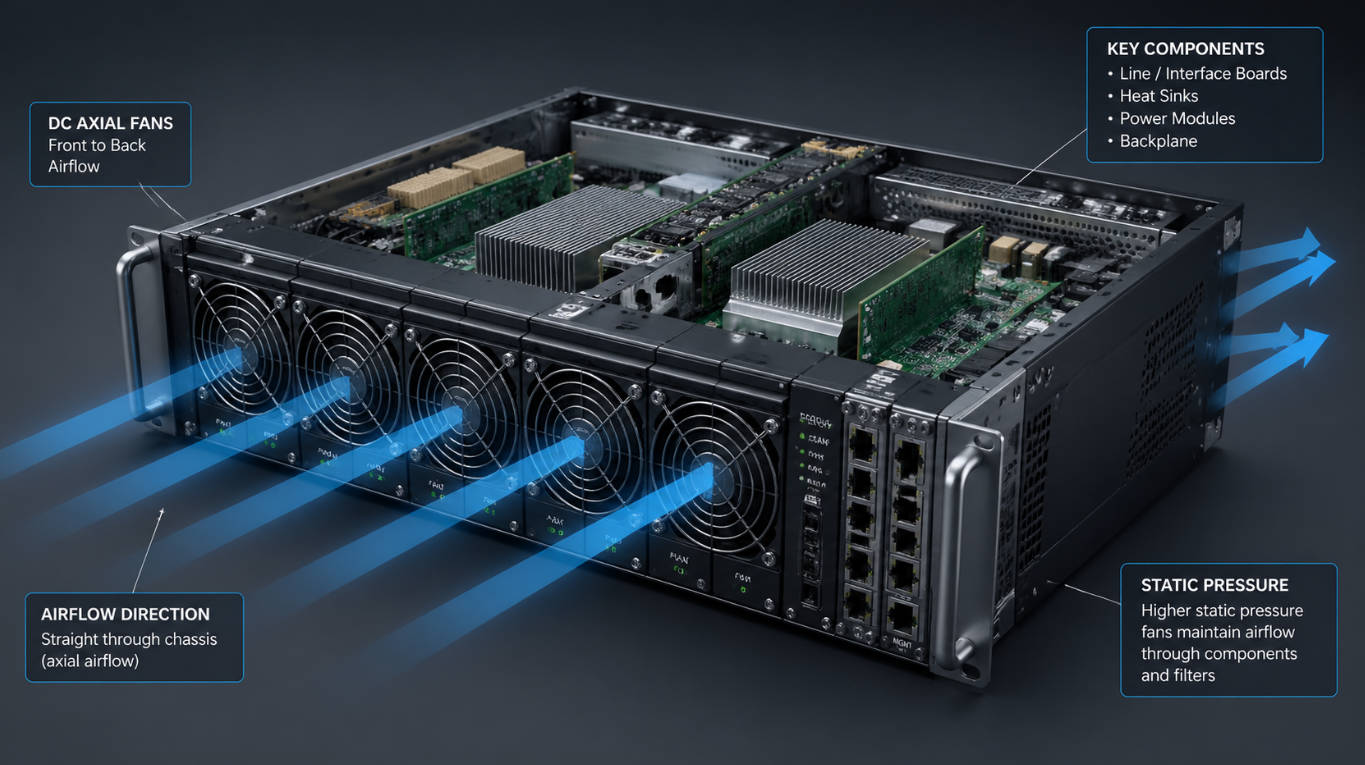
Axial fans move air parallel to the fan's axis, like a propeller, pulling air in from one side and pushing it out in the same direction. They are optimized for high airflow volume at relatively low static pressure, which makes them ideal for open or low‑resistance systems. [uk.rs-online]
Typical characteristics of axial fans: [pelonistechnologies]
- Air moves straight through, parallel to the shaft
- High airflow (CFM / m³/h), low pressure
- Compact, lightweight construction
- Often lower power consumption than centrifugal at the same airflow
- Generally quieter and less expensive
- Common in DC fan and AC fan formats for electronics and appliances
In my work with telecom and networking customers, axial DC fans are often the default choice for rack‑mount equipment and base stations where there is a relatively straight airflow path and limited height. [sofasco]
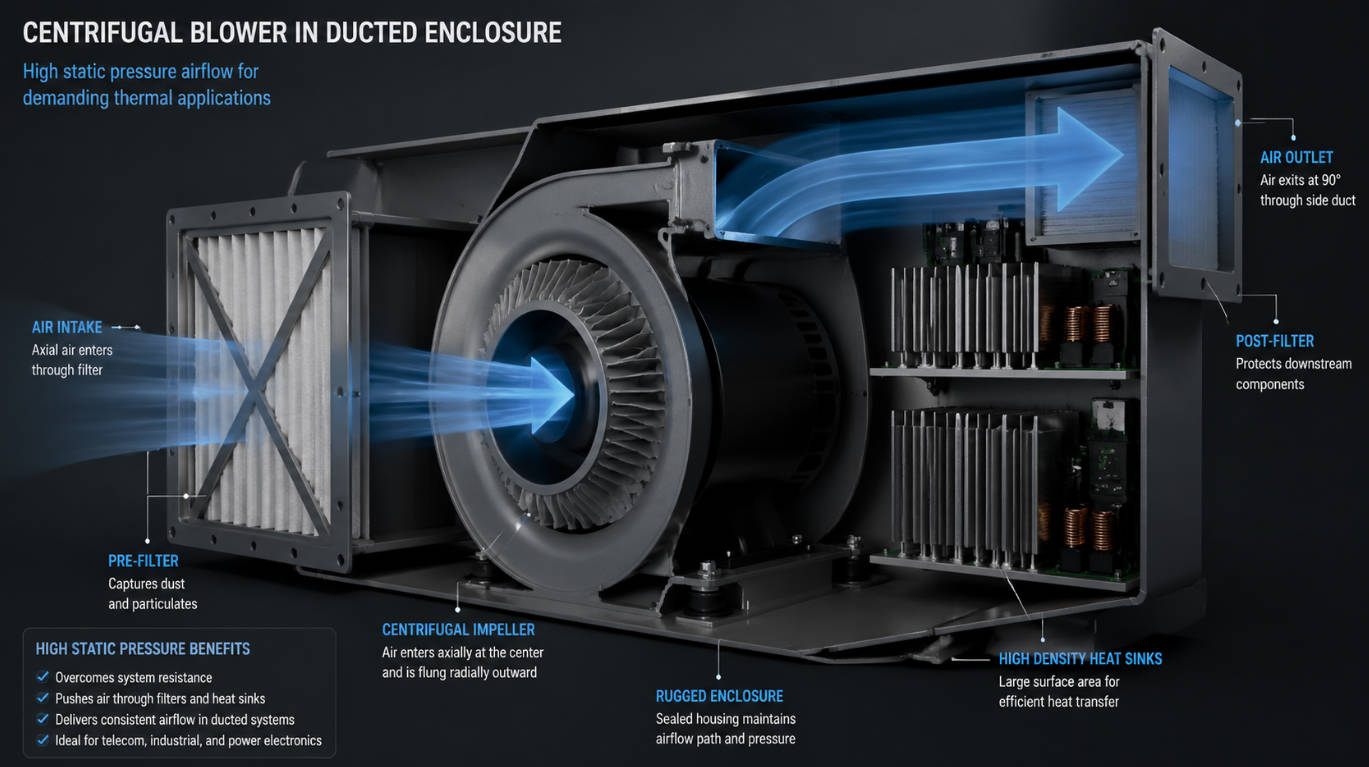
Centrifugal fans (often called blowers) draw air in along the axis and then force it out at roughly 90 degrees to the inlet, using centrifugal force from a rotating impeller. They are designed to deliver higher static pressure, making them suitable for air movement through ducts, filters, heat sinks and complex enclosures with higher resistance. [metastatinsight]
Typical characteristics of centrifugal fans: [cbifans]
- Air enters axially and exits radially at a right angle
- Lower airflow volume than axial at the same size, but much higher pressure capability
- Better for long duct runs, dense heat sinks or restrictive chassis
- Typically higher power consumption and noise than axial
- Very robust and suitable for harsh environments
For example, in industrial drives, power supplies and base station cabinets with complex ducting and filters, we regularly specify centrifugal blowers because axial fans alone cannot overcome the system impedance. [forum.digikey]

| Aspect | Axial Fan | Centrifugal Fan |
|---|---|---|
| Airflow direction | Parallel to shaft, straight‑through | Inlet axial, outlet at ~90° (radial) cbifans |
| Typical performance | High volume, low pressure | Lower volume, high pressure cbifans |
| Static pressure handling | Best for low impedance systems | Best for high impedance / ducted systems fansandblowers |
| Energy usage | Often lower power at given flow | Higher power for high‑pressure delivery cbifans |
| Noise profile | Generally quieter | Typically louder sameskydevices |
| Size / form factor | Slim, compact, easy to integrate | Bulkier housings due to scroll / volute cbifans |
| Cost | Usually lower | Usually higher, especially industrial grades cbifans |
From a design perspective, one of the most critical practical differences is the fan curve: axial fans provide excellent flow at low pressure, but their performance drops quickly as backpressure rises, while centrifugal fans maintain usable flow at much higher static pressure. [nmbtc]
Understanding the airflow mechanism is essential when you're mapping out a cooling path.
- Blades are aligned with the axis, similar to an airplane propeller. [fanquip.com]
- Air enters and exits along the same line, which simplifies panel or chassis mounting. [fansandblowers]
- Ideal when air can move freely in and out with minimal obstruction. [sofasco]
- Impeller blades draw air into the center and fling it outward by centrifugal force. [uk.rs-online]
- A scroll or volute housing converts this radial movement into a directional airflow at 90° to the inlet. [fanquip.com]
- Ideal for ducted systems, filters, complex channels and long airflow paths. [metastatinsight]
In practical thermal design reviews, we always overlay the fan curve onto the system impedance curve to see if the chosen fan type can actually operate where the design team expects. [nmbtc]
Axial DC and AC fans are widely used in:
- Telecom and networking equipment (switches, routers, base stations) [linkedin]
- Consumer electronics (set‑top boxes, gaming consoles, servers) [24marketreports]
- HVAC and ventilation where high volume, low pressure is needed [fansandblowers]
- Cooling of cabinets with perforated doors or open vents [sofasco]
They shine when you have compact spaces and relatively short, straight airflow paths with limited obstructions. [fansandblowers]
Centrifugal fans and blowers are more common in:
- Systems with long duct runs or complex airflow paths [metastatinsight]
- Equipment with dense heat sinks, filters or grills that create high impedance [sofasco]
- Industrial processes, air filtration and cooling towers [cbifans]
- Harsh environments where robust housings are required [pelonistechnologies]
In scenarios where engineers initially tried to solve high backpressure with "more and bigger" axial fans, we often switch them to a properly sized centrifugal blower and immediately see improved temperature margins and lower overall fan count. [forum.digikey]
Both fan types generate airflow and electromagnetic noise, but centrifugal models are typically louder at equivalent air movement because they operate at higher pressure and often lower blade tip speeds but with more turbulence. Axial fans tend to be preferred in noise‑sensitive applications such as office IT equipment and consumer devices. [sameskydevices]
- Axial fans are generally more efficient for moving large volumes of air against low resistance, which usually translates to lower power usage for the same flow. [24marketreports]
- Centrifugal fans can be more efficient when static pressure is high because they are designed for those conditions, even though their input power is higher. [cbifans]
Modern brushless DC (BLDC) motors and optimized impeller designs enable both fan types to reach 20–30% better efficiency than legacy designs, which aligns with regulatory and sustainability targets. [24marketreports]
For OEMs in telecom and industrial markets, reliability is non‑negotiable. When reviewing fan options, we focus on:
- Bearing systems (sleeve vs. ball vs. advanced bearing designs) [forum.digikey]
- Operating temperature range and derating curves
- Ingress protection (dust, moisture) and contamination tolerance
- Continuous duty performance and L10 life expectations
Reputable brands and experienced manufacturers typically provide detailed reliability data, which is essential when you design for 24/7 operation in critical infrastructure. [nmbtc]
Over the years, I've found that successful fan selection follows a simple but disciplined process rather than a guess or a price‑driven choice. [forum.digikey]
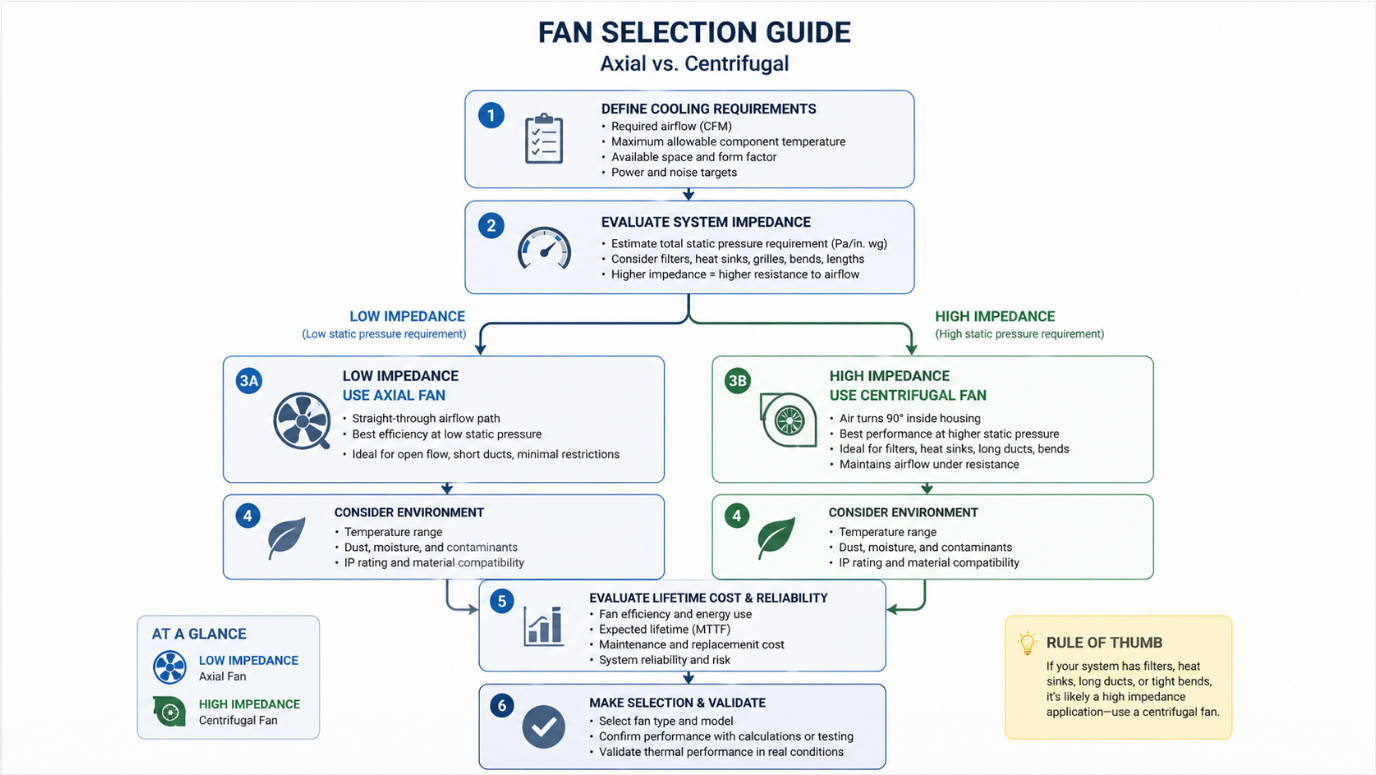
- Total heat load (W) and acceptable component / ambient temperatures
- Required airflow (CFM or m³/h) at the operating backpressure
- Target noise level and acoustic profile
A preliminary thermal analysis and CFD or empirical testing can prevent "patchwork" fixes later in development. [nmbtc]
Airflow impedance – the resistance to air movement caused by grills, filters, ducting and components – is a critical factor. [sofasco]
- For low impedance systems (short, open airflow paths), an axial fan is usually the best starting point. [fansandblowers]
- For high impedance systems (filters, dense fins, long ducts), centrifugal fans are often required to reach the operating point. [metastatinsight]
As a rule of thumb, many engineers select a fan with 75–100% more free‑air flow than the calculated requirement at zero backpressure to account for real operating conditions and tolerances. [sofasco]
When we consult on a new design, we always ask:
- Is the equipment installed indoors or outdoors?
- Are there dust, fumes, moisture or corrosive agents present?
- What are the space constraints (height, depth, footprint)?
- Are there strict EMI/EMC or acoustic regulations?
These factors often push the choice toward robust centrifugal designs in harsh environments or compact axial DC fans in dense electronics. [forum.digikey]
An axial fan might be cheaper per piece, but if it cannot maintain required airflow at actual backpressure, it may result in:
- Elevated operating temperatures and reduced component lifetime
- Higher field failure rates and warranty costs
- Retrofits or redesigns later in the product lifecycle
Total cost of ownership (including energy consumption and reliability) is usually more important than initial purchase price in professional applications. [24marketreports]
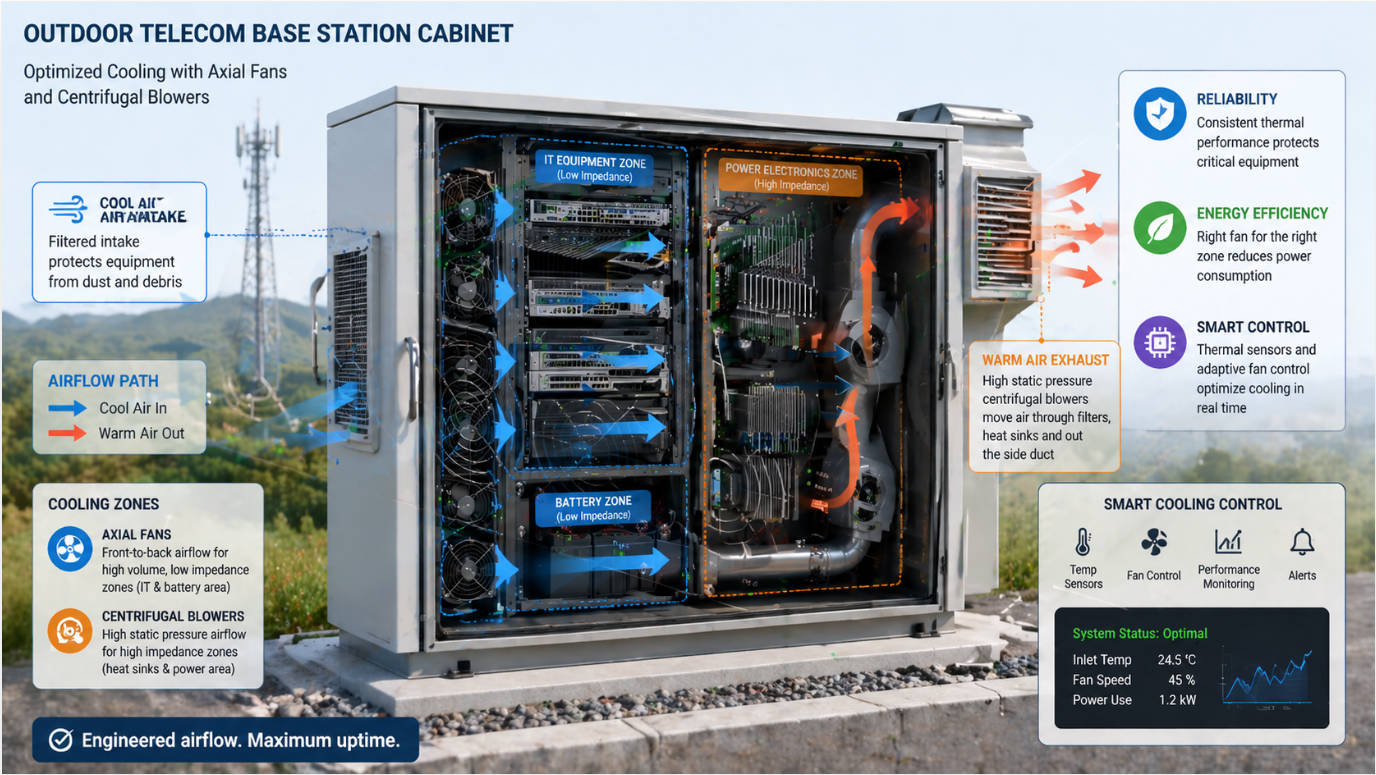
In telecom and wireless communication equipment for customers like ZTE, Huawei and Hytera, we routinely encounter a mix of constraints: high density boards, tough environmental conditions and strict uptime requirements. [linkedin]
A typical scenario looks like this:
- Requirement: Maintain safe operating temperatures for RF modules and power stages in a compact outdoor cabinet.
- Challenge: Airflow path includes EMI filters, dust filters and tight heat sink channels, creating high system impedance.
- Approach:
- Use high‑reliability DC axial fans for general cabinet ventilation and bulk airflow.
- Add centrifugal blowers at critical zones where air must be forced through dense fin stacks or long channels.
- Implement PWM speed control to balance noise, power and thermal headroom across varying loads.
The combination of axial and centrifugal technologies, matched carefully to the thermal model, usually gives the best balance of performance, reliability and cost. [linkedin]
The fan market is evolving quickly with regulatory, efficiency and digitalization trends. [linkedin]
Key trends we see when working with global customers:
- Energy efficiency and regulations: There is a strong push toward fans that meet or exceed energy‑related directives and sustainability goals, with BLDC technology and optimized aerodynamics becoming standard. [24marketreports]
- Smart control and monitoring: PWM and voltage control, tachometer outputs and even integrated diagnostics are increasingly common to allow dynamic speed control and predictive maintenance. [linkedin]
- High‑performance cooling in compact designs: Demand for higher power density in electronics is driving the adoption of high‑performance axial and centrifugal fans that deliver more static pressure within similar footprints. [metastatinsight]
- Reliability and ruggedization: For telecom, industrial and outdoor applications, enhanced sealing, corrosion resistance and extended temperature capability are becoming baseline expectations rather than "nice to have". [nmbtc]
Manufacturers that combine in‑house brands with top‑tier global partners are well positioned to offer tailored DC and AC fan solutions that track these trends over the full product lifecycle. [cbifans]
When we support customers in early design reviews, we usually summarize fan choice into a few practical rules:
- Start with axial fans when:
- Your system has low to moderate airflow resistance.
- Space is tight and you need a slim profile.
- Noise and energy efficiency are key priorities.
- Start with centrifugal fans when:
- You must push air through filters, ducts or tight fin channels.
- The application demands high static pressure.
- The environment is harsh and needs robust construction.
Whenever possible, we recommend running at least one iterative prototype test with instrumented airflow and temperature monitoring to validate the fan selection before locking the design. [forum.digikey]
If you are designing a new device or upgrading an existing platform and are unsure whether axial or centrifugal fans will deliver the best result, the most efficient next step is a short, data‑driven consultation. Based on your thermal requirements, space constraints, environment and lifecycle targets, an experienced cooling solutions provider can recommend the optimal mix of DC fans, AC fans and blowers, along with control strategies and reliability options tailored to your project. [nmbtc]
Share your system specifications, drawings and performance targets, and request a customized thermal assessment and fan selection proposal so you can move forward with confidence.
If your airflow path includes filters, long ducts, dense heat sinks or complex baffles that create significant backpressure, a centrifugal fan is often required to deliver the necessary airflow at operating pressure. A fan curve vs. system impedance analysis is the most reliable way to confirm this. [fansandblowers]
Axial fans are usually more efficient when moving large volumes of air against low resistance, which means lower power consumption in open or lightly restricted systems. However, in high‑pressure environments, a well‑selected centrifugal fan can be more efficient overall because it operates closer to its optimal point. [cbifans]
For most office, IT and consumer devices, axial fans are preferred because they generally generate less audible noise than centrifugal fans at comparable airflow levels. Using BLDC motors, optimized blade geometries and PWM speed control can further reduce acoustic impact. [sameskydevices]
Yes, many high‑performance systems successfully combine axial fans for bulk ventilation and centrifugal blowers for localized high‑pressure cooling zones. The key is to design the airflow paths so that the fans do not work against each other and to validate the combined performance with testing. [fansandblowers]
You should collect basic thermal data (heat load, critical component temperatures), mechanical constraints (available space, mounting options), environmental conditions (temperature, dust, humidity), noise requirements and any regulatory or reliability targets. Supplying a block diagram or 3D model of your system greatly improves the accuracy of any fan selection or thermal proposal. [sofasco]
1. CBI Group – "Axial Fan vs Centrifugal Fan: All You Need To Know"
https://www.cbifans.com/en/blog/axial-fan-vs-centrifugal-fan-all-you-need-to-know [cbifans]
2. Same Sky Devices – "Axial Fans vs. Centrifugal Fans – What's the Difference?"
https://www.sameskydevices.com/blog/axial-fans-vs-centrifugal-fans-what-is-the-difference [sameskydevices]
3. RS Components – "The Difference Between Centrifugal Fans and Axial Fans"
https://uk.rs-online.com/web/content/discovery/ideas-and-advice/difference-between-centrifugal-fans-axial-fans [uk.rs-online]
4. Pelonis Technologies – "Centrifugal Fan vs. Axial Fan"
http://www.pelonistechnologies.com/blog/differences-between-axial-fans-centrifugal-fans [pelonistechnologies]
5. Fans and Blowers – "Axial Fans vs Centrifugal Fans – Which fan is best for you?"
https://fansandblowers.com/news/axial-fans-vs-centrifugal-fans/22 [fansandblowers]
6. 24MarketReports – "Cooling Axial Fan Market 2026 forecast to 2032"
https://www.24marketreports.com/machines/global-cooling-axial-fan-market [24marketreports]
7. Sofasco Fans – "Selection Guide for Electronic Cooling Fans"
https://sofasco.com/blogs/article/selection-guide-for-electronic-cooling-fans [sofasco]
8. Metastat Insight – "Axial Fan Market Size, Share & Growth Industry Analysis, 2033"
https://metastatinsight.com/report/axial-fan-market [metastatinsight]
9. NMB Technologies – "How to Choose the Right Fan"
https://nmbtc.com/white-papers/which-fan/ [nmbtc]
10. LinkedIn – "The Key Trends Fueling Electronic Fan Market Growth from 2026–2033"
https://www.linkedin.com/pulse/key-trends-fueling-electronic-fan-market-growth-from-2026-2033-nuwqf [linkedin]
11. Digi-Key Forum – "How to Choose the Right Fan for Your Industrial Application – Expert Tips from Cooltron"
https://forum.digikey.com/t/how-to-choose-the-right-fan-for-your-industrial-application-expert-tips-from-cooltron/53742 [forum.digikey]
12. YouTube – "Difference Between Axial and Centrifugal Fans"
https://www.youtube.com/watch?v=jDYvYvkxo4k [youtube]
13. Fanquip – "Axial Flow Fan Vs Centrifugal Fan – What's the difference?"
https://www.fanquip.com.au/news/product-highlight/axial-flow-fan-vs-centrifugal-fan/ [fanquip.com]


