From idea to market-ready product, our NPI solutions make every stage easier, faster. Discover How We Help
Help Center

Views: 265 Author: Capital Technology Publish Time: 2026-08-27 Origin: Site
Content Menu
● Where Axial Flow Fans Are Used
>> Industrial Control Cabinets and Automation Systems
>> Telecom, Networking, and 5G Equipment
>> Data Centers, Servers, and IT Infrastructure
>> HVAC, Commercial Ventilation, and Air-Handling Equipment
>> Transportation, Energy, and Outdoor Equipment
● How to Select the Right Axial Flow Fan
>> Step 1: Define the Heat Load
>> Step 2: Determine Static Pressure
>> Step 3: Match Fan Type to the Application
>> Step 4: Verify Noise, Life, and Environment
● Common Fan-Selection Mistakes
● Why Work With Capital Technology
● Get a Fan Selection Recommendation
● FAQ
>> 1. What is the main advantage of an axial flow fan?
>> 2. What is the difference between a DC fan and an AC fan?
>> 3. When should I use a high-static-pressure axial fan?
>> 4. How do I calculate the airflow required for an enclosure?
>> 5. Can an axial fan be used in dusty or outdoor environments?
>> 6. Why does a fan provide less airflow after installation?
>> 7. How can I reduce fan noise without causing overheating?
Axial flow fans are among the most widely used air-moving devices in modern equipment because they can deliver high airflow in a compact footprint. From telecom cabinets and server racks to HVAC equipment, industrial control panels, transportation systems, and machinery, the right axial fan helps manage heat, protect electronics, and maintain safe operating conditions.
For engineers, OEMs, and system integrators, however, choosing an axial flow fan is not simply a matter of selecting the highest CFM rating. Real-world fan performance depends on airflow resistance, installation space, temperature, voltage, noise requirements, contamination, reliability targets, and the thermal load of the equipment. This guide explains the most important axial flow fan applications and provides a more practical framework for choosing DC fans, AC fans, and high-reliability cooling solutions.

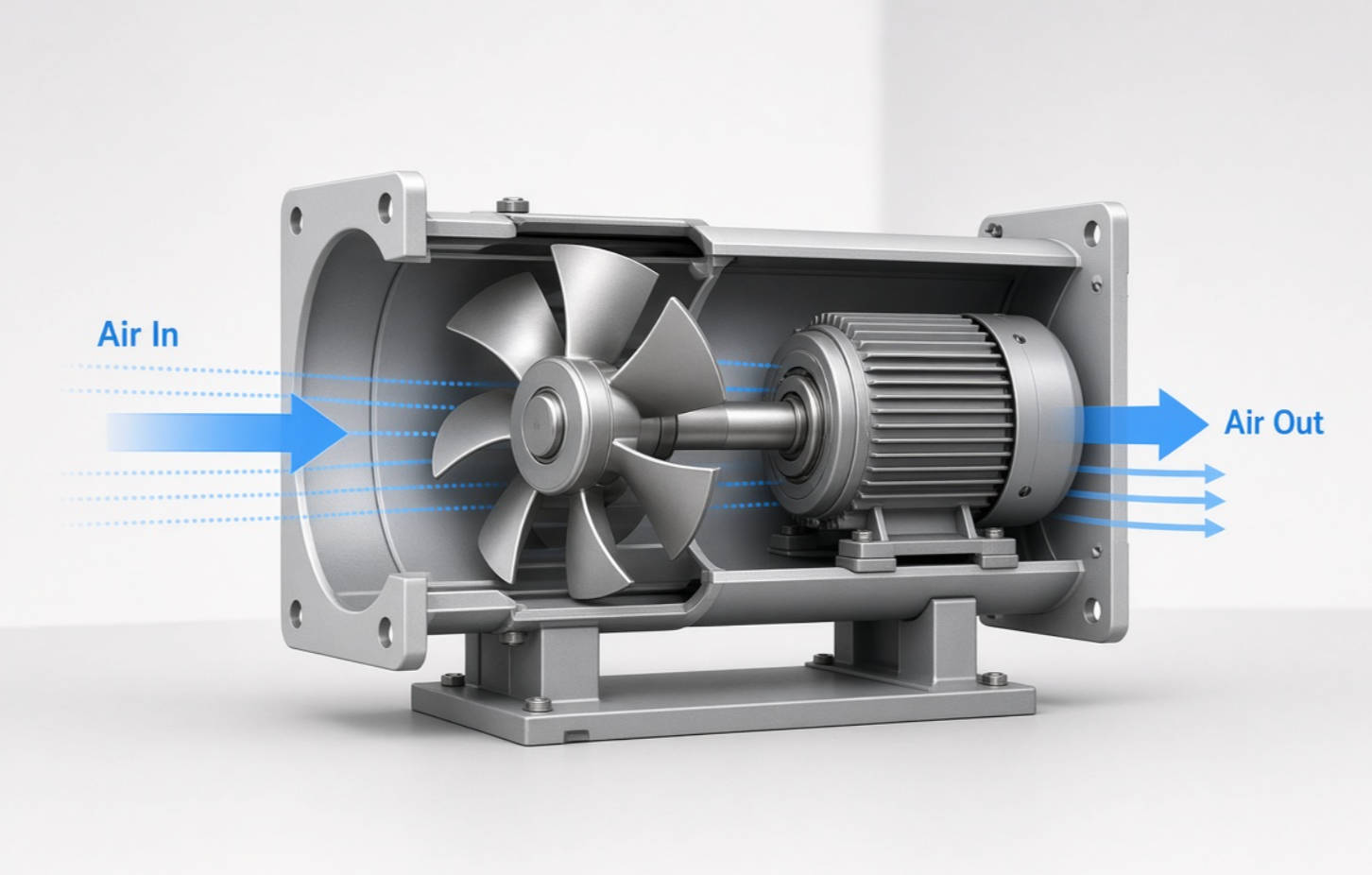
An axial flow fan moves air parallel to the fan shaft. Air enters from one side of the fan and exits in the same axial direction, creating a relatively straight airflow path.
This operating principle makes axial fans especially suitable when a system needs to move a large volume of air through a cabinet, enclosure, rack, heat sink, or open ventilation path. Compared with centrifugal fans, axial fans generally offer a more compact structure and are often preferred where high airflow, lower weight, and direct airflow are the main priorities.
Axial flow fans are available in many formats, including:
- DC axial fans for telecom equipment, servers, battery systems, automation cabinets, and electronic devices
- AC axial fans for industrial machinery, electrical enclosures, ventilation equipment, and commercial installations
- EC fans for energy-conscious systems requiring speed control and improved efficiency
- High-static-pressure fans for dense electronic assemblies, filters, heat sinks, and restricted airflow paths
- Long-life, low-noise, waterproof, dust-resistant, and high-temperature fan designs for demanding environments
At Capital Technology Co., Limited, we supply cooling solutions under the independent CAPITAL brand and serve as a leading SANYO DENKI distributor. This combination enables customers to source both cost-effective cooling fan solutions and high-performance San Ace fan products for mission-critical applications.
Industrial control cabinets contain PLCs, drives, power supplies, relays, communication modules, and other heat-generating components. As internal temperatures rise, electronic reliability can decline, and equipment may experience nuisance alarms, derating, or premature failure.
DC and AC axial fans are commonly installed on cabinet doors, side panels, roof panels, and internal cooling paths. Their role is to introduce cooler air, exhaust hot air, and prevent thermal hotspots around sensitive components.
Typical industrial applications include:
- PLC and motion-control cabinets
- Variable-frequency drives and inverter systems
- CNC machines
- Power distribution cabinets
- Factory automation equipment
- Packaging and printing machines
- Welding equipment
- Industrial battery chargers
For these applications, the fan must match the enclosure's airflow path. A fan with high free-air CFM may underperform if filters, louvers, grilles, cable bundles, or heat sinks create significant static pressure. Fan selection should therefore be based on the operating point on the airflow–static pressure curve, rather than the maximum airflow shown on a datasheet.
Telecom equipment operates continuously and often sits in compact, high-density enclosures. Base stations, wireless equipment, optical transmission systems, routers, switches, and outdoor communication cabinets all depend on stable thermal management.
Axial flow fans support the cooling of:
- Telecom power systems
- Baseband units
- Radio-frequency equipment
- Network switches and routers
- Optical transmission equipment
- Outdoor telecom cabinets
- Edge computing enclosures
- Radio communication equipment
In this environment, reliability is often more important than initial fan cost. A cooling fan failure can increase internal temperature quickly, trigger equipment protection mechanisms, degrade performance, or shorten the life of power semiconductors and capacitors.
For high-availability projects, engineers should consider long-life fans, tachometer output, locked-rotor alarms, PWM speed control, redundant fan modules, and operating-temperature margins. SANYO DENKI's San Ace product range is known for high airflow, high static pressure, low vibration, and long-life options, including models designed for extended service life.
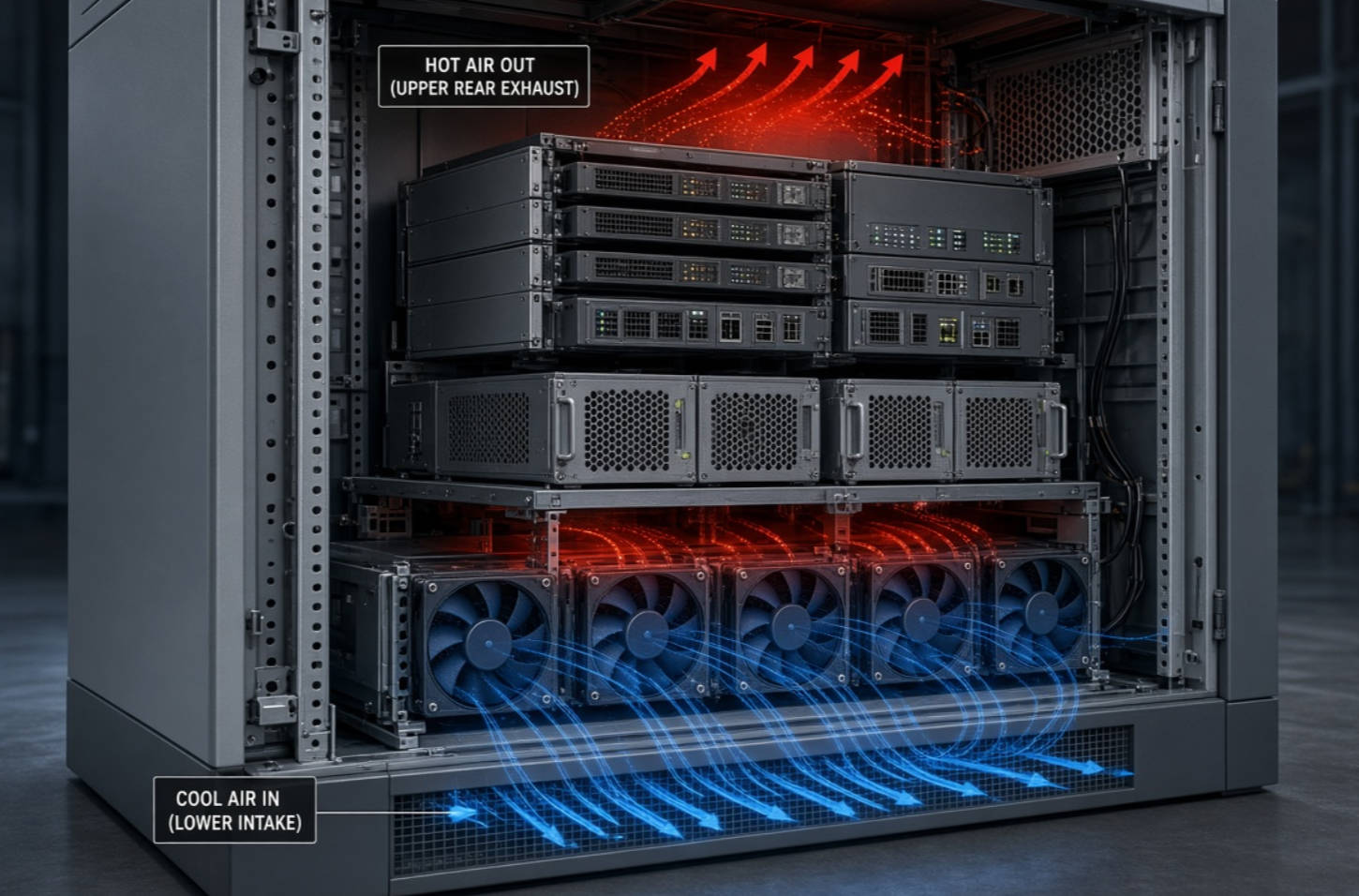
Data centers and enterprise IT rooms concentrate large amounts of processing power in limited space. Servers, storage systems, switches, UPS units, and rack-mounted power equipment all generate substantial heat.
Axial fans are integrated into server chassis, rack-mounted devices, fan trays, cooling modules, and airflow-management systems. Their ability to move high volumes of air in a compact format makes them essential in electronics cooling.
Common applications include:
- Rack servers
- Storage arrays
- Network switches
- GPU servers and AI computing equipment
- UPS systems
- Power distribution units
- Data center containment systems
- Edge data center cabinets
A good design focuses on the temperature of air entering the equipment, not only the room temperature. Industry guidance commonly identifies a recommended server inlet-temperature range of 18°C to 27°C, although equipment-specific limits must always take priority.
For server and network hardware, fan performance must be considered together with pressure losses from narrow chassis channels, dense heat sinks, cable congestion, filters, and high component density. This is where high-static-pressure DC fans can be more appropriate than standard axial fans.
Axial flow fans are used in HVAC and ventilation systems to exchange air, remove heat, support cooling processes, and improve indoor air quality. They can be installed in wall-mounted ventilation units, condenser equipment, rooftop systems, air-handling assemblies, and exhaust applications.
Typical HVAC-related uses include:
- Condenser and refrigeration equipment
- Ventilation units
- Air curtains
- Commercial kitchen exhaust support
- Warehouse air circulation
- Electrical-room ventilation
- Heat-exchanger cooling
- Equipment-room exhaust systems
In industrial and commercial facilities, axial fans can help remove stale air, fumes, heat, and airborne contaminants. However, ventilation systems with long duct runs, restrictive filters, or complex duct geometry may require a centrifugal fan or a mixed-flow fan instead. The key question is not "Which fan moves the most air?" but "Which fan can deliver the required airflow at the actual system resistance?"
Vehicles, rail systems, charging stations, renewable-energy equipment, and outdoor cabinets often expose fans to vibration, dust, moisture, large temperature swings, and continuous operation.
Axial flow fans are used in:
- EV charging stations
- Battery energy storage systems
- Solar inverter cabinets
- Railway control systems
- Automotive electronics
- Marine electronics
- Outdoor power cabinets
- Traffic-control equipment
- Security and surveillance systems
These environments require more than a standard fan specification. Engineers should assess ingress protection, bearing type, corrosion resistance, vibration performance, operating temperature range, connector reliability, and maintenance access.
For example, an outdoor charging cabinet may need a fan that delivers sufficient static pressure through a filtered intake while maintaining stable performance during summer heat, dust exposure, and long operating cycles. Selecting a fan solely by nominal airflow may lead to overheating after the filter becomes partially loaded.
A technically sound fan-selection process begins with the thermal problem, not with a catalogue model number.
First, estimate the total heat generated inside the enclosure. This includes heat from power supplies, processors, power electronics, displays, drives, batteries, and other active components.
The required airflow can be estimated using:
Q=(3.16×P)/ΔT
Where:
- Q = airflow in CFM
- P = heat load in watts
- ΔT = allowable temperature rise in °C
This is a preliminary calculation. It does not replace validation testing, because actual cabinet performance also depends on airflow bypass, recirculation, component layout, ambient temperature, and system resistance.
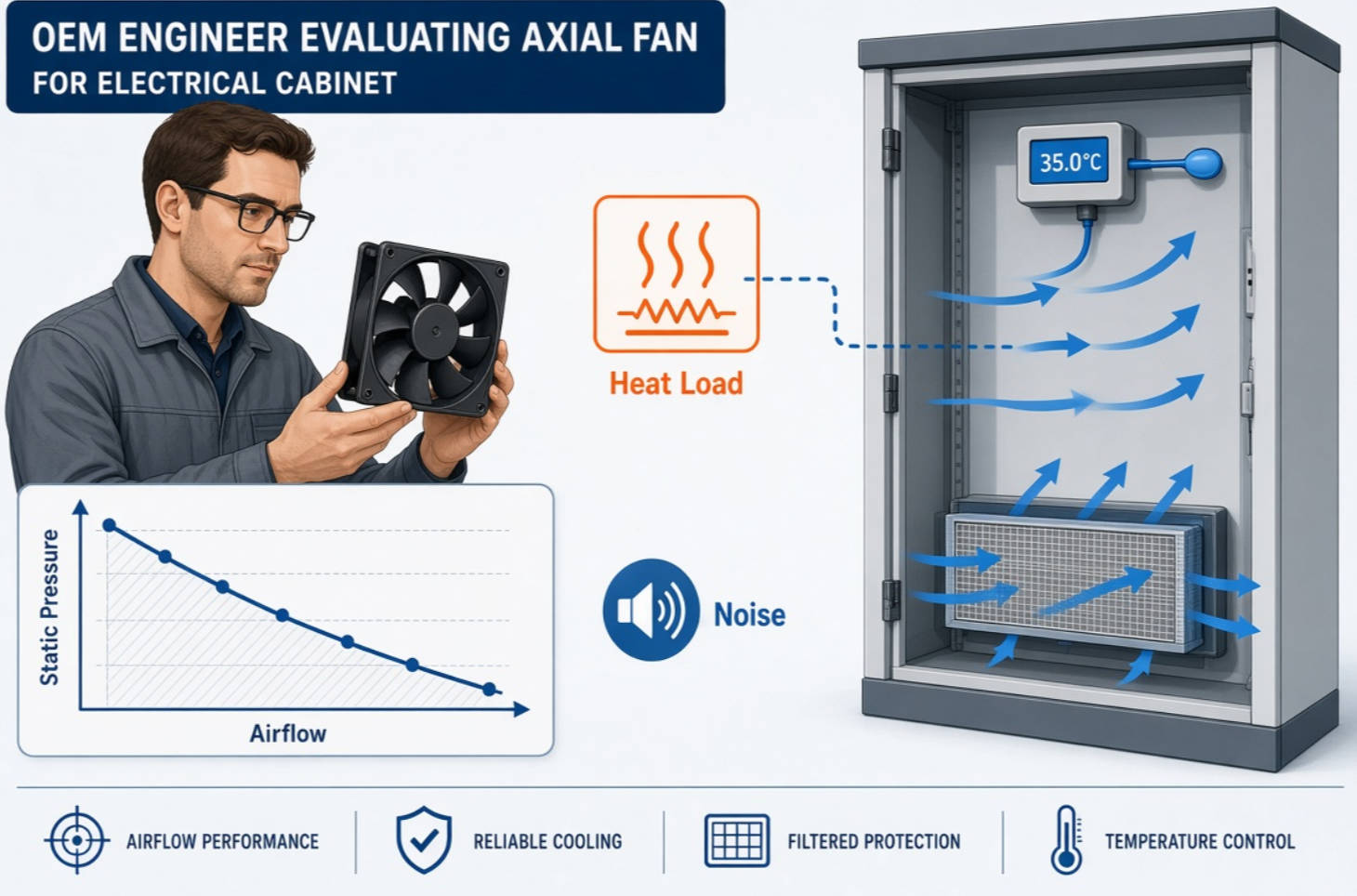
Static pressure is the resistance the fan must overcome to move air through the system. Common sources include:
- Air filters
- Fan guards and louvers
- Ducts and bends
- Dense heat sinks
- Narrow ventilation channels
- EMI shielding
- Cable bundles
- Perforated metal panels
A fan's free-air airflow rating is measured with little or no restriction. In a real enclosure, the fan operates at the intersection of its fan curve and the system-resistance curve. As resistance rises, delivered airflow decreases.
SANYO DENKI's fan-selection guidance recommends considering actual system impedance and selecting with margin when resistance cannot be measured accurately. It notes that operating airflow often falls within a portion of the fan's maximum airflow range after installation.
| Selection factor | DC axial fan | AC axial fan |
|---|---|---|
| Typical voltage | 5V, 12V, 24V, 48V DC | 110V, 115V, 220V, 230V AC |
| Common uses | Electronics, telecom, servers, battery systems | Cabinets, machinery, ventilation equipment |
| Speed control | PWM, voltage control, smart control options | More limited unless paired with external controls |
| Monitoring | Tach signal, alarm signal, locked-rotor output | Usually simpler monitoring options |
| Best fit | Precision thermal management and intelligent equipment | Straightforward mains-powered ventilation |
There is no universal "best" fan type. The correct choice depends on available power, required control, operating conditions, service expectations, and total cost of ownership.
Noise level matters in offices, medical devices, communication rooms, and commercial equipment. Yet selecting the quietest fan can create a thermal risk if the fan does not provide enough airflow or pressure.
Instead, balance:
- Airflow and static pressure
- Acoustic noise
- Power consumption
- Expected service life
- Ambient temperature
- Dust, oil mist, humidity, or corrosive exposure
- Bearing technology
- Alarm and speed-control requirements
- Installation orientation and maintenance access
A fan should be evaluated as part of the entire cooling system. In many projects, a slightly higher-performance fan with speed control can provide a better long-term outcome than an undersized low-noise model operating continuously at maximum speed.
The following mistakes frequently lead to poor cooling performance:
1. Using free-air CFM as the only selection criterion. The installed airflow can be much lower when the system includes filters, grilles, heat sinks, and narrow internal channels.
2. Ignoring airflow direction. Intake and exhaust positions must create a continuous path through the hottest components, not simply circulate air inside the enclosure.
3. Underestimating future filter resistance. A clean filter and a partially loaded filter create very different operating conditions.
4. Selecting without temperature margin. A cabinet that performs adequately at 25°C ambient temperature may fail during peak summer conditions.
5. Treating the fan as a commodity. In telecom, medical, power, transport, and data-center equipment, fan reliability can directly affect system uptime.
6. Skipping prototype validation. Thermal imaging, temperature sensors, airflow measurement, and life testing can reveal bypass airflow and hotspots that calculations alone may miss.
A cooling fan supplier should support more than product delivery. The right partner helps engineers identify the required airflow, static pressure, voltage, dimensions, connector, control method, and environmental protection level before a production issue occurs.
Capital Technology Co., Limited provides DC fan, AC fan, and thermal-management solutions for industrial and electronic applications. With the independent CAPITAL brand and a leading SANYO DENKI distribution capability, we can support projects that require flexible sourcing, customized specifications, and high-reliability cooling fan options.
Our experience serving customers in communications and electronics supply chains—including enterprises such as ZTE, HUAWEI, and HYTERA—helps us understand the practical requirements behind thermal design: stable quality, dependable lead times, traceable specifications, and engineering-oriented support.
Need help choosing a DC fan, AC fan, or high-static-pressure cooling fan for your product?
Send Capital Technology your application requirements, including enclosure dimensions, heat load, voltage, operating temperature, target airflow, noise limit, and environmental conditions. Our team can help identify a suitable cooling solution from the CAPITAL range or SANYO DENKI San Ace product portfolio.
An axial flow fan can move a large volume of air in a direct path while maintaining a relatively compact design. It is widely used for electronics cooling, cabinet ventilation, HVAC equipment, and industrial machinery.
DC fans operate from direct-current power and commonly offer speed control, tachometer feedback, and alarm functions. AC fans operate from mains power and are widely used in industrial cabinets, ventilation systems, and equipment with AC power available.
Use a high-static-pressure fan when air must pass through restrictive components such as filters, dense heat sinks, narrow air channels, grilles, radiators, or packed electronic assemblies.
Start by identifying total heat load in watts and the maximum allowable temperature rise. A preliminary CFM estimate can be calculated using the thermal-load formula, but the result should be validated through actual system testing.
Yes, provided that the fan is selected for the environment. Consider filter design, ingress protection, corrosion resistance, operating temperature, bearing type, and maintenance requirements.
The rated airflow shown on a datasheet is often measured under free-air conditions. Once installed, filters, grilles, ducts, heat sinks, and other restrictions create static pressure, reducing the airflow delivered by the fan.
Use a correctly sized fan, minimize unnecessary airflow restrictions, optimize the internal airflow path, consider PWM speed control, and validate temperatures under worst-case operating conditions. Do not reduce fan speed unless the system still meets its thermal requirements.
1. Blauberg Motors. "What Are Axial Flow Fan Applications?" [Read the original article].
2. SANYO DENKI. "Long Life Fan | San Ace." [View product information].
3. SANYO DENKI America. "San Ace Cooling Fan Systems." [Explore San Ace products].
4. SANYO DENKI. "Overview and Characteristics of Fan Guideline in Selecting a Fan." [Read the fan-selection guide].
5. TechTarget. "Data Center Temperature and Humidity Guidelines." [Read the guidance summary].
6. Sunbird DCIM. "What Are Data Center Temperature and Humidity Standards?" [Review the data-center standards overview].
7. Consulting-Specifying Engineer. "Achieving Optimal Fan Performance." [Read the fan-performance article].


