From idea to market-ready product, our NPI solutions make every stage easier, faster. Discover How We Help
Help Center

Views: 275 Author: Capital Technology Publish Time: 2026-09-04 Origin: Site
Content Menu
>> Typical Axial Fan Applications
>> How Radial Fans Generate Higher Pressure
>> Typical Radial Fan Applications
● Axial Fan vs Radial Fan: Side-by-Side Comparison
● Airflow and Static Pressure: The Deciding Factors
>> Understanding the Fan Operating Point
>> Practical Example: Cooling a Power Electronics Enclosure
● Performance Differences in Real Applications
>> High Airflow vs High Pressure
>> Energy Efficiency and Speed Control
● Axial Fan vs Radial Fan for Electronics Cooling
● A Five-Step Fan Selection Process
>> 1. Define the Thermal Requirement
>> 3. Estimate Required Airflow and Static Pressure
>> 4. Compare Fan Curves, Not Just Catalog Ratings
>> 5. Validate the Installed System
● Expert Insight: Avoid the "Free-Air CFM" Selection Mistake
● How Capital Technology Supports Fan Selection
>> 1. What is the main difference between an axial fan and a radial fan?
>> 2. Is a radial fan the same as a centrifugal fan?
>> 3. Which fan is better for a heat sink?
>> 4. Are axial fans more energy efficient than radial fans?
>> 5. Why does a fan deliver less airflow after installation?
>> 6. How do I calculate the static pressure required for my fan?
>> 7. Should I use a DC fan or an AC fan?
>> 8. What information should I provide when requesting a fan recommendation?
Choosing between an axial fan and a radial fan is not simply a matter of selecting the model with the highest airflow rating. The correct choice depends on the relationship between airflow volume, static pressure, system resistance, available space, acoustic limits, reliability requirements, and the operating environment.
For engineers, procurement teams, OEM designers, and thermal-management specialists, the core question is straightforward: Does the application need to move a large volume of air through an open or low-resistance path, or does it need to force air through resistance? Axial fans are generally designed for high airflow at relatively low static pressure. Radial fans—often called centrifugal fans or blowers—are built to maintain airflow when ducts, filters, heat sinks, enclosures, bends, grilles, and other restrictions create resistance.
At Capital Technology Co., Limited, we work with DC fans, AC fans, cooling fans, and customized thermal-management solutions for demanding electronics and industrial applications. With our own CAPITAL brand and experience supporting customers in communications, power electronics, industrial control, and equipment manufacturing, we see one recurring challenge: a fan that looks correct on paper can fail in the real enclosure if selection is based only on free-air CFM.
This guide explains the practical differences between axial fans and radial fans, including airflow direction, pressure capability, energy use, noise, maintenance, application fit, and a proven fan-selection process.

An axial fan moves air parallel to the fan's rotating shaft, or axis. Air enters on one side of the fan and exits on the opposite side in a generally straight direction.
The operating principle is similar to a propeller. As the blades rotate, they create a pressure difference that pulls air into the fan and pushes it forward. This makes axial fans highly effective when the goal is to move a large volume of air through a relatively open pathway.
Common axial fan formats include:
- DC axial cooling fans
- AC axial fans
- EC axial fans
- Tube axial fans
- Vane axial fans
- Compact electronics cooling fans
- High-speed server and telecom fans
In electronic equipment, a DC axial fan is often the first choice for ventilation because it is compact, straightforward to install, and capable of moving significant airflow across circuit boards, power modules, battery packs, and heat-generating components.
The blades of an axial fan rotate around a central hub. Their blade angle creates lift, which moves air in the same direction as the shaft.
This design is especially effective when there is low airflow resistance. For example, an axial fan can ventilate an enclosure efficiently when air has a direct inlet path, a direct outlet path, and sufficient open area around the fan.
However, axial fan performance changes significantly as static pressure rises. A dense filter, restrictive louver, narrow heat sink, perforated panel, sharp duct bend, or poorly designed inlet can reduce delivered airflow far below the number shown in a free-air specification.
Key axial fan characteristics:
- High airflow volume capability
- Lower static-pressure capability than centrifugal designs
- Compact and lightweight construction
- Often cost-effective for electronics cooling
- Suitable for open spaces and short airflow paths
- Available in AC, DC, and EC motor configurations
- Commonly used in cabinet cooling and ventilation
Axial fans are widely used when airflow volume is more important than pressure.
Typical applications include:
- Telecom base stations and communication cabinets
- Server racks and data-center equipment
- Power supplies and inverters
- EV chargers and battery thermal management
- Network switches and routers
- Outdoor electrical enclosures
- Air-conditioning condensers
- Refrigeration equipment
- Medical devices
- Agricultural ventilation
- Factory ventilation and exhaust systems
For example, a telecom cabinet with a clean, short front-to-back airflow path may benefit from a high-performance DC axial fan. The fan can bring cool outside air across electronic components and exhaust heated air from the opposite side of the enclosure.
A radial fan moves air outward from the center of the impeller at approximately 90 degrees to the inlet direction. It is commonly known as a centrifugal fan, centrifugal blower, or radial blower.
Instead of pushing air straight through the fan, a radial fan draws air into the center of a rotating impeller. The impeller accelerates the air outward toward the housing wall, where the housing converts part of that velocity into useful pressure.
This airflow pattern allows radial fans to overcome higher resistance than many standard axial fan designs.
Air enters a centrifugal fan through the inlet, typically at the center of the fan housing. The rotating impeller transfers energy to the air and throws it outward. The scroll-shaped or volute-shaped housing then guides the air toward an outlet.
Because of this design, radial fans can be highly suitable for systems where airflow must pass through components that create pressure drop, including:
- Long ducts
- HEPA or particulate filters
- Dense heat sinks
- Air scrubbers
- Cooling coils
- Narrow channels
- Complex equipment housings
- Sound attenuators
- Industrial extraction systems
A radial fan does not automatically outperform an axial fan. The right answer depends on the operating point. But when a system includes meaningful resistance, a centrifugal solution may maintain airflow more effectively than an axial alternative.
Key radial fan characteristics:
- Higher static-pressure capability
- Better performance in restrictive airflow paths
- Suitable for ducts, filters, and enclosed channels
- Often more robust for industrial environments
- More complex mechanical structure than a basic axial fan
- Available in forward-curved, backward-curved, and radial-blade impeller designs
- Frequently used for air handling, extraction, and high-pressure cooling
Radial fans are commonly used in applications where the air path is restricted or engineered.
Typical examples include:
- HVAC air-handling units
- Industrial dust collection systems
- Fume extraction systems
- Battery cooling channels
- High-density power electronics
- Laser equipment
- Medical and laboratory equipment
- Automated production machinery
- Packaging machinery
- Cleanroom and filtration systems
- HVAC duct systems
- Material handling and pneumatic conveying systems
A compact radial blower can also be valuable inside a high-density electronics enclosure. If airflow must pass through a narrow fin stack, a tightly packed PCB assembly, or a high-impedance filter, a blower may produce better real-world cooling than a larger axial fan.
The table below summarizes the most important differences between axial fans and radial fans.
| Feature | Axial Fan | Radial Fan / Centrifugal Fan |
|---|---|---|
| Airflow direction | Air moves parallel to the fan shaft | Air enters centrally and exits outward, usually at 90 degrees |
| Best airflow condition | High airflow with low resistance | Controlled airflow through medium-to-high resistance |
| Static pressure | Low to moderate | Moderate to high |
| Typical form factor | Flat, compact, direct-through airflow | Housing with impeller and side discharge |
| Best applications | Ventilation, open cooling, short ducts, electronics cabinets | Ductwork, filters, heat sinks, extraction, restrictive enclosures |
| Energy efficiency | Efficient when operating near its intended low-pressure duty point | Efficient when selected correctly for a higher-pressure duty point |
| Noise profile | Often lower at modest speeds, but can become noisy when restricted | Can produce more tonal or turbulent noise depending on impeller and housing design |
| Maintenance | Usually simple due to fewer parts and accessible construction | May require more cleaning and inspection in dusty or contaminated applications |
| Cost | Often lower for standard models | Often higher due to housing and impeller complexity |
| Installation | Simple panel or enclosure mounting | Requires attention to inlet, outlet, duct connection, and housing orientation |
The most important distinction is not "axial versus radial" in isolation. It is whether the fan curve intersects the system curve at the airflow and pressure point your equipment actually requires.
When comparing an axial fan vs radial fan, airflow and static pressure should drive the selection process.
Airflow is usually expressed as:
- CFM: cubic feet per minute
- m³/h: cubic meters per hour
- L/s: liters per second
Static pressure is commonly expressed as:
- Pa: pascals
- mmH₂O: millimeters of water column
- in. w.g.: inches of water gauge
A fan's published airflow rating may look impressive, but that number is often measured under free-air conditions. Free air means the fan operates with little or no resistance.
In real equipment, airflow meets resistance from:
- Intake grilles
- Dust filters
- EMI shielding
- Cable bundles
- Heat sinks
- PCB components
- Ducts and elbows
- Exhaust louvers
- Narrow airflow passages
- Dirty filters over time
As resistance increases, the delivered airflow falls. This is why a fan must be evaluated against its P–Q curve, also called the pressure-flow curve or fan performance curve.
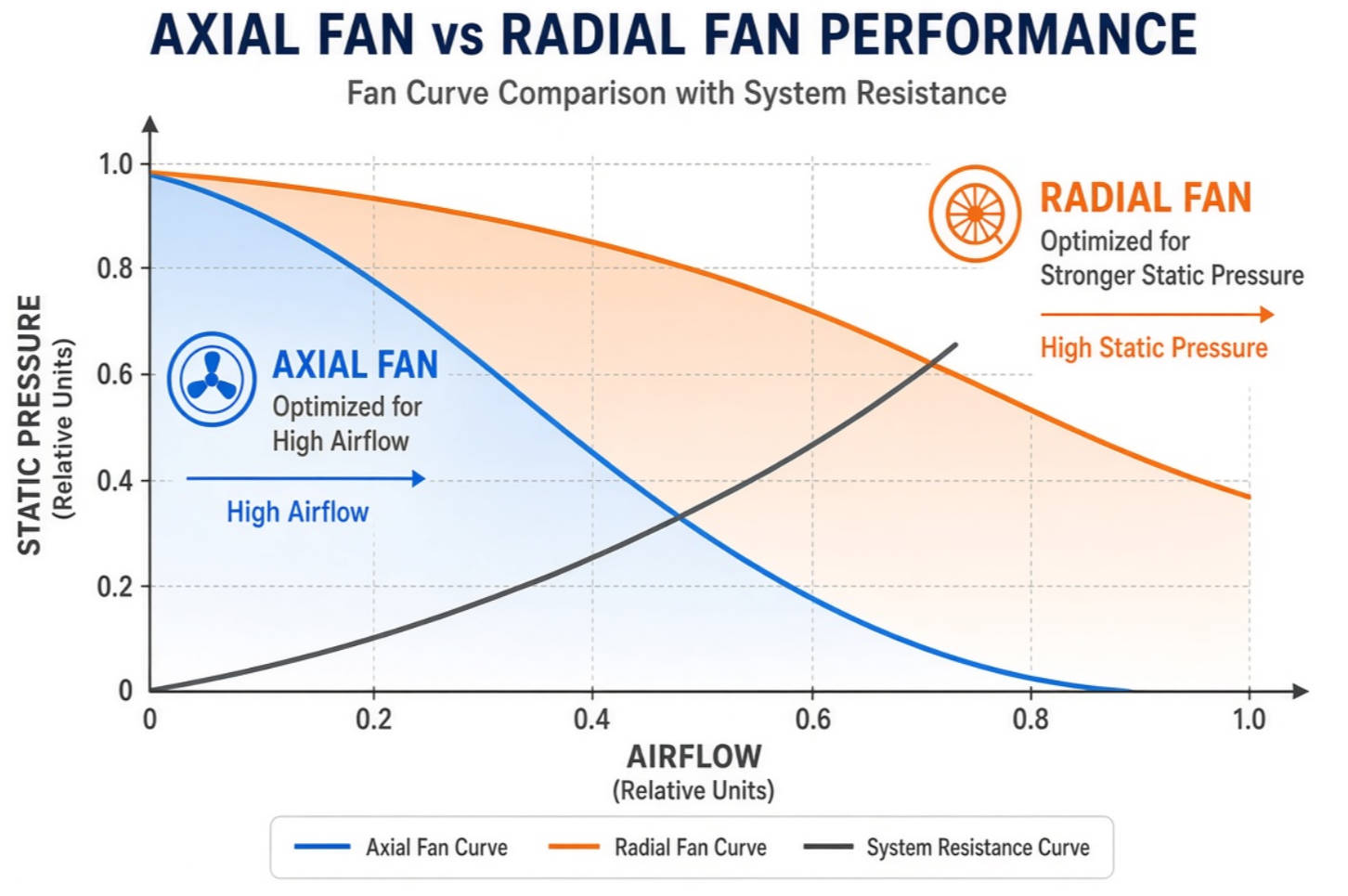
The fan operating point is where the fan curve and system curve meet.
- The fan curve shows how much airflow the fan can deliver at different static-pressure levels.
- The system curve shows how much resistance the equipment or duct system creates at different airflow levels.
- Their intersection represents the actual operating condition.
This is a critical concept for thermal design. A free-air airflow number alone does not tell you how much air will move through a real system. Fan selection should start with the required airflow and total system pressure, then identify a fan design that can achieve that duty point.
Consider two cooling designs for a power-control cabinet.
Design A: The enclosure uses wide intake openings, a direct airflow channel, and low-density internal components. An axial fan may be the most efficient and cost-effective option.
Design B: The enclosure includes a washable filter, narrow inlet louvers, dense heat sinks, a cable harness, and a baffled air outlet. The airflow path now has much higher static pressure. A radial blower or high-static-pressure axial fan may be required to maintain useful cooling airflow.
The lesson is simple: select the fan for the real airflow path, not for an empty enclosure.
Axial fans are generally preferred when the application needs a large volume of air and the air path is relatively unrestricted.
Examples include:
- Ventilating a telecom cabinet
- Cooling a condenser coil
- Exhausting warm air from a room
- Moving air across a large electronics enclosure
- Providing general ventilation in a factory or warehouse
Radial fans are generally preferred when the application needs airflow to overcome resistance.
Examples include:
- Pushing air through a high-density heat sink
- Pulling contaminated air through a filtration system
- Moving air through a long duct run
- Ventilating a machine with narrow internal channels
- Maintaining airflow after filters accumulate dust
The practical selection rule is:
Choose axial airflow for volume. Choose radial airflow for resistance.
This rule is useful, but it should not replace engineering validation. Certain high-performance axial fans can produce meaningful static pressure, and compact blowers may be unnecessary for low-resistance designs. Always compare actual curves at the required operating point.
Noise should be evaluated early, especially in telecom, medical, office, laboratory, server, and consumer-facing equipment.
Fan noise is influenced by more than fan type. Important factors include:
- Fan speed
- Blade geometry
- Impeller design
- Motor control method
- Turbulence at the inlet or outlet
- Obstructions near the fan
- Mounting vibration
- Duct design
- Operating point
An axial fan may be quieter in a low-resistance application because it can deliver the required airflow at a lower speed. However, if an axial fan is forced to operate against excessive resistance, it may generate turbulence, tonal noise, reduced airflow, and poor efficiency.
A radial fan can be the quieter choice in a high-pressure system if it is properly sized and allowed to operate near its efficient range.
Noise-reduction recommendations:
- Avoid placing a grille too close to the fan inlet.
- Use sufficient open area at intake and exhaust locations.
- Minimize sharp bends directly before or after a fan.
- Isolate the fan from vibrating panels with suitable mounting methods.
- Consider PWM or variable-speed control for DC fans.
- Use a larger fan running at lower speed when space allows.
- Test noise under the actual installed condition, not only in open-air testing.
AMCA notes that poor inlet or outlet conditions can create "system effect," including uneven or spinning airflow, which can negatively affect delivered performance.
A fan is energy-efficient only when it is correctly selected for the operating point. A low-power fan that cannot maintain required airflow may cause equipment overheating, thermal derating, reduced component life, or system failure.
For variable-speed fan systems, the fan laws are especially important:
Where:
- Q is airflow
- Ps is static pressure
- N is fan rotational speed
This means reducing fan speed can produce meaningful energy savings. A modest reduction in speed can lower power consumption substantially because fan power changes approximately with the cube of speed.
For example, intelligent DC fan control can reduce fan speed during lower thermal loads, helping lower energy consumption and acoustic noise. This approach is especially valuable in communication equipment, battery systems, industrial control cabinets, and server hardware where heat load varies throughout the day.
Electronic devices create an increasingly difficult thermal environment. Power density is rising, equipment is becoming more compact, and enclosures often contain restrictions that make cooling more challenging.
For electronics cooling, the choice between DC axial fans and radial blowers should consider both thermal load and airflow impedance.

An axial fan is usually a good choice when:
- The enclosure has a straight or open airflow path.
- The system needs high airflow volume.
- Space favors a thin fan profile.
- The required static pressure is modest.
- The equipment uses large vents or open ventilation panels.
- Cost sensitivity is high.
- The fan can pull or push air directly through the enclosure.
Typical products include communication cabinets, inverter enclosures, power supplies, network equipment, LED lighting systems, and general industrial electronics.
A radial fan is usually a good choice when:
- The airflow path includes dense heat sinks.
- Filters or fine intake screens create resistance.
- The cooling channel is narrow.
- Air must be routed around internal components.
- The system needs air delivered through ducts.
- High static pressure is required.
- The equipment must maintain cooling performance under increasing filter loading.
Typical products include laser equipment, air-cleaning devices, compact HVAC modules, high-power battery systems, laboratory instruments, and tightly packaged industrial electronics.
Selecting the right cooling fan requires more than comparing size, voltage, and airflow ratings. Use the following process to make a more reliable decision.
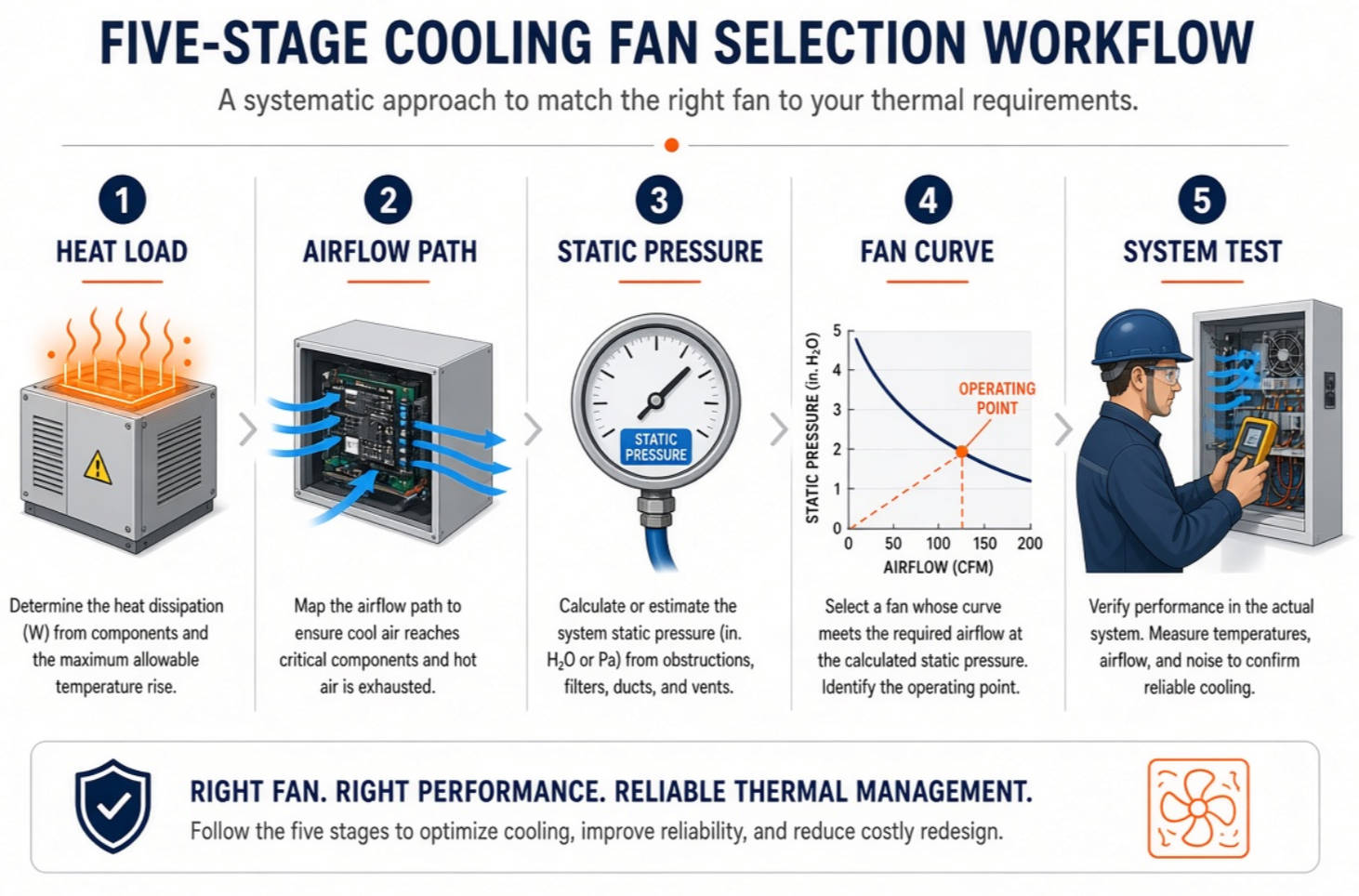
Start with the heat that must be removed.
Collect information on:
- Total heat dissipation in watts
- Maximum allowable internal temperature
- Ambient temperature range
- Component temperature limits
- Operating altitude
- Continuous or intermittent duty cycle
Higher ambient temperature reduces cooling margin. A fan that works in a 25°C laboratory may not be sufficient in a 45°C outdoor cabinet.
Identify every restriction between air intake and exhaust.
Check:
- Vent size and free area
- Filter type and pressure drop
- Heat sink fin density
- Internal partitions
- PCB layout
- Cable routing
- Duct length and bends
- Exhaust grille design
- Fan placement
This step often reveals why a cooling system underperforms.
Use thermal calculations, CFD analysis, prototype testing, or engineering consultation to estimate the required duty point.
Do not rely only on free-air CFM. Instead, define a target such as:
- Required airflow: 180 m³/h
- Required static pressure: 120 Pa
- Maximum sound level: 55 dB(A)
- Supply voltage: 24 VDC
- Operating temperature: −20°C to +70°C
This specification gives manufacturers and engineers enough information to recommend a suitable model.
Review each candidate fan's pressure-flow curve.
Look for:
- Airflow at the required static pressure
- Efficiency near the duty point
- Motor current and power consumption
- Noise rating
- Speed-control compatibility
- Bearing type
- Expected service life
- IP protection level
- Operating-temperature range
A fan may advertise high maximum airflow but provide insufficient airflow at your actual system resistance.
The final step is testing.
Measure:
- Internal temperatures
- Airflow direction
- Fan speed
- Acoustic level
- Current consumption
- Temperature rise at critical components
- Performance with clean and partially loaded filters
This validation is especially important for OEM products supplied at scale. A small airflow improvement can have a major impact on reliability, warranty exposure, and customer satisfaction.
One of the most common fan-selection mistakes is comparing only the maximum airflow figure in the catalog.
A fan rated at 200 CFM in free air may deliver much less once it is installed behind a restrictive grille or forced through a dense heat sink. In contrast, a fan with a lower free-air CFM rating but stronger static-pressure performance may provide more useful airflow inside the actual product.
This is particularly important for:
- High-density telecom equipment
- Data-center hardware
- Outdoor communication cabinets
- EV charging systems
- Industrial automation cabinets
- Power conversion equipment
- Battery energy-storage systems
- Medical diagnostic equipment
For serious thermal-management projects, specify the duty point first. Then select the fan.
A better procurement question is not: "What is your highest-CFM fan?"
A better procurement question is: "Which fan can deliver our required airflow at our measured static pressure, temperature, voltage, noise target, and service-life requirement?"
Capital Technology Co., Limited provides cooling-fan and thermal-management support for projects requiring DC fans, AC fans, customized cooling solutions, and dependable supply capability.
Our approach focuses on application fit rather than one-size-fits-all recommendations. Depending on the project, the evaluation can include:
- DC axial fan and AC axial fan selection
- High-static-pressure fan recommendations
- Radial blower and centrifugal fan options
- Voltage, current, and connector configuration
- PWM, FG, RD, and speed-control requirements
- Bearing selection for expected service life
- Noise and airflow balancing
- Operating-temperature assessment
- Mechanical mounting compatibility
- Sample evaluation and production support
With experience serving recognized communication and technology customers, including ZTE, HUAWEI, and HYTERA, our team understands that cooling components must support not only airflow targets but also product reliability, supply consistency, and long-term field performance.
The best choice in the axial fan vs radial fan comparison depends on your system's airflow resistance.
Choose an axial fan when you need high airflow volume through an open or low-resistance path. It is often the practical choice for ventilation, cabinet cooling, condensers, and many electronic enclosures.
Choose a radial fan when the application requires stronger static pressure to move air through filters, ducts, narrow channels, heat sinks, or complex internal structures.
Before placing an order, confirm the real operating conditions: airflow, static pressure, voltage, temperature, noise limit, mounting space, control requirement, and environmental exposure. This prevents undersized cooling designs, unnecessary energy use, excess fan noise, and costly product redesigns.
Need help selecting a DC fan, AC fan, axial fan, or radial blower for your application? Contact Capital Technology with your airflow target, static-pressure requirement, enclosure drawing, operating temperature, and voltage specification. Our technical team can help you identify a cooling solution designed for your actual working conditions—not just a catalog number.
An axial fan moves air parallel to its rotating shaft, making it suitable for high-volume, low-resistance airflow. A radial fan moves air outward from the center of an impeller and is better suited for higher-pressure applications with ducts, filters, heat sinks, or restricted passages.
Yes. In many industrial and electronics-cooling contexts, a radial fan is commonly referred to as a centrifugal fan or centrifugal blower. The fan draws air into the center of the impeller and discharges it outward through the housing.
The answer depends on heat-sink resistance. A low-density heat sink with an open airflow path may work well with an axial fan. A dense heat sink with narrow fin spacing often requires a high-static-pressure axial fan or a radial blower to force air through the fins effectively.
Neither type is always more efficient. An axial fan can be highly efficient in a high-airflow, low-pressure application. A radial fan can be more efficient when the system has high resistance. The most efficient fan is the one that operates near its intended duty point.
Installed airflow can decrease because of system resistance. Filters, grilles, heat sinks, cables, ducts, bends, and narrow openings all create pressure drop. This shifts the operating point and reduces actual airflow compared with the fan's free-air rating.
Static pressure is determined by the resistance of the complete airflow system. It can be estimated using engineering calculations, component pressure-drop data, CFD simulation, or physical testing. Include all airflow restrictions, including filters, vents, heat sinks, ducting, bends, and exhaust openings.
DC fans are commonly selected for electronics, telecom equipment, battery systems, and applications that need compact size, speed control, monitoring signals, or low-voltage operation. AC fans are often used in industrial equipment and fixed-speed applications where AC power is readily available. The appropriate choice depends on voltage availability, control requirements, environmental conditions, and required performance.
Provide the required airflow, static pressure, voltage, available installation space, operating temperature, maximum noise limit, control method, expected service life, mounting orientation, inlet/outlet restrictions, and application environment. Photos or drawings of the enclosure are also highly useful.
1. U.S. Department of Energy. Improving Fan System Performance: A Sourcebook for Industry. This guide explains that fan selection begins by calculating system airflow and pressure requirements, then selecting a fan design suitable for the application. [Read the source]
2. Air Movement and Control Association International. Mitigating System Effect to Optimize Fan Performance and Efficiency. The article discusses how inlet and outlet conditions, obstructions, and inadequate duct design can affect actual fan performance. [Read the source]
3. ASHRAE Terminology. Fan Types. ASHRAE identifies centrifugal and axial fans as the two main fan categories used in HVAC&R applications. [Read the source]
4. Consulting-Specifying Engineer. Air Movement and Air Handling Systems. This technical overview explains the use of airflow and total pressure requirements when selecting fan performance from curves. [Read the source]
5. Integra Controls. Fan Curves Explained: A Complete Guide. The guide describes the relationship between airflow, static pressure, fan speed, and fan laws. [Read the source]
6. Hartzell Air Movement. Axial Fans and How They Work in Different Systems. The article discusses using axial fans for high airflow and low pressure, while centrifugal fans are more suitable for resistance from filters, bends, and ducts. [Read the source]
7. Longwell Fans. Axial Fan vs. Radial Fan: Key Differences Explained. Competitor reference article reviewed for topical coverage and comparison structure. [Read the source] [docs.nlr]


