From idea to market-ready product, our NPI solutions make every stage easier, faster. Discover How We Help
Help Center

Views: 267 Author: Capital Technology Publish Time: 2026-07-22 Origin: Site
Content Menu
● Axial Fan vs Radial Fan: What's the Real Difference?
>> Axial Fan Working Principle
>> Radial Fan Working Principle
● Axial Fan vs Radial Fan Comparison
● Performance Factors That Matter
>> Noise
● Where Each Fan Performs Best
● Industry Insight: Why High-Density Equipment Changes the Choice
● Capital Technology Co., Limited Positioning
● Summary
● FAQ
>> 1. What is the main difference between axial fan and radial fan?
>> 2. Which fan is better for high airflow?
>> 3. Which fan is better for high static pressure?
>> 4. Are radial fans louder than axial fans?
>> 5. How do I choose the right fan for my product?
>> 6. Are axial fans always more energy efficient?
When comparing axial fan vs radial fan, the key question is not which one is universally better. The real question is which fan type fits the pressure, airflow, noise, size, and reliability demands of the application.
In industrial cooling, that choice can affect temperature stability, energy use, maintenance frequency, and product lifespan. For manufacturers and system integrators, the correct fan selection is often the difference between stable long-term operation and recurring thermal problems.
At Capital Technology Co., Limited, this topic is highly relevant in telecom equipment, industrial control cabinets, power systems, and other heat-sensitive environments. In simple terms, axial fans move large volumes of air in a straight line, while radial fans turn airflow by 90 degrees and perform better in higher-pressure systems.
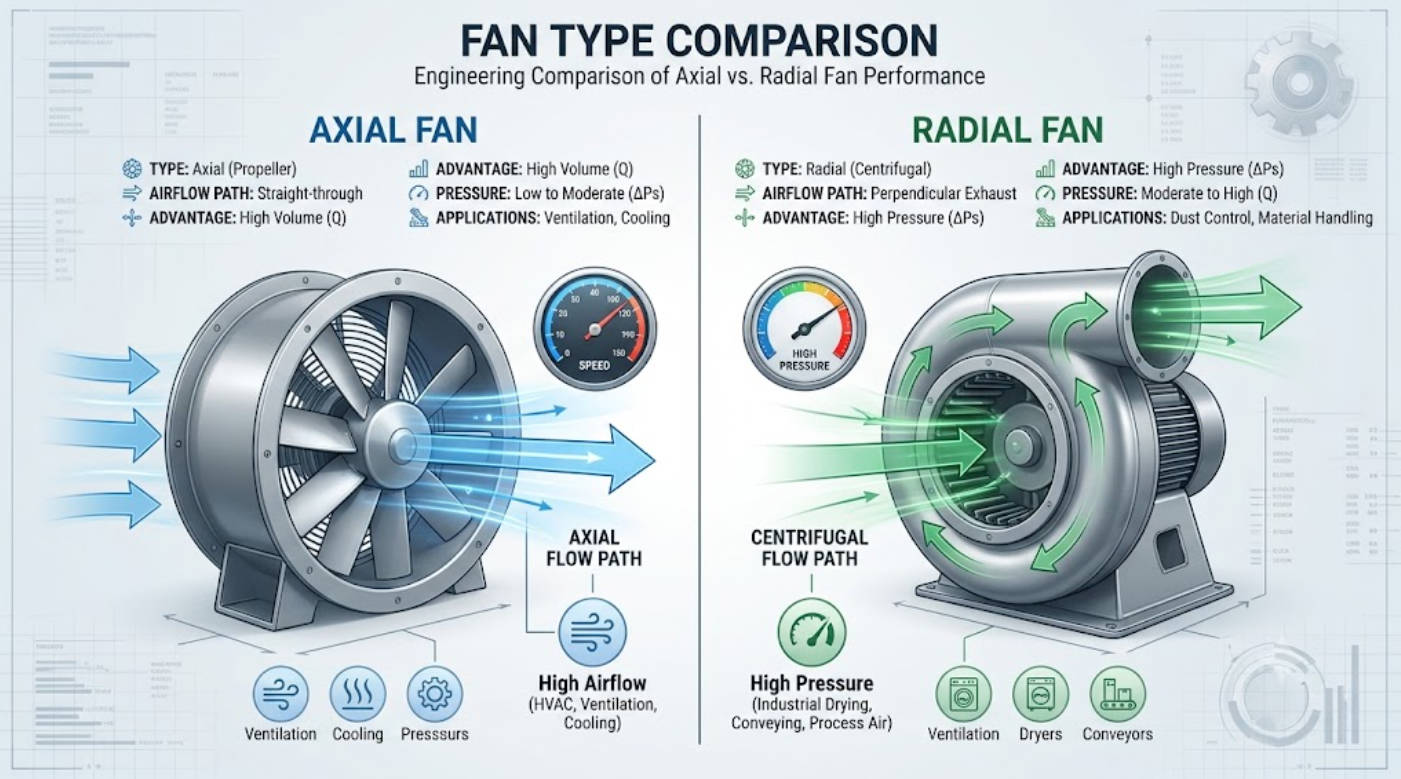
An axial fan pushes air parallel to the shaft, similar to a propeller. This straight-through airflow makes it ideal when the system has low resistance and the main goal is moving a large volume of air quickly.
Axial fans are often chosen for open-space cooling, general ventilation, electronics exhaust, and applications where size, cost, and airflow volume matter more than pressure. They are usually simple in structure and can be very efficient in low-static-pressure systems.
A radial fan, also called a centrifugal fan, draws air into the impeller and then discharges it at a right angle. That change in direction creates stronger pressure capability, which is why radial fans perform better in restrictive systems, ducted paths, filters, and dense enclosures.
This makes radial fans a strong choice when air must travel through resistance. In many engineering cases, pressure is more important than raw airflow volume, especially in cabinets, industrial blowers, and systems with heat exchangers or dust filters.
| Factor | Axial Fan | Radial Fan |
|---|---|---|
| Airflow direction | Parallel to the shaft | Air enters axially, exits at 90° |
| Best strength | High airflow | High static pressure |
| Best environment | Low-resistance, open airflow | Restrictive, ducted, or filtered systems |
| Noise profile | Often louder at high speed | Often steadier in pressure-driven systems |
| Space use | Compact, straight-through design | Usually requires more housing space |
| Energy efficiency | Strong in low-pressure applications | Better when pressure resistance is high |
| Typical use cases | Servers, ventilation, general cooling | Blowers, ducts, filter systems, enclosures |
If your system needs to move a lot of air quickly, axial fans usually have the advantage. They tend to deliver higher airflow in open conditions. That is one reason they are common in server ventilation, telecom cooling, and other applications where air can move freely through the chassis.
If your system has resistance, pressure matters more than airflow volume. Radial fans are designed to overcome that resistance better than axial fans, especially in ducted or blocked pathways. This is why centrifugal and radial designs are often selected for equipment racks, filtration systems, and industrial cabinets.
Noise is not just about comfort. In industrial product design, noise can affect perceived quality and practical usability. Axial fans can become noisy at higher speed, while radial fans often handle pressure more steadily and can be quieter in the right installation.
A fan is most efficient when it matches the system curve properly. Fan performance should always be evaluated against the pressure drop of the full system, not in isolation. In low-resistance applications, axial fans may use less energy; in high-resistance systems, radial fans may be the better-performing and more stable choice.
Axial fans are usually best when the system is open and airflow needs are high. Common applications include:
- Server and telecom cooling.
- General cabinet ventilation.
- HVAC intake and exhaust.
- Electronics and power supply cooling.
- Applications where low cost and compact size matter.
Radial fans are usually best when the system includes resistance. Common applications include:
- Filtered air systems.
- Ducted cooling paths.
- Industrial blowers.
- High-static-pressure enclosures.
- Heat exchangers and dense electronic modules.
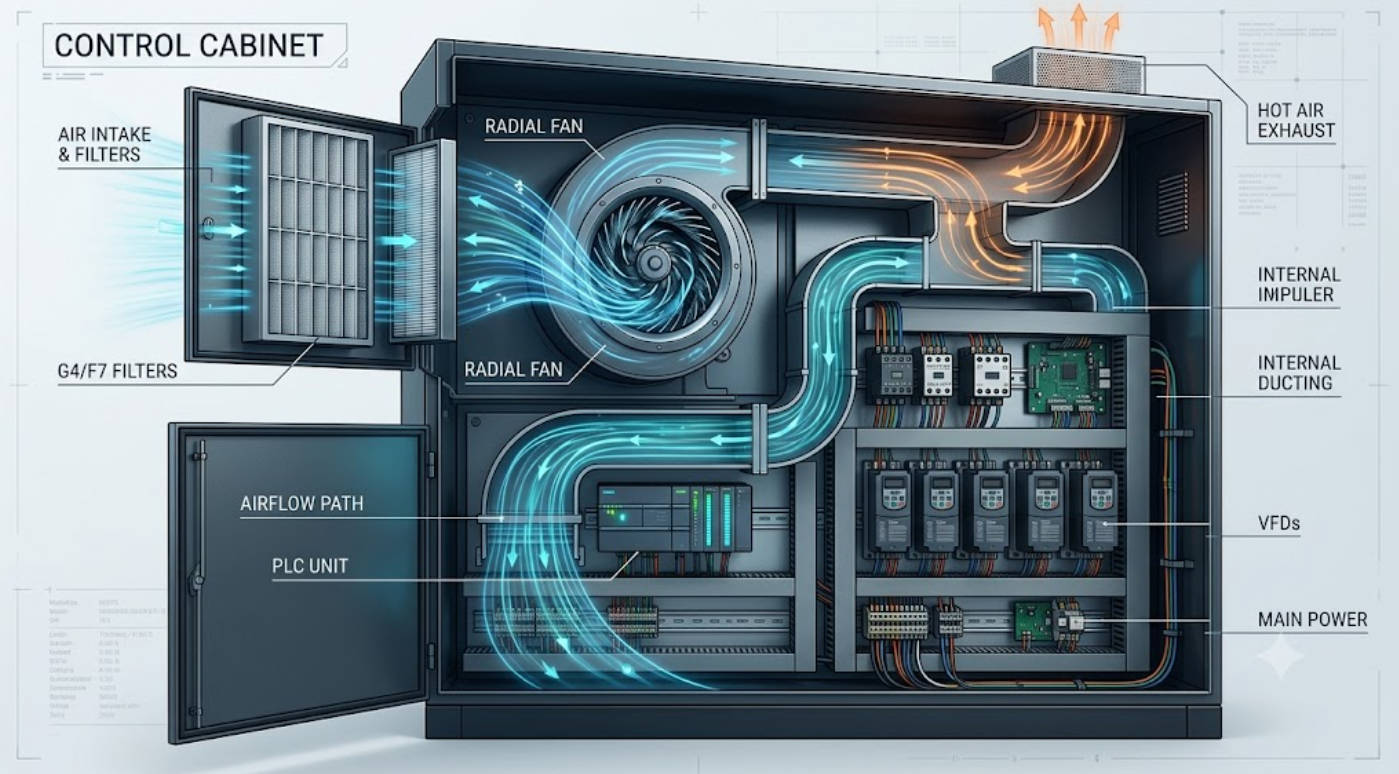
A good engineer does not start with fan type. A good engineer starts with the system curve. The fan and the system must intersect at the correct operating point, or the cooling result will disappoint in real-world use.
Here is a practical selection process:
1. Define the thermal load.
2. Measure the expected airflow resistance.
3. Check the required static pressure.
4. Decide whether airflow volume or pressure is the priority.
5. Match the fan curve to the system curve.
6. Validate with prototype testing when the enclosure is complex.
This approach is especially important for industrial buyers because catalog airflow values can look impressive but still fail once filters, bends, grills, and dense components are added.
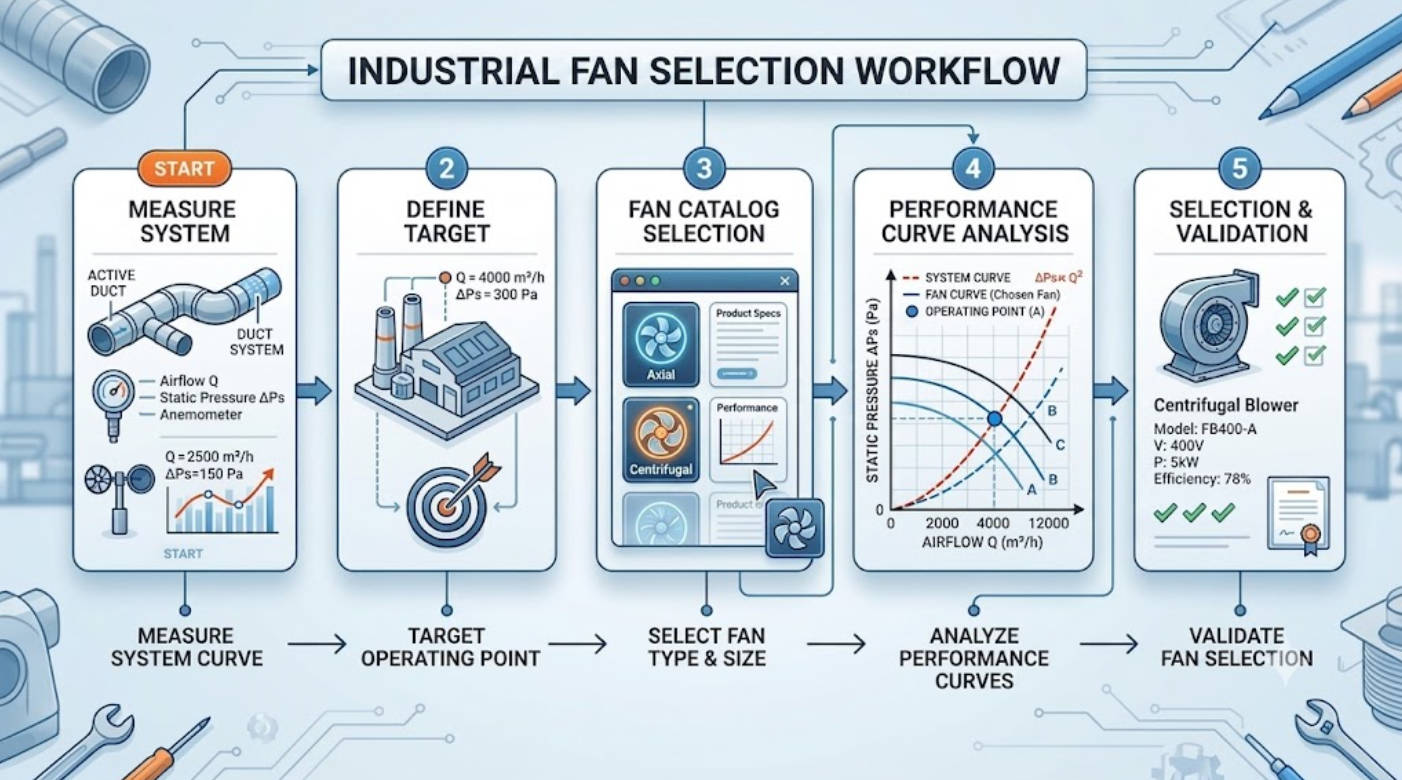
High-density electronics often behave differently from simple ventilation systems. As components get closer together, airflow resistance rises quickly, and an axial fan that looked ideal on paper may lose performance in practice. That is why high-static-pressure designs are increasingly important in servers, telecom racks, and compact control systems.
Recent fan development trends show a clear movement toward stronger pressure performance, higher airflow, lower power use, and longer expected life in demanding environments. For manufacturers serving enterprise hardware, this confirms a simple truth: fan selection is now a system engineering decision, not just a parts decision.
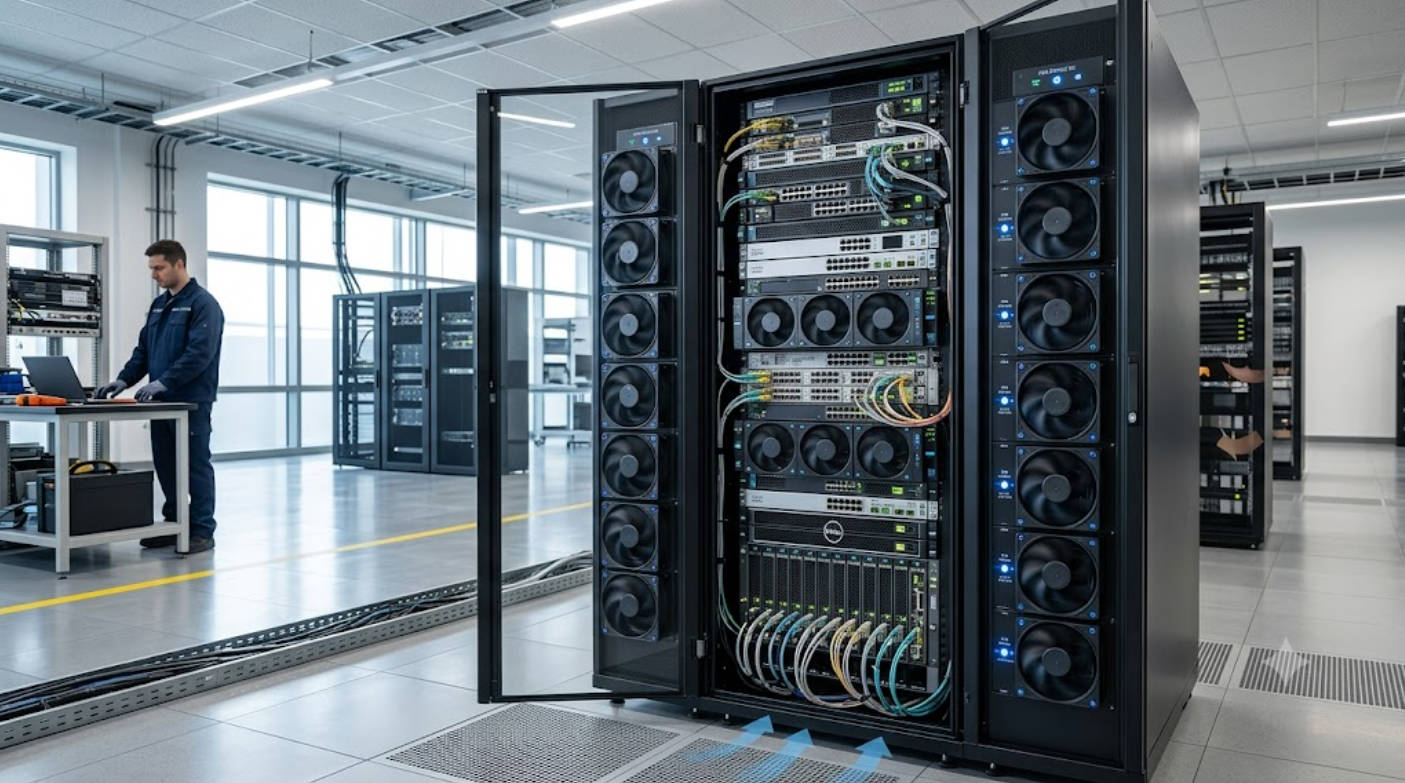
As a source manufacturer of DC fan and AC fan cooling solutions, Capital Technology Co., Limited is positioned to support both standard and demanding cooling scenarios. The company's independent brand CAPITAL and its role as a chief agent for SANYO DENKI strengthen its ability to supply high-performance cooling solutions for customers in telecommunications, industrial equipment, and other demanding sectors.
For B2B buyers, this matters because the right supplier should do more than ship fans. A strong supplier should help with product selection, application matching, reliability expectations, and cooling-system optimization.
The choice between an axial fan and a radial fan depends on the system, not the label. Axial fans are generally better for high airflow in open, low-resistance spaces, while radial fans are better for restrictive environments that demand higher static pressure.
For industrial cooling projects, the most reliable approach is to match the fan curve to the real system curve, then verify performance in the intended installation. That method reduces risk, improves thermal stability, and supports better long-term product performance.
A well-chosen fan is more than a component. It is part of the cooling architecture that supports product reliability, customer satisfaction, and long-term system efficiency.
Axial fans move air parallel to the shaft, while radial fans turn air outward at a 90-degree angle and generate higher pressure.
Axial fans are usually better for high airflow in low-resistance environments.
Radial fans are usually better for high static pressure and restrictive systems.
Not always. Noise depends on speed, system resistance, and installation, but axial fans can become louder at high speed.
Start with the system curve, required airflow, static pressure, noise target, and size constraints, then match the fan curve to the application.
No. Axial fans are often more efficient in low-pressure systems, but the best option depends on the full system design.
1. AMCA. “Straightening Out Fan Curves.” https://www.amca.org/educate/articles-and-technical-papers/amca-inmotion-articles/straightening-out-fan-curves.html
2. QATs. “Performance Differences between Fan Types Used for Electronics Cooling.” https://www.qats.com/cms/2012/06/06/performance-differences-between-fan-types-used-for-electronics-cooling/
3. Sodeca. “Fan airflow and pressure.” https://www.sodeca.com/images/techinfo/Downloads/InformacioTecnica_01_EN.pdf
4. Ventilator.de. “Types of fans simply explained.” https://www.ventilator.de/en/types-of-fans
5. Aerovent. “Fan Performance Characteristics of Centrifugal Fans.” https://www.aerovent.com/wp-content/uploads/sites/2/2021/12/Fan-Performance-Characteristics-of-Centrifugal-Fans-FE-2400.pdf
6. SANYO DENKI. “San Ace | Product Site.” https://products.sanyodenki.com/en/sanace/
7. SANYO DENKI. “92 × 92 × 25 mm ACDC Fan with the Highest Static Pressure in the Industry.” https://www.sanyodenki.com/america/products/product_news/2025/20250526_sanace_92ad_acdc-fan.html
8. SANYO DENKI. “60 × 60 × 38 mm DC Fan with the Highest Static Pressure in the Industry.” https://www.sanyodenki.com/america/products/product_news/2022/sanace_60hva_dc-fan.html
9. SANYO DENKI AMERICA. “Cooling Fan Systems.” https://www.sanyodenki.com/america/products/sanace/index.html


