From idea to market-ready product, our NPI solutions make every stage easier, faster. Discover How We Help
Help Center

Views: 287 Author: Capital Technology Publish Time: 2026-07-18 Origin: Site
Content Menu
● Axial Fan vs Centrifugal Blower – A Practical Engineer's Guide
● What Is a Centrifugal Blower?
● Structural and Performance Differences
● Where Axial Fans Are the Better Choice
● Where Centrifugal Blowers Are the Better Choice
● Axial Fan vs Centrifugal Blower – Practical Selection Framework
● Insights from Industrial Cooling Practice
● Emerging Trends in Cooling Components
● Practical Design Checklist Before Final Selection
● Conclusion – Choosing the Right Cooling Solution
● FAQs – Axial Fan vs Centrifugal Blower
>> Q1: Is an axial fan always the more economical option?
>> Q2: When should a project transition from axial fans to centrifugal blowers?
>> Q3: Can axial fans and centrifugal blowers be combined in one system?
>> Q4: Are centrifugal blowers quieter than axial fans in all situations?
>> Q5: What information should be prepared before selecting a cooling solution?
Choosing between an axial fan and a centrifugal blower is a fundamental design decision that directly shapes airflow performance, noise behavior, space usage, and long‑term reliability. This article approaches the topic from an industrial practitioner's perspective, focusing on telecom, networking, power electronics, and industrial control systems where cooling is mission‑critical.
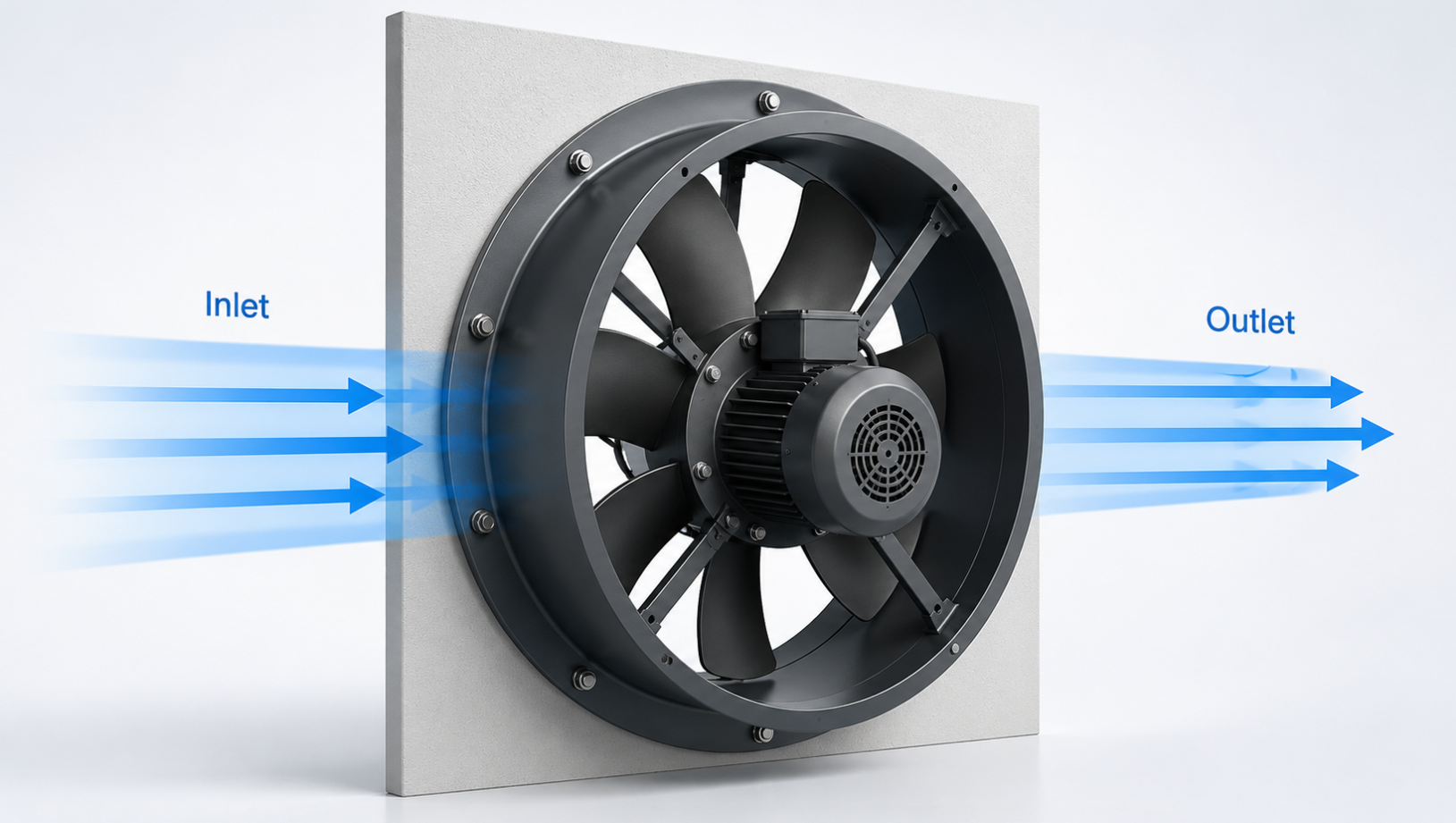
In real projects, axial fans and centrifugal blowers are not just interchangeable air‑moving devices. Each has a distinct operating profile, mechanical structure, and ideal application range. Understanding these differences helps engineers, product managers, and procurement teams specify cooling solutions that match actual constraints such as enclosure space, airflow path, contamination risk, and acceptable noise levels.
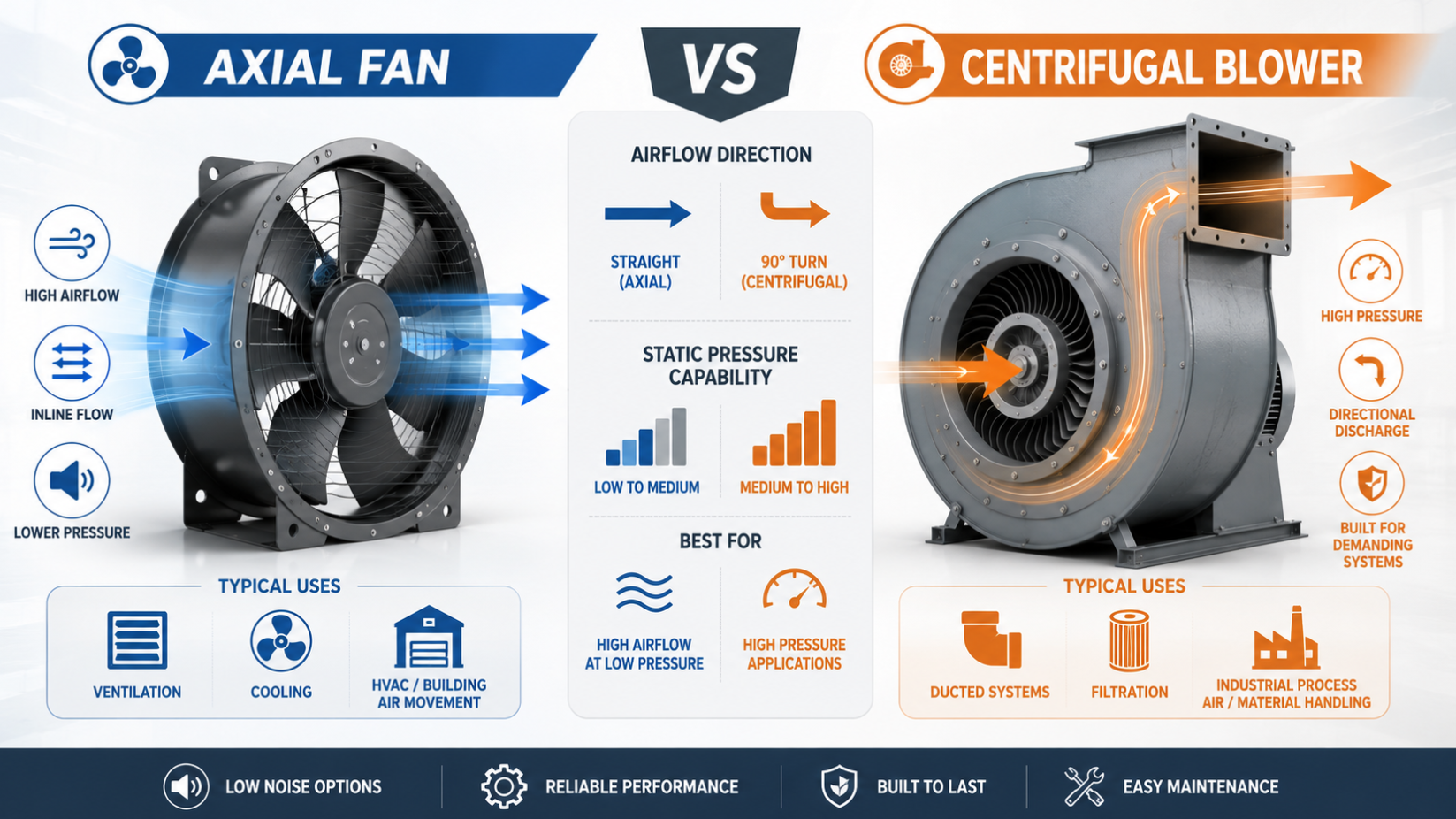
An axial fan moves air in a direction that is essentially parallel to the shaft of the rotating blades. Air enters from one side and exits from the other in a straight line, similar to a propeller. This simple flow path is the main reason axial fans can deliver high airflow volume with relatively low static pressure.
In practice, axial fans are commonly used in:
- Electronic equipment cabinets
- Telecom racks and base stations
- Network switches and storage devices
- General ventilation and condenser units
Because of their compact geometry and relatively light weight, axial fans fit well inside tight enclosures and on densely populated PCBs. They are particularly effective when the airflow path is short and the resistance to airflow—such as grills, filters or heatsinks—is moderate.
A centrifugal blower, often called a centrifugal fan, draws air into the center of a rotating impeller and then discharges it outward at approximately a right angle to the inlet. The change in direction, combined with the impeller design, allows the blower to generate higher static pressure than a typical axial fan.
Centrifugal blowers are widely applied in:
- Ducted ventilation and exhaust systems
- Filtration units and cleanroom equipment
- Combustion air and boiler systems
- Industrial drying and process air applications
Whenever air must travel through long ducts, multiple bends, filters, or restrictive channels, centrifugal blowers maintain airflow more consistently than axial fans. Their performance curves are better suited to systems where resistance changes over time due to filter loading or environmental conditions.

Axial fans excel at delivering large volumes of air across short, relatively open paths. They are often used to move air across heatsinks, through perforated doors, or directly into and out of enclosures. When static pressure rises sharply—for example in heavily ducted systems—axial fans may lose effectiveness, leading to reduced flow and elevated temperatures.
Centrifugal blowers are designed to maintain airflow even when confronted with higher resistance. Their impeller geometry and scroll housings enable higher static pressure, which is essential for overcoming filters, narrow channels, and long ducts. This makes them more suitable for centralized ventilation, exhaust, and situations where air must be routed away from sensitive equipment.
Noise characteristics also differ. Axial fans tend to produce turbulence noise directly along the airflow path. At their design point and properly sized, they can operate quietly, but when pushed beyond their optimal range, noise can increase significantly. Centrifugal blowers, because they are often enclosed in housings and can be located away from occupied spaces, provide more options for acoustic treatment and noise control, especially in systems with high pressure demands.
Axial fans are typically favored when the primary requirement is high airflow in a compact, cost‑effective package. They are the default solution for many electronics cooling scenarios and are widely used in telecom and networking equipment.
Typical situations where axial fans are a strong fit include:
- Front‑to‑rear cooling in telecom racks with perforated doors
- Localized cooling of high‑power components using short air paths
- Condenser or radiator applications where air moves across fin surfaces
- General cabinet ventilation where static pressure is low
Key advantages:
- Compact footprint suitable for tight enclosures
- Simple mechanical integration and mounting
- Lower unit cost for many standard sizes
- High airflow at modest static pressure
For manufacturers with a wide range of DC and AC axial fans, covering different sizes and specifications, designers can select models that align closely with target airflow, noise, and temperature requirements across small devices, standard racks, and large cabinets.
Centrifugal blowers become the preferred option when air must be transported over longer distances or through more complex paths. They are particularly relevant in systems where filters, bends, or restrictive components create substantial resistance.
Typical situations where centrifugal blowers are a strong fit include:
- Ventilation systems with long duct runs and multiple elbows
- Exhaust systems that must route air out of a facility or away from critical equipment
- Filtration units with high‑efficiency filters and dense media
- Industrial process equipment where consistent pressure is crucial
Key advantages:
- Higher static pressure capability to handle complex airflow paths
- Stable performance across varying system resistance
- Flexible discharge configurations via different housing orientations
- Better opportunities for managing noise through enclosures and acoustic treatment
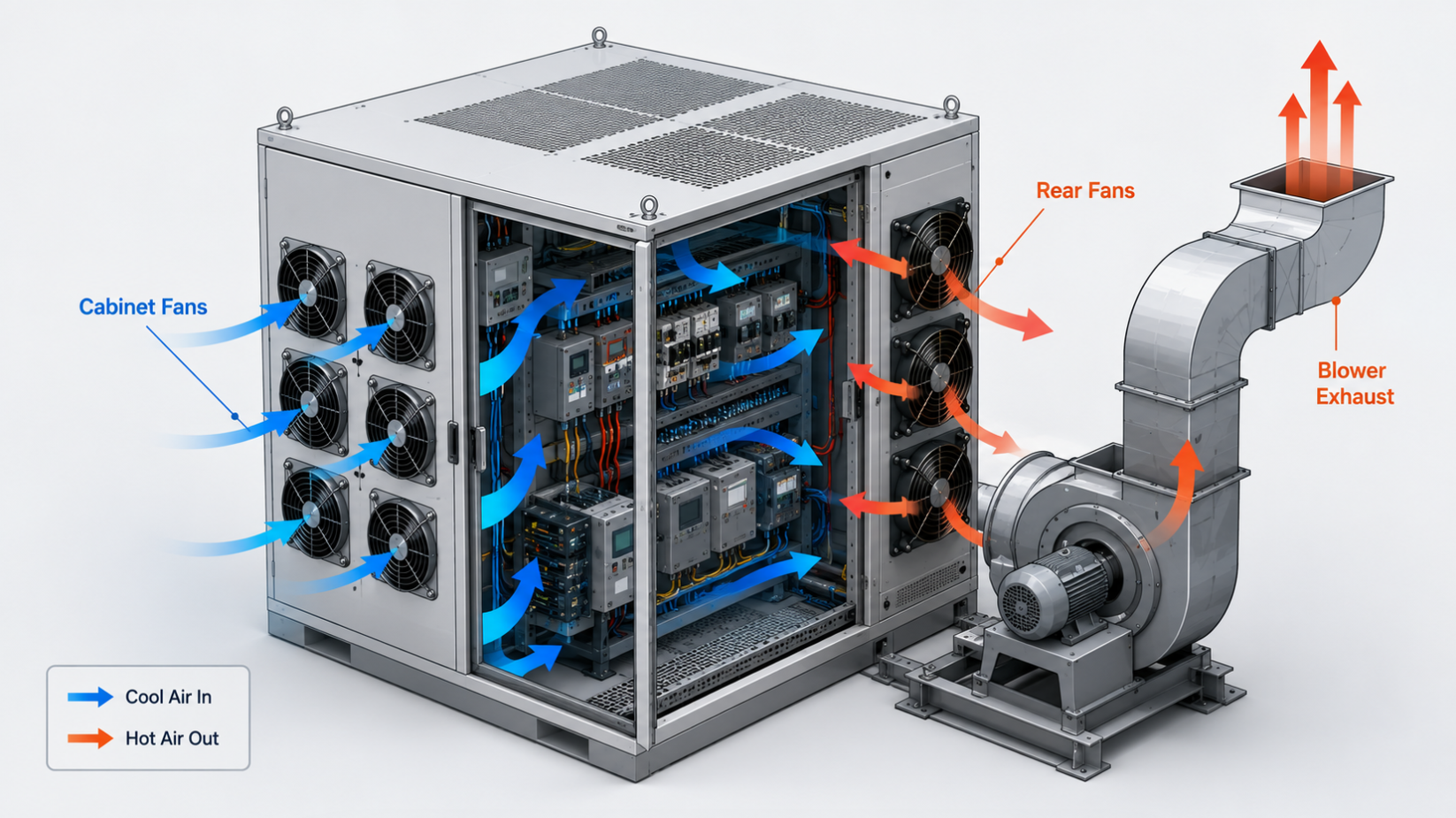
In many industrial and telecom environments, centrifugal blowers are used to handle cabinet‑ or room‑level ventilation, while axial fans manage component‑level cooling inside equipment.
A structured decision process helps non‑specialist teams choose between axial fans and centrifugal blowers based on real system needs:
1. Evaluate static pressure requirements
- Low resistance, short airflow paths and minimal filtration often point toward axial fans.
- High resistance, multiple bends, or dense filters usually require centrifugal blowers.
2. Define airflow volume
- Very high volume at low pressure is typically best served by axial fans.
- Moderate to high volume under significant resistance favors centrifugal blowers.
3. Check available space and layout
- Tight enclosure or PCB space with straightforward intake and exhaust suits axial fans.
- Dedicated modules, ducts, or external housings can accommodate centrifugal blowers.
4. Consider noise and maintenance
- Simple axial fan layouts are easy to maintain and monitor.
- Centralized blower systems may simplify filter replacement and noise management.
Following this approach transforms the choice from a generic catalog decision into a repeatable, application‑driven selection process.
Manufacturers and solution providers that focus on DC fans, AC fans, and comprehensive cooling hardware have accumulated extensive experience across telecom, networking, power electronics, and industrial automation projects.
Some practical observations from such projects include:
- Telecom equipment often uses axial fans inside racks and cabinets, while central ventilation may be based on centrifugal blowers connected to duct systems.
- High‑density power electronics and outdoor installations require wide‑temperature and long‑life fans, sometimes combined with filtered housings and blowers that sustain performance under dust and moisture.
- Engineering teams increasingly rely on measurement tools and controllers to validate airflow, temperature, and noise against design targets, rather than relying solely on nominal data sheet values.
By combining product breadth (DC and AC fans, blowers, filters, radiators, reactors) with application engineering, solution providers help customers avoid mismatches—such as selecting axial fans for systems that actually require higher pressure capability or choosing blowers where simpler axial arrangements would be more efficient.
Recent years have seen several notable trends in the design and application of fans and blowers:
- Growing demand for wide‑temperature and long‑life models for outdoor and high‑reliability applications
- Increasing use of splash‑proof and vibration‑resistant designs for transportation, mining, and heavy industry
- Expansion of integrated fan and controller solutions, allowing speed regulation, status monitoring, and fault signaling
Axial fans are evolving with improved blade profiles, bearing technologies, and compact formats, whereas centrifugal blowers continue to advance in impeller efficiency and housing geometry. Both categories are moving toward higher reliability and smarter integration into modern electronic systems.
Before committing to a specific fan or blower type, design teams can run through a concise checklist:
- Map intake, obstacles, and exhaust to understand the full airflow path.
- Define target operating temperature and worst‑case ambient conditions.
- Assess contamination risks such as dust, moisture, and airborne oils.
- Determine acceptable noise levels for operators and nearby equipment.
- Plan maintenance intervals and access for cleaning or replacement.
This checklist encourages a holistic view of the cooling system. Instead of focusing only on airflow values from data sheets, engineers consider environmental conditions, enclosure limitations, and service strategies.
The decision between an axial fan and a centrifugal blower should reflect the realities of airflow paths, static pressure, space constraints, noise requirements, and maintenance practices. Axial fans provide high airflow in compact, straightforward layouts and are especially effective in electronics cooling with short air paths. Centrifugal blowers offer higher pressure capability and greater flexibility in ducted and filtered systems, making them more suitable for centralized ventilation and complex exhaust networks.
By treating cooling design as an integral part of the overall system—in telecom, networking, power electronics or industrial automation—organizations can achieve stable temperatures, predictable noise performance, and reliable long‑term operation.
Axial fans are often more economical for standard sizes and simple layouts because of their compact structure and lower material use. However, in high‑resistance systems, a centrifugal blower may provide better long‑term value by maintaining performance where axial fans struggle.
A project should consider transitioning when pressure losses from ducts, filters or dense components exceed the typical operating range of available axial fans, or when airflow stability becomes more important than minimal footprint.
They can be combined effectively. A common approach is to use axial fans for direct component or board‑level cooling, while centrifugal blowers handle cabinet, enclosure, or room‑level exhaust through ducts and filters.
Not in all situations, but centrifugal blowers often allow better noise management in high‑pressure systems because they are frequently housed separately and can be acoustically treated. Axial fans can be quiet at their optimal operating point, yet they may become noisier when pushed for higher airflow in open environments.
Design teams should prepare enclosure drawings, target operating temperatures, expected ambient conditions, airflow paths, contamination risks, and preliminary noise limits. With this information, it becomes easier to decide whether axial fans or centrifugal blowers—or a combination of both—will best match the application.
1. Capital Technology Co., Limited – About Us (Product portfolio, manufacturing capabilities, and application experience). https://www.sanyodenki-cn.com/aboutus.html
2. PBMMF – "Centrifugal Blower vs Axial Fan: Key Differences, Applications, and Selection Tips." https://www.pbmmf.com/news/centrifugal-blower-vs-axial-fan.html
3. Cooling Fans – "Centrifugal Blowers vs Axial Fans: Which Is Better for Your Industrial Application?" https://coolingsfans.com/centrifugal-blowers-vs-axial-fans-which-is-better-for-your-industrial-application/
4. AirMover – "Centrifugal vs Axial Fan: Key Differences Explained." https://www.airmover.net/news/industry-news/centrifugal-vs-axial-fan-key-differences-explained.html
5. FY Motors – "Industrial Axial Fans vs Centrifugal Blowers: 40‑Point Technical Comparison." https://www.fy-motors.com/industrial-axial-fans-vs-centrifugal-blowers-40-point-technical-comparison/


