From idea to market-ready product, our NPI solutions make every stage easier, faster.
Discover How We Help
Help Center

Views: 222 Author: Astin Publish Time: 2026-04-18 Origin: Site


Active cooling is no longer just a "component choice" for us at Capital Technology Co., Limited – it is the backbone of reliable 5G, data networking, industrial electronics, and mission‑critical communication systems worldwide. As a DC and AC fan manufacturer and SANYO DENKI's leading agent, I've seen first‑hand how a well‑engineered active cooling strategy can be the difference between stable operation and catastrophic downtime.

Active cooling refers to mechanically driven thermal management systems that use energy (usually electricity) to move air or coolant and actively carry heat away from electronic components. Unlike passive cooling, which relies only on natural convection, radiation, and conduction, active cooling uses devices such as DC axial fans, AC fans, blowers, pumps, and thermoelectric modules to accelerate heat dissipation.
Electronic systems are designed to operate within a strictly defined temperature range; once internal temperatures exceed that range, performance degrades, lifespans shorten, and failure rates rise sharply. For example, an ASHRAE study shows that electronics may lose around 50% of durability for every 10 °C increase above a typical 21 °C baseline operating temperature. In real projects with customers like ZTE, HUAWEI, and HYTERA, we have repeatedly confirmed this pattern in field data and reliability testing.
As devices become more powerful and more compact, power density rises and so does heat flux per unit area. This is obvious in applications like 5G base stations, high‑density servers, small form‑factor power supplies, and compact radio terminals.
Without efficient active cooling:
- Components hit thermal throttling thresholds, reducing CPU, GPU, or FPGA frequency to prevent damage.
- MTBF (mean time between failures) drops, increasing service calls, RMA rates, and total cost of ownership.
- Plastic, solder joints, and electrolytic capacitors age faster at elevated temperatures, causing latent failures over months rather than years.
By integrating optimized DC fans, AC fans, or EC fans into the system design, we keep critical components within their safe temperature window, enabling:
- Stable full‑load performance without sudden slowdowns.
- Longer equipment life and fewer emergency shutdowns.
- Higher reliability in harsh environments (high temperature, dust, humidity) when combined with proper sealing and materials.
Air‑based active cooling is the most widely used thermal solution across electronics, industrial machinery, and automotive systems. It uses axial, radial (centrifugal), or crossflow fans to force air across hot surfaces, increasing convective heat transfer.
Common advantages of air‑based cooling include:

- Cost‑effectiveness for a wide range of applications.
- Simple mechanical design with fewer components and easier maintenance.
- Relatively low energy consumption compared with more complex liquid systems.
A powerful enhancement is to combine heat pipes or vapor chambers with fans: sealed copper tubes or flat plates transfer heat quickly from hot spots to finned heatsinks, where fans remove the heat via forced convection. This architecture is now standard in high‑performance servers, telecom base stations, and industrial controllers.
Liquid cooling uses a circulating coolant (often water with additives like propylene glycol) to absorb heat from components, then passes through a radiator where fans reject the heat to the surrounding air.
Studies published through IEEE have shown that under heavy loads, liquid cooling can reduce operating temperatures by roughly 20–30 °C compared with conventional air cooling in some high‑power systems. This makes it especially attractive for:
- High‑density data center racks.
- Power electronics and drives.
- Industrial robots and high‑power laser equipment.
Key advantages include:
- Superior heat dissipation for very high heat flux.
- Compact system layouts by moving heat away from cramped boards to remote radiators.
Thermoelectric cooling (TEC) uses the Peltier effect to pump heat from one side of a module to the other when current flows. It is ideal when precise temperature control is more important than pure efficiency, such as:
- Medical analyzers and diagnostic instruments.
- Laser diode drivers and optical communication modules.
- Aerospace and defense systems that see extreme ambient conditions.
Main characteristics:
- No moving parts, so minimal mechanical wear and silent operation.
- Compact and easy to integrate in tight spaces.
- Fine temperature control, often combined with PID controllers and temperature sensors.
Passive cooling relies on natural airflow and conduction through heatsinks, chassis design, and component layout, with no mechanical moving parts. It offers excellent inherent reliability, as there are no fans or pumps that can fail, and it works well for low‑power or low‑heat systems.
However, passive methods alone struggle in systems with:
- High power density.
- Limited surface area for large heatsinks.
- Enclosures with restricted natural airflow.
Active cooling, by contrast, uses fans, pumps, or TECs to push heat out more aggressively. This enables:
- Much higher allowable power density.
- More compact mechanical designs.
- Stable operation even under heavy or dynamic loads.
The trade‑offs of active cooling include increased power consumption, acoustic noise, and mechanical failure risk from moving parts. In practice, most modern designs adopt a hybrid approach: a solid passive path (heatsinks, heat spreaders, heat pipes) plus optimized DC/AC fans or blowers to ensure performance and reliability.

From laptops to high‑end gaming PCs and data centers, active cooling is indispensable.
- Gaming systems rely on multiple axial fans and liquid cooling loops to keep CPUs and GPUs within safe temperatures, even when overclocked.
- Data centers consume an estimated 40% of their energy on cooling, according to Uptime Institute, driving innovations such as intelligent airflow management, containment strategies, and immersion cooling.
At the rack level, axial and centrifugal fans maintain airflow through densely packed servers, preventing local hot spots and protecting critical network infrastructure.
In metalworking, high‑speed machining generates intense friction and heat; coolant systems and heavy‑duty fans are deployed to stabilize tool temperature and improve surface finish. In plastics injection molding, precisely controlled mold temperatures ensure consistent part quality and reduce scrap.
Here, our AC and DC axial fans are often integrated into:
- Control cabinets.
- Variable‑frequency drives (VFDs).
- Cooling units for welding and laser systems.
Traditional internal combustion engines rely on radiators, water pumps, and fans as core elements of their active cooling systems. With the rise of electric vehicles (EVs), the focus has shifted to battery thermal management.
Research in the Journal of Power Sources shows that lithium‑ion batteries operated above about 30 °C suffer significantly shortened cycle life. To prevent this, EVs deploy:
- Liquid cooling plates for battery packs.
- High‑reliability DC fans for inverters, onboard chargers, and DC‑DC converters.
Aerospace engines produce enormous heat, where a combination of liquid, air, and advanced fan systems keeps turbine and electronics temperatures under control. Defense applications use active cooling for:
- Radar and communication electronics exposed to desert or arctic conditions.
- Guidance systems that must operate reliably under extreme vibration and temperature swings.
In these environments, high‑reliability DC fans and blowers, often with redundant configurations, are essential for mission safety.
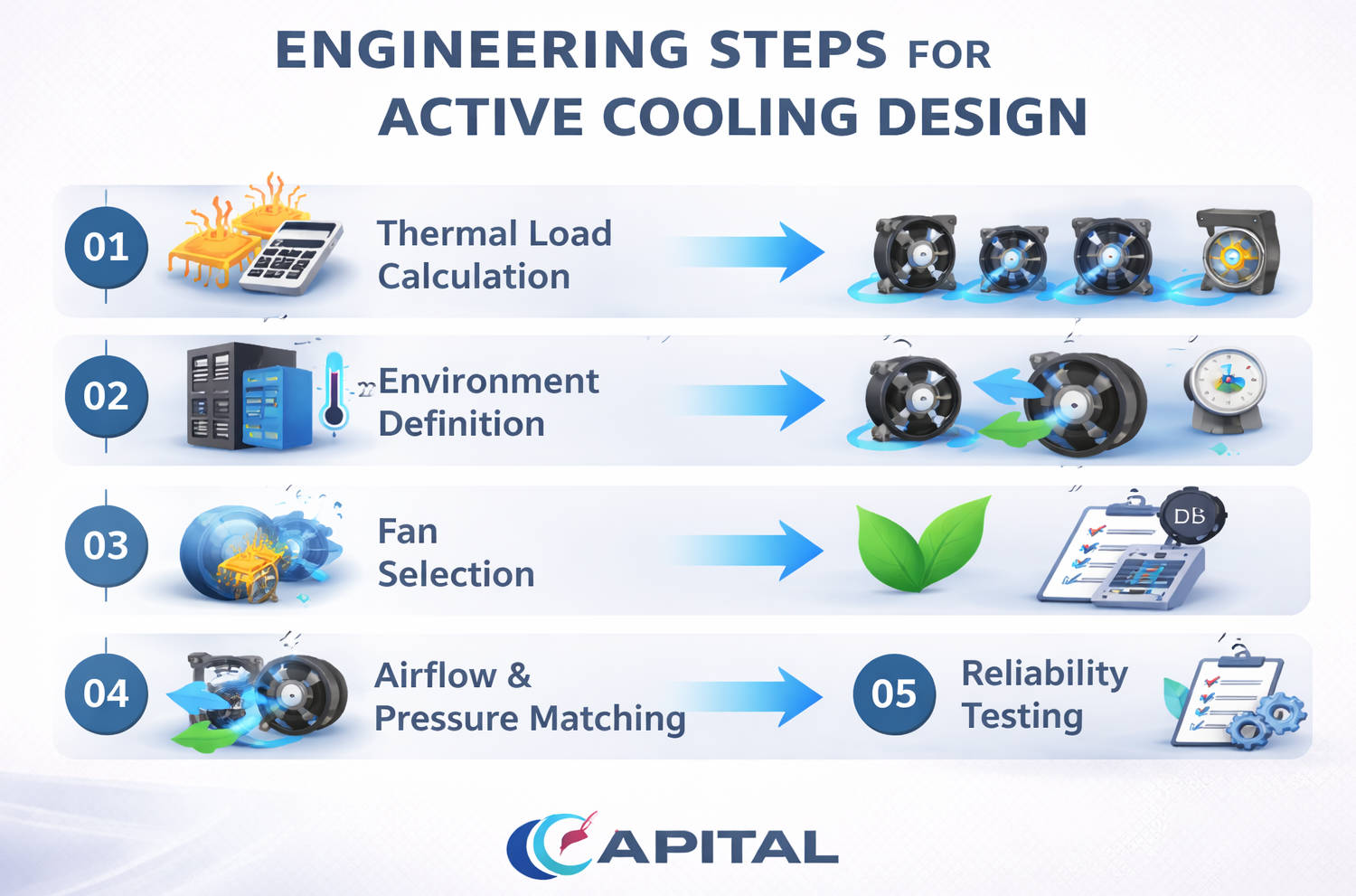
From an engineering and supplier perspective, an effective active cooling design starts with a thorough thermal analysis of the system. This includes identifying heat sources, power dissipation, temperature limits, and airflow paths.
Key factors we focus on with our OEM partners:
1. Thermal load and environment
- Total power dissipation and peak loads.
- Ambient temperature range, altitude, humidity, and contamination (dust, corrosive gases).
2. Cooling method selection
- Air‑based cooling for most electronics and telecom racks.
- Sealed liquid systems in dusty or harsh environments, where airflow through the enclosure is undesirable.
- TECs when precise setpoint control is required.
3. Material and mechanical design
- Use high‑conductivity materials such as aluminum and copper for heatsinks and heat spreaders.
- Optimize fan placement, ducting, and baffle design to avoid dead zones and recirculation.
4. Energy efficiency and noise
- Match fan size, speed, and pressure characteristics to system impedance to avoid overspecification.
- Use low‑noise, high‑efficiency DC fans and intelligent speed control (PWM, temperature‑based control) to reduce power and acoustic output.
5. Reliability and maintainability
- Select long‑life bearings, robust housings, and fans rated for the target environment.
- Consider redundancy (N+1 fans) in mission‑critical equipment.
- Ensure easy access for filter and fan replacement to minimize downtime.
Active cooling is not only an engineering topic; it has direct business implications. Modern enterprises rely on IT, communication infrastructure, and automation systems that must run 24/7.
According to Fortune Business Insights, the global thermal management systems market was valued at USD 56.72 billion in 2023 and is projected to grow to USD 95.64 billion by 2032, reflecting the rising importance of efficient cooling in all industries. In practice, improved cooling can deliver:
- Reduced unplanned downtime and service costs.
- Longer equipment replacement cycles and better asset utilization.
- Energy savings when intelligent, efficient fans and airflow architectures are used.
Some studies show that optimizing cooling and airflow management in facilities can contribute to notable reductions in overall energy expenditure, especially in data centers and large industrial plants.
Choosing the right cooling partner is critical for long‑term performance and reliability. You should look for:
- Customized solutions, not just catalog fans.
- Strong engineering support for thermal and mechanical integration.
- Proven field reliability in your target industries.
- Continuous innovation in materials, motor design, and control electronics. [monsterinsights]
As a manufacturer with our own brand CAPITAL and as a chief agent of SANYO DENKI, we offer:
- A full range of AC axial fans, AC radial fans, DC axial fans, DC radial fans, and EC fans covering multiple sizes, voltages, and airflow/pressure requirements. [sanyodenki]
- ADC‑12 aluminum alloy housings for mechanical strength and heat resistance, plus compliance with RoHS 2.0 environmental standards.
- Multiple invention and utility model patents in fan design and structure, reflecting our ongoing R&D investments in advanced cooling technology.
- Proven supply experience with major telecom and communication companies, ensuring we understand the demands of high‑reliability applications.
For extreme environments, we provide waterproof, dust‑proof, and high‑temperature fan solutions that maintain stable performance where standard fans quickly fail.
From real projects, we recommend a simple, engineer‑friendly process to select the right fan for your active cooling design:
1. Define system constraints
- Target component temperature limits (e.g., 85 °C for power devices).
- Maximum allowable noise level and power budget.
2. Estimate required airflow
- Calculate thermal load and allowable temperature rise to approximate airflow (CFM) needed.
- Use simulation or empirical testing to refine the estimate.
3. Match airflow and pressure
- For open enclosures, axial fans often suffice.
- For high‑resistance paths such as filters or long ducts, radial/centrifugal fans provide better static pressure performance.
4. Consider supply voltage and control options
- Choose between AC fans (simple, robust) and DC or EC fans (better efficiency, controllability).
- Implement PWM or voltage control for adaptive speed and noise reduction.
5. Validate in real conditions
- Test prototypes in worst‑case ambient and load conditions.
- Monitor temperature, vibration, noise, and fan speed over extended periods to verify reliability.
Working closely with a fan manufacturer early in the design stage often reduces redesign cycles and shortens time‑to‑market.
Several trends are reshaping how we design and deploy active cooling systems:
- Higher efficiency EC fans that combine AC input with brushless DC motors, cutting power consumption and enabling intelligent control. [relentless-digital]
- Smart thermal management, where sensors and firmware dynamically adjust fan speeds, pump rates, and airflow routing based on real‑time load and temperatures. [builtrightdigital]
- Integration with system monitoring, so fan status, alarms, and lifetime estimation are exposed to higher‑level management software.
- Sustainability focus, driving designs that reduce energy usage and support longer product lifecycles. [wellows]
For OEMs, partnering with vendors that actively adopt and develop these technologies will become a strategic advantage rather than just a cost factor.
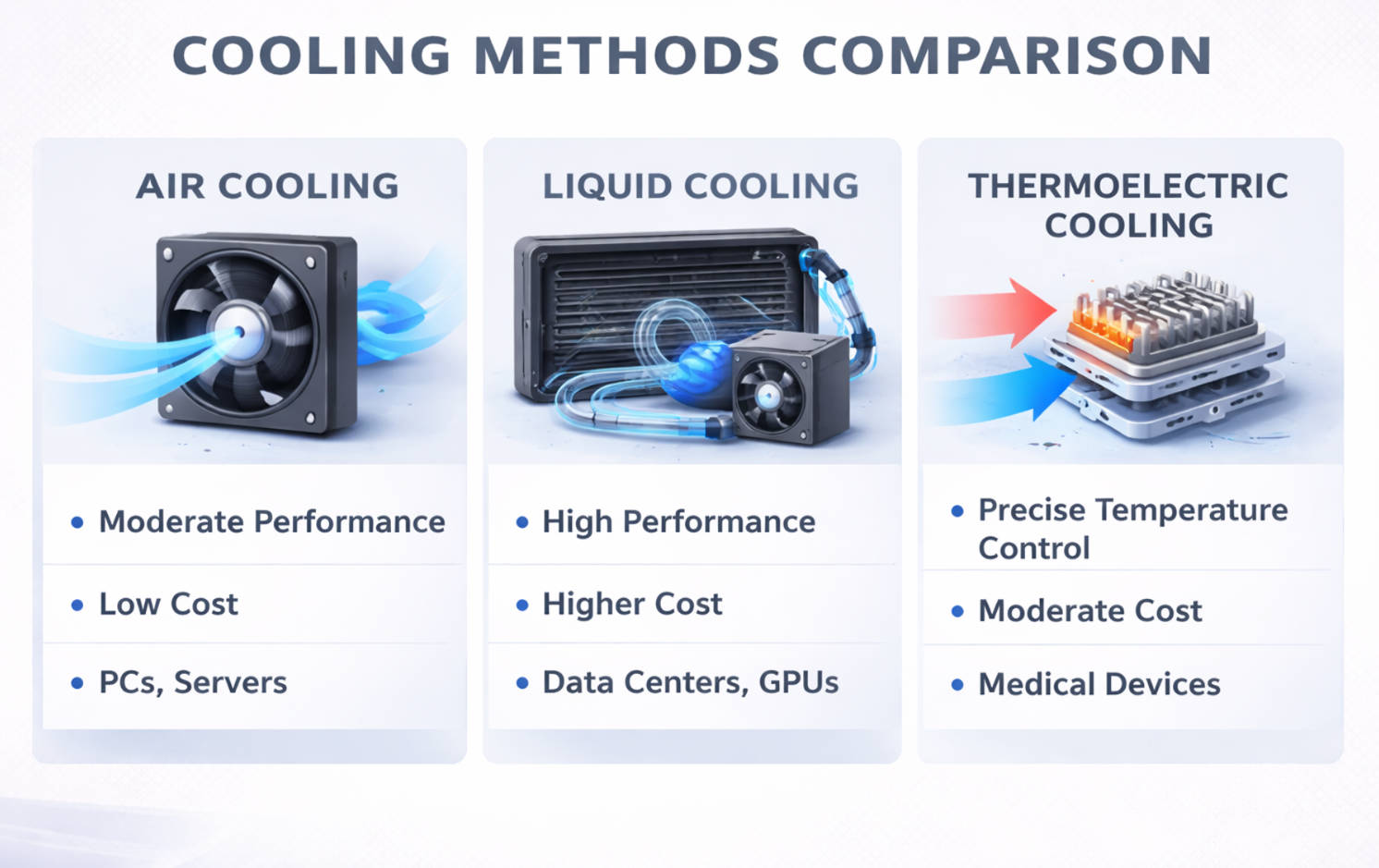
| Cooling Method | Key Features | Main Advantages | Typical Applications |
|---|---|---|---|
| Air‑based (DC/AC fans) | Forced convection using axial, radial, or crossflow fans | Cost‑effective, simple, scalable | Telecom, servers, power supplies, industrial control |
| Liquid cooling | Pumped coolant loop with radiator and fans | Handles very high heat density, compact layouts | Data centers, EV power, industrial robots |
| Thermoelectric (TEC) | Solid‑state Peltier modules | Precise temperature control, no moving parts | Medical devices, lasers, aerospace electronics |
If your project involves telecom, networking, power electronics, industrial control, or mission‑critical communications, your cooling strategy will directly impact performance and lifetime. We can work with your engineering team to:
- Analyze your thermal requirements.
- Recommend the optimal DC/AC/EC fan configuration.
- Provide samples and support for validation testing.
You can reach out to our team at Capital Technology Co., Limited to discuss your active cooling challenges and request a tailored fan solution designed for your real‑world operating conditions. [monsterinsights]
If your device runs at high power density, shows signs of thermal throttling, or fails in high ambient temperatures, active cooling is usually necessary to maintain safe operating temperatures. Passive cooling alone tends to be sufficient only for low‑power or well‑ventilated systems.
DC fans use low‑voltage DC power and usually offer better efficiency, speed control, and lower noise potential, while AC fans run directly from mains voltage and are valued for simplicity and robustness. The choice depends on your system power architecture and control needs. [sanyodenki]
You can reduce noise by selecting larger, slower‑running fans, optimizing airflow paths to reduce turbulence, and using intelligent speed control so fans only ramp up when required. Additionally, acoustic insulation and vibration‑damping mounts can further cut perceived noise.
Not always. While liquid cooling can handle higher heat loads and tight spaces, it brings additional complexity, cost, and maintenance. Well‑designed air‑cooled systems with appropriate DC/AC fans remain the most cost‑effective solution for many telecom, industrial, and IT applications.
Prepare details on power dissipation, target temperatures, ambient conditions, space constraints, noise limits, and available supply voltages. The more accurate your data, the better a specialized fan manufacturer can propose a reliable and efficient active cooling solution.
1. ACDCFAN – "Maximizing Performance with Active Cooling Solutions."
https://www.acdcecfan.com/active-cooling/
2. SANYO DENKI – Technical information on cooling fans (San Ace series).
https://www.sanyodenki.com/global/archive/document/product/servo/San_Ace_technicalinfo_2021.pdf [sanyodenki]
3. Fortune Business Insights – "Thermal Management Market Size and Forecast."
https://www.fortunebusinessinsights.com/thermal-management-market-102293 [servicetitan]
4. MonsterInsights – "How to Optimize for E‑E‑A‑T."
https://www.monsterinsights.com/how-to-optimize-for-e-e-a-t/ [monsterinsights]
5. HubSpot – "Is Your Website EEAT‑Compliant?"
https://blog.hubspot.com/website/eeat-compliance [blog.hubspot]
6. Wellows – "E‑E‑A‑T Checklist for SEO."
https://wellows.com/blog/e-e-a-t-checklist/ [wellows]
7. ServiceTitan – "HVAC SEO Tips."
https://www.servicetitan.com/blog/hvac-seo [servicetitan]
8. Built‑Right Digital – "HVAC SEO Tips for More Customers."
https://builtrightdigital.com/hvac-seo-tips/ [builtrightdigital]
9. Relentless Digital – "HVAC SEO Strategies Guide."
https://www.relentless-digital.com/hvac-seo-strategies-guide-2023 [relentless-digital]
10. LinkedIn – "5 Steps to Writing Engaging Technical Content."
https://www.linkedin.com/pulse/5-steps-writing-engaging-technical-content-daniel-martin [linkedin]


