From idea to market-ready product, our NPI solutions make every stage easier, faster. Discover How We Help
Help Center

Views: 211 Author: Capital Technology Publish Time: 2026-10-22 Origin: Site
Content Menu
● AC Cooling Fan vs DC Cooling Fan: Key Differences
● How AC Cooling Fans and DC Cooling Fans Work
>> AC Cooling Fans: Direct Integration With Mains-Powered Equipment
>> DC Cooling Fans: Electronic Commutation and Flexible Control
● Comparing Cooling Performance, Efficiency, and Noise
>> Airflow and Static Pressure: Compare the Installed Operating Point
>> Energy Efficiency: Compare Equal Cooling Duty
>> Noise: Operating Speed Matters More Than the Label
● Reliability and Environmental Suitability
● A Third Option: AC-Input EC and ACDC Cooling Fans
● Practical Insight 1: Estimate Airflow Before Comparing Products
● Practical Insight 2: Calculate Lifetime Cost With a Transparent Example
● Practical Insight 3: Validate Fan Failure, Not Just Normal Operation
● Which Cooling Fan Is Better for Your Industrial Application?
● Selecting an Industrial Cooling Solution With CAPITAL
>> 1. Is a DC Cooling Fan Always Better Than an AC Cooling Fan?
>> 2. Can I Replace an AC Cooling Fan With a DC Cooling Fan?
>> 3. Which Fan Type Lasts Longer?
>> 4. Do All DC Cooling Fans Support PWM Control?
>> 5. Is an EC Fan the Same as a Conventional AC Fan?
>> 6. What Information Should I Provide for Fan Selection?
Choosing an AC cooling fan vs DC cooling fan is not simply a question of which motor technology is newer. It is a decision about airflow, electrical infrastructure, control requirements, reliability, and lifetime operating cost. A fan that performs well in an open cabinet may struggle behind a restrictive filter or densely packed components.
For most electronically controlled equipment, a DC cooling fan offers greater flexibility through adjustable speed and monitoring options. A conventional AC cooling fan remains a practical choice for straightforward, mains-powered ventilation. AC-input electronically commutated fans provide a third option when direct mains connection and electronic control are both important.
From a manufacturer's perspective, the right choice starts with the equipment's thermal requirements—not the fan's label.
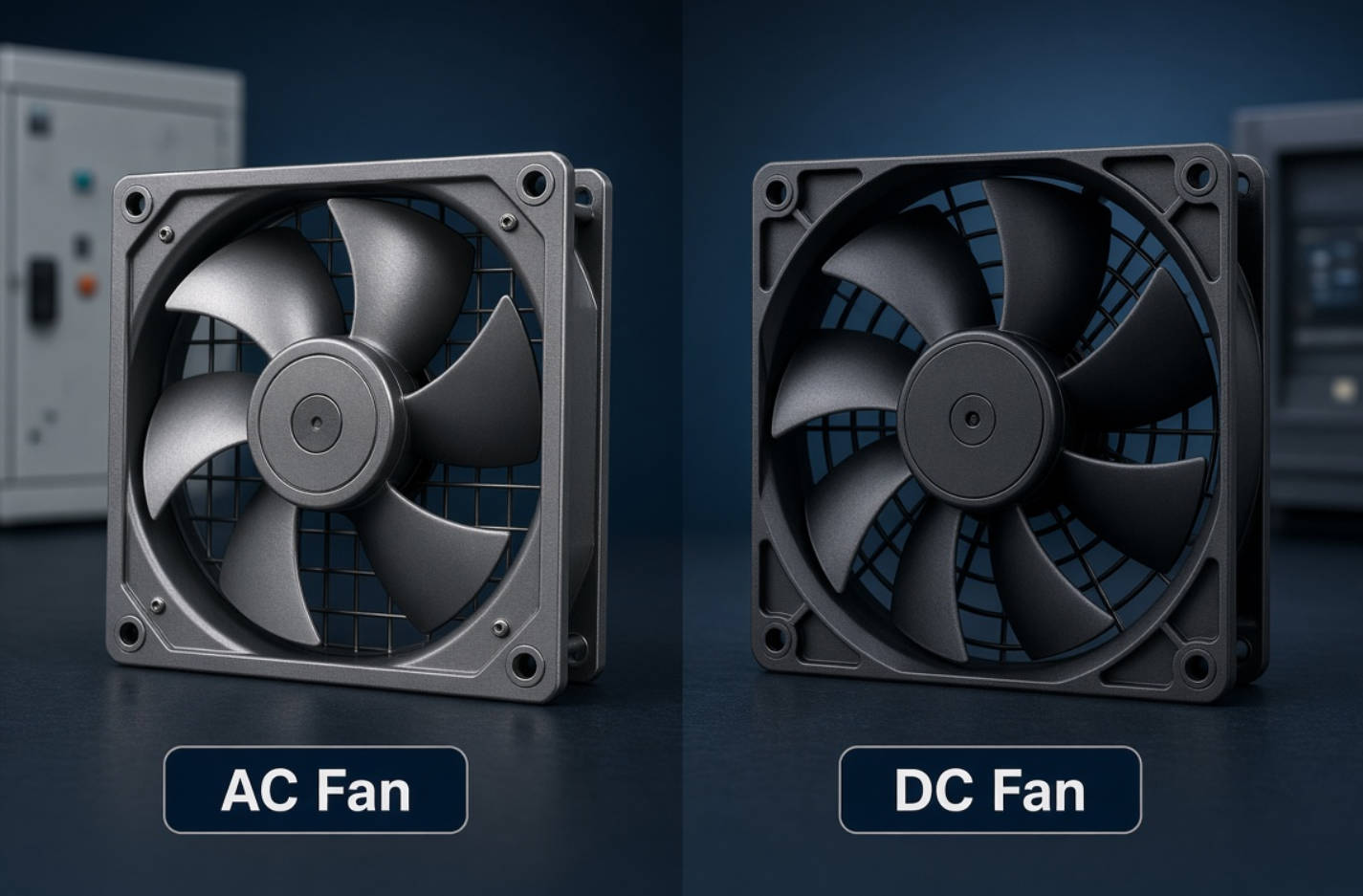
The comparison below distinguishes conventional AC-motor fans from brushless DC fans. An AC-input fan with integrated electronic conversion belongs in a separate category.
| Selection Factor | Conventional AC Cooling Fan | Brushless DC Cooling Fan |
|---|---|---|
| Power input | AC supply matched to rated voltage and frequency | DC supply matched to rated voltage |
| Motor operation | Commonly uses an induction motor | Uses electronic commutation |
| Speed adjustment | Depends on motor design and compatible controller | Often available through PWM or other specified controls |
| Energy consumption | May be less favorable in fixed-speed, oversized applications | Often advantageous with efficient motors and demand-based control |
| Monitoring | Model-dependent alarm options | Tachometer and alarm options are commonly available |
| Integration | Convenient where suitable AC power already exists | Convenient where a suitable DC rail already exists |
| Airflow and pressure | Determined by the specific fan design | Determined by the specific fan design |
| Typical selection priority | Simple ventilation and replacement compatibility | Variable-load cooling and electronic integration |
Neither category automatically wins on noise, service life, or cooling capacity. Those outcomes depend on the selected model and its operating conditions.
Conventional AC cooling fans commonly use induction motors connected to an appropriate AC supply. They suit industrial cabinets and machinery requiring relatively steady ventilation.
Their appeal is straightforward integration. If suitable AC power is available, a separate DC power supply may be unnecessary.
However, check both voltage and frequency. Performance can differ between 50 Hz and 60 Hz operation. Speed control also requires a compatible motor and controller; a generic dimmer is not an acceptable substitute.
Brushless DC cooling fans use electronic circuits to switch current through the motor windings. Industrial models are available for different DC supply voltages, with control and feedback functions depending on the specification.
A PWM input can regulate speed without changing the main supply voltage. A tachometer output can report rotational speed to the equipment controller.
These features make DC fans useful where cooling demand changes with workload. Nevertheless, not every DC fan includes PWM, feedback, reverse-polarity protection, or automatic restart. Confirm each feature individually.
Maximum airflow is usually measured under free-air conditions. Maximum static pressure represents the opposite end of the performance curve, where airflow approaches zero.
Neither figure alone describes cooling inside equipment.
The actual operating point occurs where the fan's pressure–airflow curve intersects the system resistance curve. Filters, grilles, heat sinks, cables, and narrow passages all increase resistance.
For a meaningful comparison:
- Match the enclosure dimensions and airflow path.
- Compare airflow at the required static pressure.
- Check the complete performance curve.
- Validate temperatures after installation.
A high-pressure AC fan can outperform an unsuitable DC fan in a restrictive enclosure. Motor category does not replace aerodynamic selection.
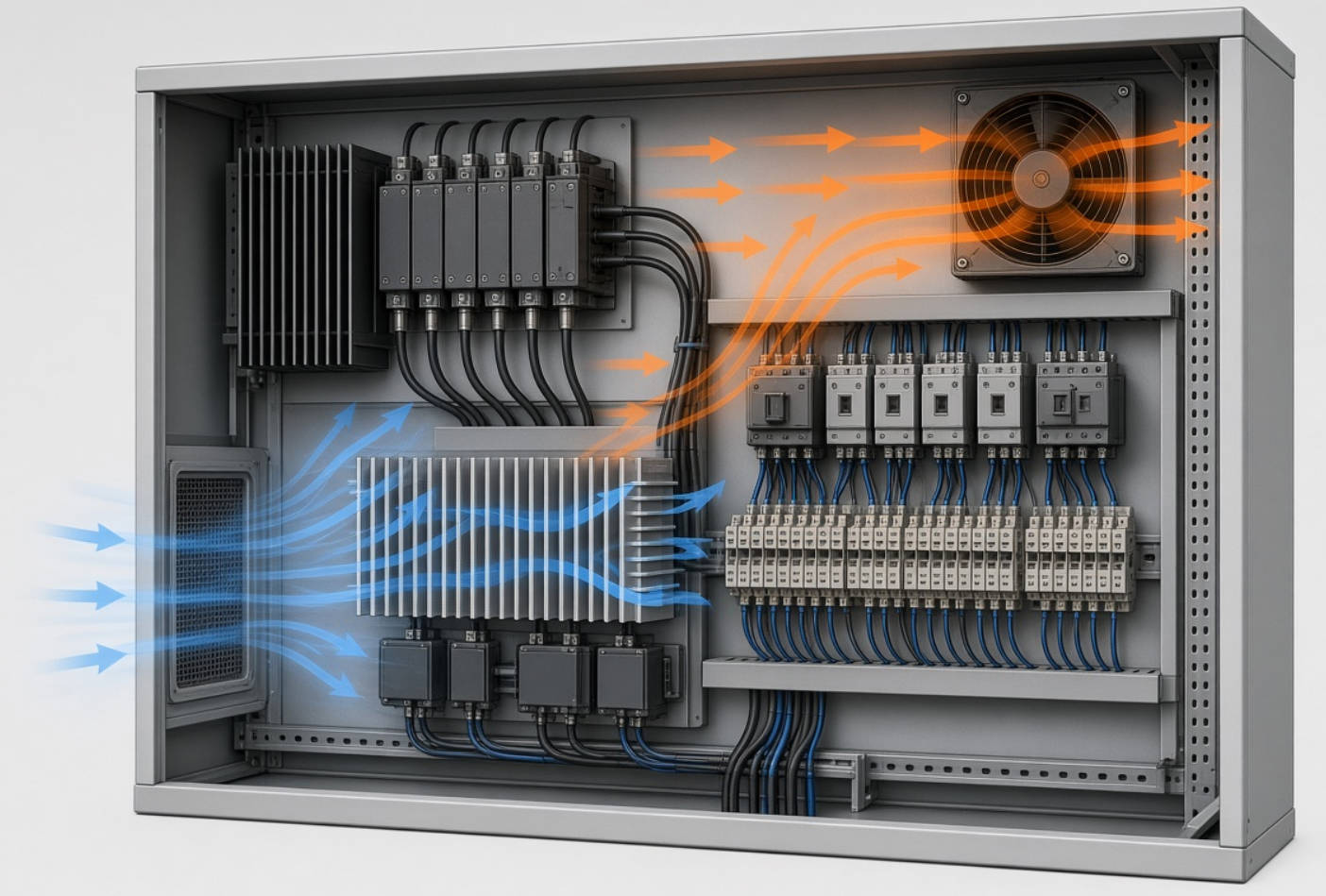
DC fans often provide opportunities to reduce consumption through efficient motor designs and speed control. However, comparing two fans at their maximum speed can produce a misleading result.
The fair question is: how much electrical input does each solution require to deliver the necessary airflow against the same resistance?
Include any external power-supply losses in the comparison. An existing DC rail and a newly installed AC-to-DC supply create different system-level economics.
Avoid applying a manufacturer's best-case percentage saving to every application. Savings depend on the models, control strategy, and operating profile.
A DC fan is not automatically quieter than an AC fan. Blade geometry, rotational speed, turbulence, mounting, and nearby obstructions all influence sound.
Adjustable-speed operation can reduce unnecessary noise during lighter loads. However, a poorly designed inlet can still create objectionable tonal noise.
Compare acoustic specifications under equivalent conditions, then evaluate the assembled equipment. Sound measured from an isolated fan does not fully represent cabinet noise.
A purchasing decision should compare service-life specifications under equivalent temperature and operating conditions.
Bearing design, ambient temperature, contamination, mounting orientation, and electrical stress all matter. Brushless construction does not eliminate bearing wear or protect electronics from every environmental hazard.
For demanding industrial applications, review:
- Operating and storage temperature ranges.
- Bearing type and life-rating conditions.
- Required ingress protection.
- Humidity and condensation exposure.
- Vibration and shock requirements.
- Locked-rotor protection and restart behavior.
- Relevant electrical safety approvals.
A published life figure is not a guaranteed maintenance interval. Ask how it was established and what failure criterion it uses.
For critical equipment, also assess the consequence of fan failure. Monitoring, alarms, redundancy, and safe shutdown behavior may matter more than a modest efficiency improvement.
The AC-versus-DC comparison becomes incomplete when electronically commutated alternatives are ignored.
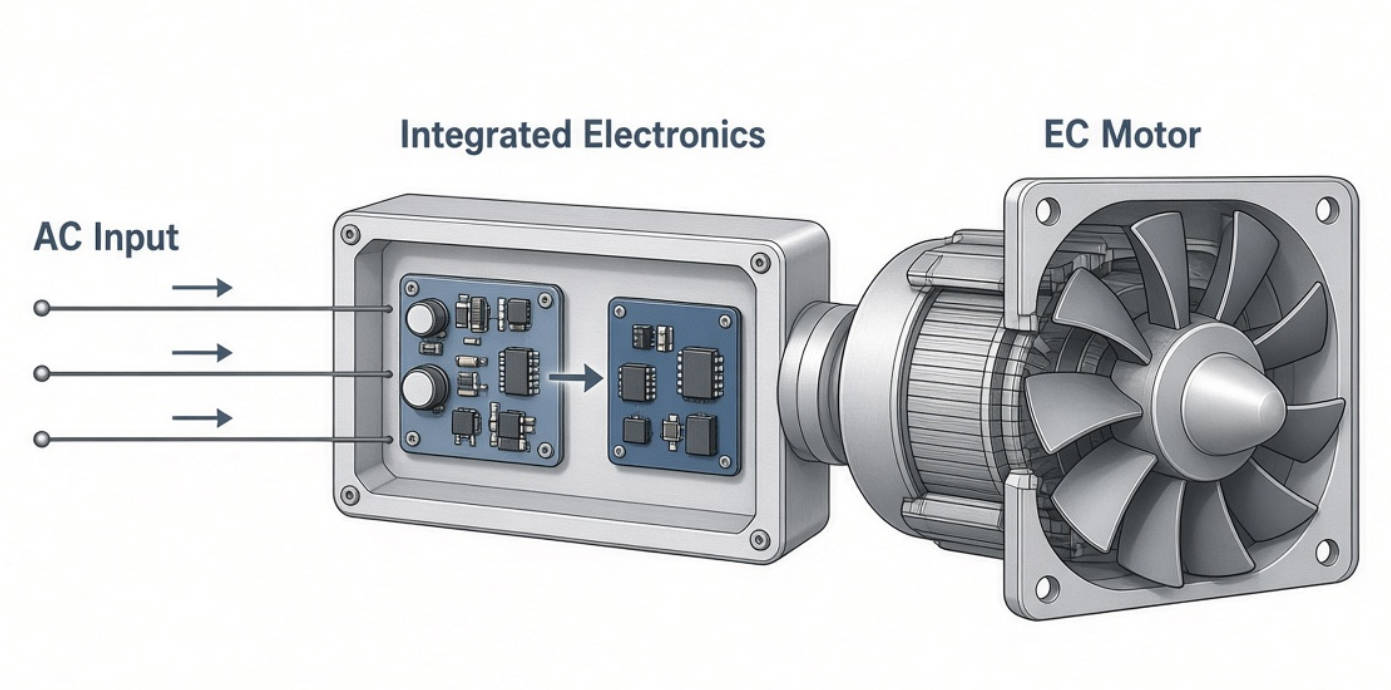
An AC-input EC or ACDC fan incorporates electronics that convert incoming AC power for an electronically commutated motor. This combines mains-powered integration with characteristics associated with brushless DC operation.
Depending on the model, benefits can include:
- PWM speed adjustment.
- Reduced power consumption.
- Speed feedback.
- Stable performance across a specified input range.
SANYO DENKI's San Ace ACDC range demonstrates this approach. Its published 120 × 120 × 25 mm model includes PWM control and pulse-sensor feedback.
For an existing mains-powered cabinet, this architecture deserves consideration before adding a separate DC supply. Check dimensions, electrical connections, control requirements, and approvals rather than assuming a direct replacement.
A useful first-pass heat-balance calculation is:
Airflow (m³/h)≈3.0×Heat load (W)/Permitted air-temperature rise (°C)
This approximation uses typical near-room-temperature air properties and assumes that ventilation carries away the stated heat load.
For example, a cabinet dissipating 500 W with a permitted air-temperature rise of 10°C requires approximately:
3.0×500/10=150 m³/h
This is an illustrative calculation, not a tested equipment result.
It also does not mean that a fan rated at 150 m³/h in free air will be sufficient. The selected fan must deliver the required airflow against actual system resistance.
The calculation estimates bulk air heating, not individual component temperatures. Validate hot spots, recirculation, altitude effects, and the highest expected ambient temperature separately.
Consider two hypothetical solutions that deliver equivalent installed cooling:
| Assumption | Solution A | Solution B |
|---|---|---|
| Total electrical input | 30 W | 12 W |
| Annual operating time | 8,000 hours | 8,000 hours |
| Annual electricity use | 240 kWh | 96 kWh |
| Annual cost at $0.15/kWh | $36.00 | $14.40 |
The annual difference is $21.60 per fan. Across 100 identical installations, that becomes $2,160 annually.
These figures illustrate the calculation only. They are not measured comparisons of CAPITAL or SANYO DENKI products.
For procurement, extend the model to include:
1. Fan purchase price.
2. Additional power supplies and controllers.
3. Installation and qualification costs.
4. Electricity over the intended service period.
5. Maintenance and potential downtime.
A lower-priced fan can become more expensive over time, but an efficiency upgrade does not automatically justify its integration cost.
An industrial cooling design should be tested beyond nominal conditions.
Run the equipment at representative maximum load and highest specified ambient temperature. Then evaluate credible abnormal conditions, such as a progressively restricted filter or a failed fan.
For monitored fans, verify that the controller detects the problem and responds appropriately.
A rotating fan does not necessarily prove adequate airflow. A tachometer can confirm rotation while a blocked filter still prevents effective ventilation.
Where overheating has serious consequences, combine fan feedback with temperature monitoring and a defined protective response. Establish alarm thresholds through equipment testing rather than choosing them arbitrarily.

| Application Situation | Starting Point | Main Qualification |
|---|---|---|
| Simple mains-powered cabinet ventilation | Conventional AC fan | Confirm installed airflow and electrical compatibility |
| Equipment with an existing suitable DC rail | Brushless DC fan | Check rail capacity, startup demand, and control compatibility |
| Variable-load electronics | PWM-controlled DC fan | Validate thermal response and minimum-speed behavior |
| Mains-powered equipment needing variable speed | AC-input EC or ACDC fan | Confirm integrated controls and input specifications |
| Dense or heavily filtered enclosure | High-pressure fan or blower | Select from the operating point, regardless of motor category |
| Critical continuous-duty equipment | Environment-rated, monitored solution | Validate fault response and maintenance requirements |
For replacement projects, preserve essential electrical and mechanical compatibility first. For new designs, compare complete cooling architectures rather than individual fan prices.
Capital Technology Co., Limited supplies DC fans, AC fans, and thermal-management solutions under its CAPITAL brand. The company also identifies itself as a chief agent for SANYO DENKI and a supplier to ZTE, HUAWEI, and HYTERA.
For buyers, the practical value is the ability to discuss both manufacturer-led solutions and established branded alternatives.
Send CAPITAL your heat load, available voltage, installation dimensions, airflow restrictions, ambient conditions, and control requirements. Request a comparison that includes performance curves, electrical input, acoustic specifications, life-rating conditions, and a sample-validation plan.
The goal is not to purchase the strongest fan. It is to specify the most appropriate cooling solution for the equipment's operating conditions.
No. DC fans are often attractive for adjustable-speed electronics, while conventional AC fans can suit steady mains-powered ventilation. Compare installed performance, integration requirements, and lifetime cost.
Yes, if the redesign provides the correct DC supply and satisfies airflow, pressure, mounting, safety, and control requirements. It is not normally a direct electrical substitution.
Neither category guarantees longer life. Compare bearing systems, rated temperatures, environmental protection, and life-test conditions. Operating a suitable fan within its specified limits is essential.
No. PWM control is model-specific. Confirm connector pinout, signal requirements, minimum speed, and behavior when the control signal is absent before connecting the fan.
No. An AC-input EC fan uses integrated electronics and electronic commutation. It accepts AC power but differs from a conventional AC induction-motor fan.
Provide heat dissipation, ambient temperature, permitted temperature rise, supply voltage, mounting space, airflow resistance, noise limits, environmental conditions, and monitoring needs. Existing temperature measurements are also valuable.
1. Oriental Motor. "How to Select a Cooling Fan." Selection methodology covering heat generation, airflow requirements, and installed pressure losses. [View technical guide]. [orientalmotor]
2. Oriental Motor. "Fan Basics: Air Flow, Static Pressure, and Impedance." Explanation of fan curves, system resistance, and operating points. [View technical article]. [blog.orientalmotor]
3. SANYO DENKI. "Features of ACDC Fans (EC Fans)." Technical explanation of integrated conversion, speed control, and model-dependent performance benefits. [View technical article]. [techcompass.sanyodenki]
4. SANYO DENKI. "120 × 120 × 25 mm ACDC Fan with the Highest Static Pressure in the Industry." Product specifications and PWM/pulse-sensor functions; the article does not generalize the product announcement's comparative claim. [View product announcement]. [sanyodenki]
5. Oriental Motor. "Cooling Fans—Thermal Management." Axial, centrifugal, and cross-flow fan application guidance. [View product and application overview]. [orientalmotor]
6. ebm-papst. "Motors—Basic Principles." Technical background on induction and electronically commutated motor operation. [View technical document]. [ebmpapst]


