From idea to market-ready product, our NPI solutions make every stage easier, faster. Discover How We Help
Help Center

Views: 298 Author: Capital Technology Publish Time: 2026-07-04 Origin: Site
Content Menu
● What Do We Mean by "AC Fan" and "Other Cooling Methods"?
● AC Fans vs. DC Fans: Control, Efficiency, and Lifetime Value
● AC Fans vs Passive Cooling: When Airflow Becomes Non‑Negotiable
● AC Fans vs Liquid Cooling: Cost, Complexity, and Risk Management
>> Trade‑offs you cannot ignore
● AC Fans in Hybrid Cooling Architectures
● Why AC Fans Still Matter in 2026 Electronics Cooling
● How OEMs Should Decide Between AC Fans and Other Cooling Methods
>> Step‑by‑step evaluation framework
● 2026 Trends Shaping AC Fan and Cooling Method Choices
● How to Select the Right Cooling Method for Your Next Project
● Key Comparison Table: AC Fans vs Other Cooling Methods
● Where AC Fans Fit in Capital Technology's Cooling Ecosystem
● FAQ
>> FAQ 1: How do I decide between AC and DC fans for my application?
>> FAQ 2: Can AC fans be combined with passive cooling to avoid liquid systems?
>> FAQ 3: Are AC fans efficient enough for modern high‑density electronics?
>> FAQ 4: How does working with Capital Technology add value beyond buying fans off‑the‑shelf?
>> FAQ 5: What long‑term trends should I consider when choosing a cooling method in 2026?
From the perspective of a thermal management specialist working with OEMs and telecom brands, AC fans remain one of the most practical and cost‑effective cooling solutions for many electronic systems—but they are no longer the only choice on the table. When we compare AC fans with other mainstream cooling methods—DC fans, liquid cooling, heat pipes, passive heatsinks, and hybrid solutions—the right decision depends on load profile, lifetime cost, safety, and integration with your existing design and supply chain. [longwellfans]
AC fans are electric fans powered directly by alternating current, typically at mains voltage, and used to move air through or across electronic equipment, cabinets, or industrial enclosures. They are widely adopted in telecom, industrial power, data communication, and LED systems because of their robust construction and simple drive electronics. [en.szcpt]
"Other cooling methods" in electronics usually include: [electronics-cooling]
- DC fans and blowers driven by low‑voltage DC (often via PWM control).
- Passive cooling: heatsinks, natural convection, thermal interface materials.
- Heat pipes and vapor chambers for spreading heat.
- Liquid cooling (closed‑loop or open‑loop).
- Hybrid systems combining forced air with liquid, phase‑change, or advanced materials.
In practice, engineers often combine AC fans with these technologies to hit thermal, cost, and reliability targets instead of choosing only one. [wjarr]
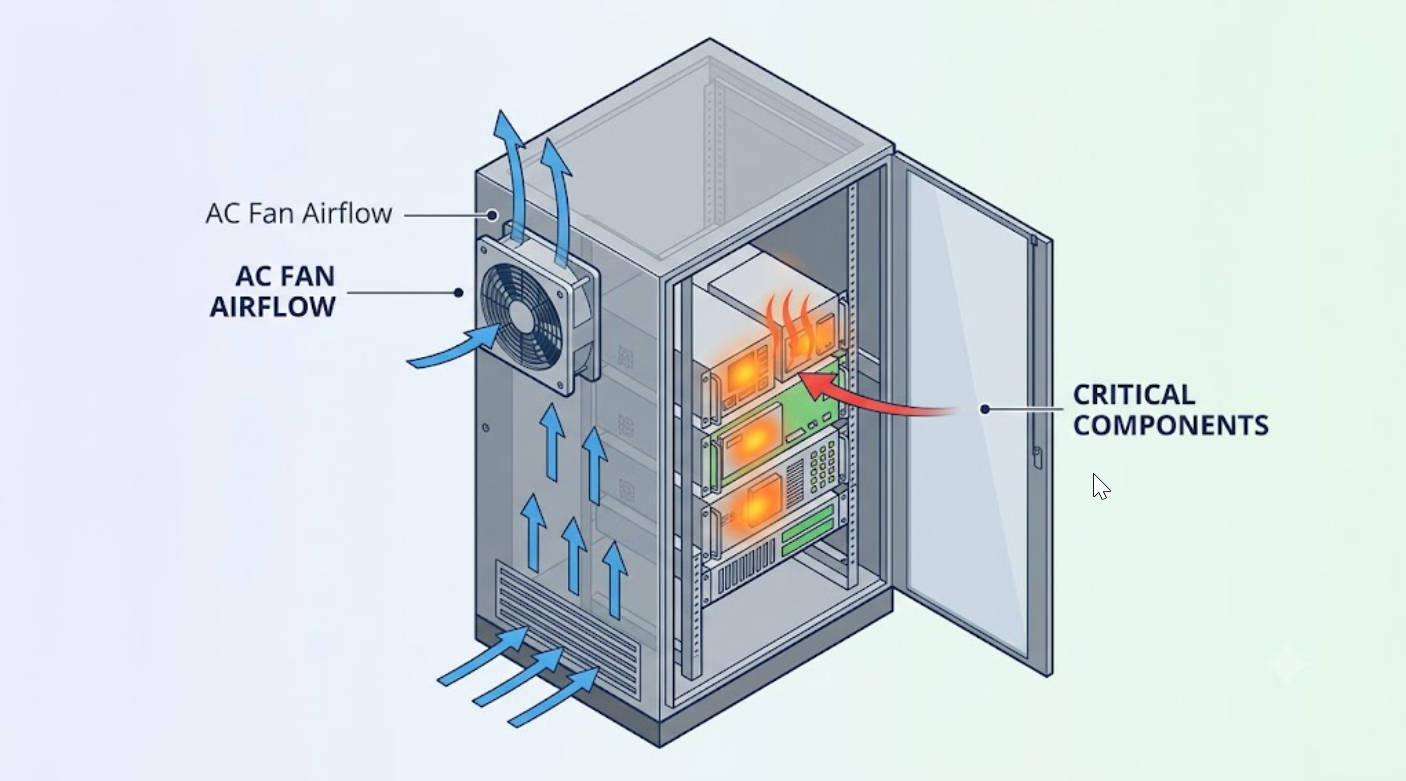
In real projects with telecom base stations, power supplies, and industrial controllers, the first comparison is usually AC fan vs. DC fan. [electronics-cooling]
- Power and drive
- AC fans: Direct mains input, simple circuitry, no external driver needed. [longwellfans]
- DC fans: Low‑voltage input (typically 12/24/48 V) plus control electronics (PWM, tach signals). [electronics-cooling]
- Speed control and noise
- AC fans: Historically fixed‑speed, though modern models can support multi‑speed or external control via transformers and controllers. [longwellfans]
- DC fans: Fine‑grained speed control, enabling dynamic thermal management and lower acoustics at partial load. [electronics.alibaba]
- Efficiency and system integration
- AC fans: Highly robust and suitable for high‑voltage environments; efficiency depends on motor design and application. [electronics-cooling]
- DC fans: Often more efficient at variable load, especially where firmware can respond to sensor data. [electronics.alibaba]
For OEMs and EMS providers, the choice is rarely "better or worse" but system‑level trade‑off:
- Use AC fans when you need simple, mains‑powered, long‑life airflow in cabinets, telecom racks, or industrial gear, and where electronics for control should stay minimal.
- Use DC fans when thermal loads change sharply and you need embedded smart control, lower noise, and integrated monitoring (tach output, alarms).
Capital Technology, as a chief agent of SANYO DENKI and an independent manufacturer, can supply both AC and DC fan solutions while staying within the same quality ecosystem, which simplifies qualification and long‑term sourcing for enterprises like ZTE, HUAWEI, and HYTERA. [made-in-china]
Passive cooling—heatsinks and natural convection—is attractive because it is silent, highly reliable, and has no moving parts. But modern high‑density electronics often exceed what passive methods can safely dissipate. [wjarr]
- Thermal performance
- Passive systems rely on natural convection and radiation, which are limited at high power density. [electronics-cooling]
- AC fans actively move air, dramatically increasing convective heat transfer, especially around complex geometries. [electronics-cooling]
- Reliability vs. risk
- Passive designs avoid mechanical failure but can be margin‑constrained; a change in ambient temperature or dust accumulation can push components beyond safe junction temperatures. [wjarr]
- AC fans add a moving part but create thermal headroom, enabling safer operation of power electronics and RF modules under varying load and environment. [electronics-cooling]
In real industrial deployments, AC fans are often the line between "theoretical safe" and "actually safe". Engineers start with the best passive layout they can design, then add an AC fan to ensure the system still performs under worst‑case ambient temperatures, dust, and load variations. [electronics-cooling]
Liquid cooling—via cold plates, pumps, and heat exchangers—can provide exceptional thermal performance and is increasingly used in high‑power applications such as EV inverters, data centers, and power electronics. However, it introduces complexity and risk that many industrial OEMs prefer to avoid unless absolutely necessary. [electronics.alibaba]
- Performance
- Liquid cooling offers superior heat removal at high flux levels, enabling very compact, high‑power designs. [wjarr]
- AC fans provide sufficient performance for a wide range of telecom, industrial, and communication products at a far lower complexity level. [en.szcpt]
- System risk and maintenance
- Liquid systems require pumps, seals, fluids, and filtration; leaks, contamination, and pump failures can be catastrophic. [electronics-cooling]
- AC fans, especially from mature brands like SANYO DENKI, are proven across decades, and their failure modes are relatively simple to detect and mitigate. [en.szcpt]
- Lifecycle cost
- Liquid cooling often forces higher CapEx and OpEx, including maintenance and specialized service procedures. [wjarr]
- AC fans offer low installed cost, short lead times, and easier field replacement—critical for large fleets of telecom cabinets or industrial controls. [made-in-china]
For most industrial and telecom projects, the best‑value choice is optimized forced air, usually based on AC or DC fans, with liquid cooling reserved for extreme power density or special environments. [electronics-cooling]
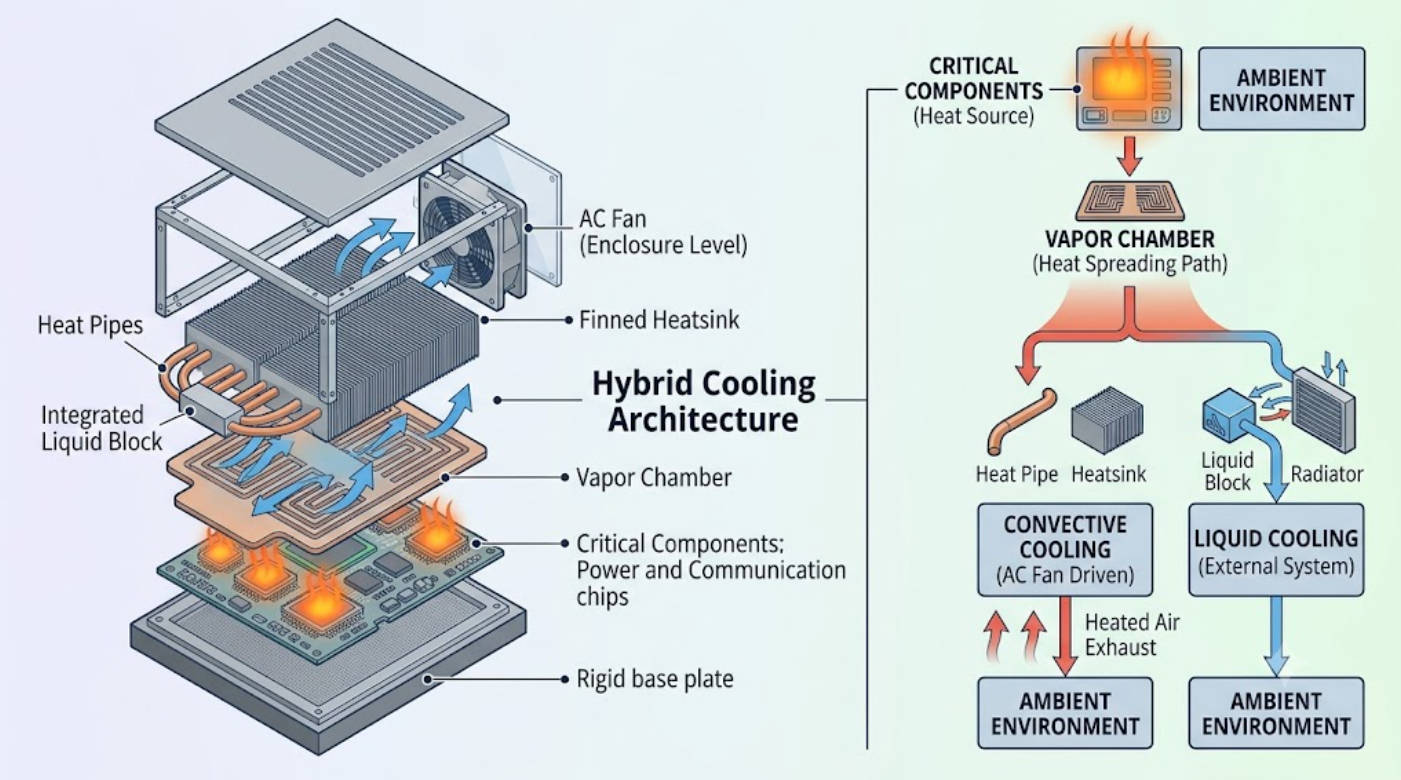
Modern electronics increasingly employ hybrid cooling architectures—combining airflow with heat pipes, vapor chambers, or localized liquid cooling. [electronics-cooling]
In these systems:
- AC fans often act as the air mover for the entire enclosure or cabinet.
- Heat pipes and vapor chambers spread heat from hotspots to finned surfaces where the AC fan can effectively evacuate it. [electronics-cooling]
- Sensors and control logic may still rely on DC fans at the board level, while AC fans handle cabinet airflow.
This layered approach allows OEMs to match cooling sophistication to risk: high‑risk modules get advanced cooling, while the rest of the system relies on trusted AC fans for stable operation. [wjarr]
Recent industry reviews on sustainable cooling and advanced power electronics emphasize three strategic priorities: energy efficiency, reliability, and sustainability. In that context, AC fans remain relevant for several reasons: [electronics.alibaba]
- Proven reliability across telecom, industrial, and communication systems. [en.szcpt]
- Compatibility with existing infrastructure and standards (racks, cabinets, mains power). [longwellfans]
- Scalability from single units to large fleets of deployed equipment, with consistent performance. [made-in-china]
- Integration with high‑quality brands like SANYO DENKI, backed by nearly a century of motor and cooling experience. [en.szcpt]
When combined with thoughtful mechanical design and monitoring, AC fans remain a core building block in modern thermal management strategies rather than a legacy option. [electronics-cooling]
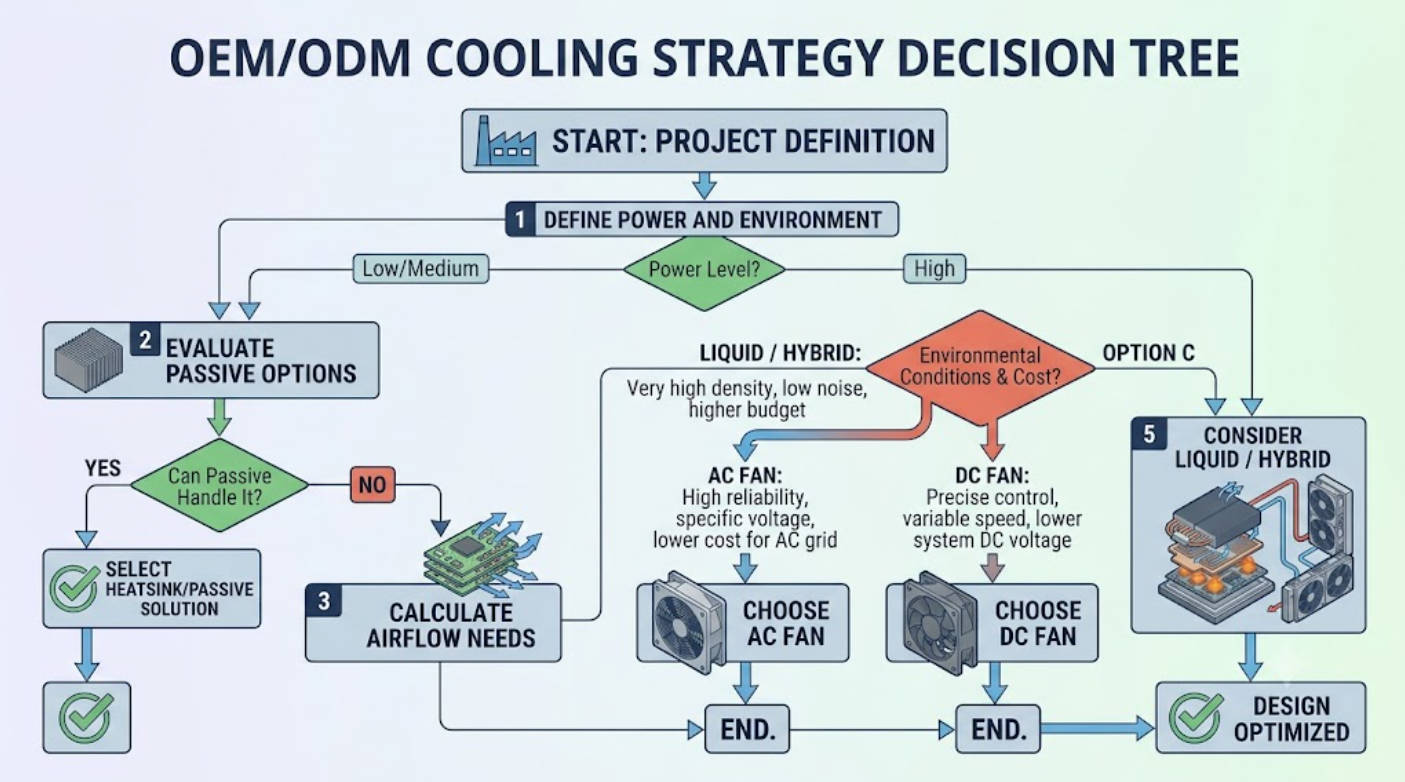
From an OEM/ODM decision‑making perspective, the question is not "AC fan or other cooling methods?" but "Which mix of solutions gives the safest thermal margin at the lowest lifecycle cost?".
1. Quantify thermal load and environment
- Define maximum power dissipation, ambient temperature range, installation altitude, and dust/humidity exposure. [wjarr]
2. Model passive capability first
- Evaluate what passive heatsinks, layout optimization, and materials can achieve without forced air. [electronics-cooling]
3. Size airflow requirements
- Use CFD or empirical calculations to determine the airflow needed to keep junction temperatures below targets. [electronics-cooling]
4. Compare AC vs DC fans vs liquid options
- AC fans: Choose when simplicity, mains compatibility, and robustness are primary. [longwellfans]
- DC fans: Choose for dynamic control, integrated monitoring, and noise optimization. [electronics.alibaba]
- Liquid/hybrid: Choose for very high heat flux or where size constraints make air cooling impractical. [electronics-cooling]
5. Validate with prototypes and long‑term tests
- Long‑duration thermal cycling and accelerated life tests are crucial to confirm that your chosen method behaves as expected in the field. [wjarr]
Capital Technology's engineers apply this framework when tailoring cooling solutions for customers like ZTE, HUAWEI, and HYTERA, ensuring that AC fans are evaluated alongside other techniques rather than in isolation. [made-in-china]
Recent market guides and academic reviews highlight several 2026 trends that directly influence the AC‑fan vs. other‑methods decision. [electronics.alibaba]
- Higher power density in compact enclosures
- Devices are smaller but hotter, pushing passive solutions to their limits and increasing the need for high‑quality forced air. [electronics.alibaba]
- Sustainability and energy efficiency
- Customers demand lower energy consumption and more recyclable designs, which encourages both high‑efficiency fan motors and smarter control strategies. [electronics.alibaba]
- Integrated cooling solutions
- Cooling is now part of the system architecture from the outset, not an afterthought; AC fans are planned together with PCB layout, enclosure design, and service strategy. [electronics.alibaba]
- Digital monitoring and predictive maintenance
- Even traditional AC fan deployments are increasingly paired with sensors and condition monitoring to predict failures and minimize downtime. [electronics-cooling]
For manufacturers and brands, working with partners like Capital Technology—who can supply both CAPITAL‑branded fans and SANYO DENKI solutions—helps align cooling choices with these evolving trends. [made-in-china]
When planning a new design, engineers should walk through a practical selection checklist:
- Define critical components and their maximum junction temperatures.
- Map airflow paths and identify potential recirculation or dead zones. [electronics-cooling]
- Assess noise constraints (office environment vs. outdoor installation).
- Evaluate service access: Can fans be replaced easily? Can liquid systems be serviced safely?
- Consider supply chain reliability, especially for high‑volume deployments. [electronics.alibaba]
Working with an experienced cooling partner, you can benchmark several options—pure AC fan, AC+heat pipe, DC fan with PWM, or liquid cooling—against the same thermal and economic criteria. [wjarr]

| Cooling method | Typical use case | Strengths | Limitations |
|---|---|---|---|
| AC fan | Cabinets, telecom, industrial gear | Simple, robust, mains‑compatible, proven. en.szcpt | Less granular control, mechanical wear. longwellfans |
| DC fan | Smart electronics, variable loads | Precise control, lower noise at part load. electronics-cooling | Needs control electronics, more design effort. electronics-cooling |
| Passive heatsink | Low–medium power, silent systems | No moving parts, high reliability. electronics-cooling | Limited in high‑density applications. electronics-cooling |
| Heat pipe/vapor chamber | Hotspots in compact devices | Excellent heat spreading. electronics-cooling | Needs airflow or secondary cooling. electronics-cooling |
| Liquid cooling | Very high power density, data centers | Superior thermal performance. electronics-cooling | Complex, higher cost, leak risk. electronics-cooling |
| Hybrid (air + advanced) | High‑reliability, high‑power systems | Balanced performance and risk. electronics-cooling | Design complexity, qualification effort. electronics-cooling |
Capital Technology Co., Limited is both an independent CAPITAL brand manufacturer and the chief agent of SANYO DENKI, a leader in the global cooling fan industry. This positioning allows Capital to offer: [en.szcpt]
- AC and DC fans tailored for telecom, industrial, and communication markets. [made-in-china]
- Custom cooling solutions that integrate fans with radiators, filters, and other thermal components. [en.szcpt]
- Engineering support grounded in more than ten years of cooling solution experience and SANYO DENKI's nearly hundred‑year brand heritage. [en.szcpt]
By evaluating AC fans alongside other cooling methods, Capital helps customers build cost‑effective, reliable, and future‑proof thermal designs rather than defaulting to any single technology. [en.szcpt]
If you are designing or upgrading a telecom cabinet, industrial controller, or communication system, and need to balance performance, cost, and reliability, partnering with a specialist cooling manufacturer is critical. Capital Technology can help you evaluate whether AC fans, DC fans, or hybrid solutions best fit your project, and provide qualified products directly from its CAPITAL line and SANYO DENKI's portfolio. [made-in-china]
To discuss a specific project requirement or request a custom cooling proposal, contact Capital Technology's engineering team and share your power, environment, and form‑factor constraints so they can recommend the most robust thermal strategy for your system. [made-in-china]
AC fans are ideal when you need straightforward, mains‑powered airflow and want to keep control electronics simple. DC fans are a better choice when you require precise speed control, lower noise at partial load, and integration with digital monitoring. [longwellfans]
Yes. Many industrial and telecom systems use optimized heatsinks and layout plus AC fans to achieve safe temperature margins, avoiding the complexity and maintenance demands of liquid cooling. [electronics-cooling]
For a large segment of power electronics, telecom, and communication equipment, high‑quality AC fans provide sufficient efficiency and thermal performance, especially when sized correctly and combined with good mechanical design. For extreme densities, hybrid or liquid solutions may be required. [electronics.alibaba]
Capital Technology combines manufacturing capability, SANYO DENKI agency status, and engineering experience, allowing it to deliver tailored solutions—rather than just individual fan models—for demanding customers like ZTE, HUAWEI, and HYTERA. [made-in-china]
Key trends include rising power density, stronger sustainability requirements, and increasing use of integrated cooling solutions and predictive maintenance. Choosing AC fans or other methods today should align with these trends to ensure your design remains viable over its full lifecycle. [electronics.alibaba]
1. Capital Technology Co., Limited – Company Profile. [en.szcpt]
[Capital Technology – Cooling Fan Manufacturer]
2. Longwell – "AC Fan vs. Other Cooling Methods – Benefits". [longwellfans]
[AC Fan vs. Other Cooling Methods]
3. Electronics Cooling – "Cooling Technology Options & Hybrid Cooling". [electronics-cooling]
4. Electronics Cooling – "Advanced Cooling for Power Electronics". [electronics-cooling]
[Advanced Cooling for Power Electronics]
5. WJARR – "Sustainable cooling solutions for electronics: A comprehensive review". [wjarr]
[Sustainable Cooling Solutions for Electronics]
6. Alibaba Electronics Guides – "Most Efficient Cooling Guide for Consumer Electronics". [electronics.alibaba]
[Most Efficient Cooling Guide]
7. Alibaba / Made‑in‑China – Capital Technology Co., Limited company introduction. [made-in-china]


