From idea to market-ready product, our NPI solutions make every stage easier, faster. Discover How We Help
Help Center

Views: 222 Author: Capital Technology Publish Time: 2026-05-11 Origin: Site
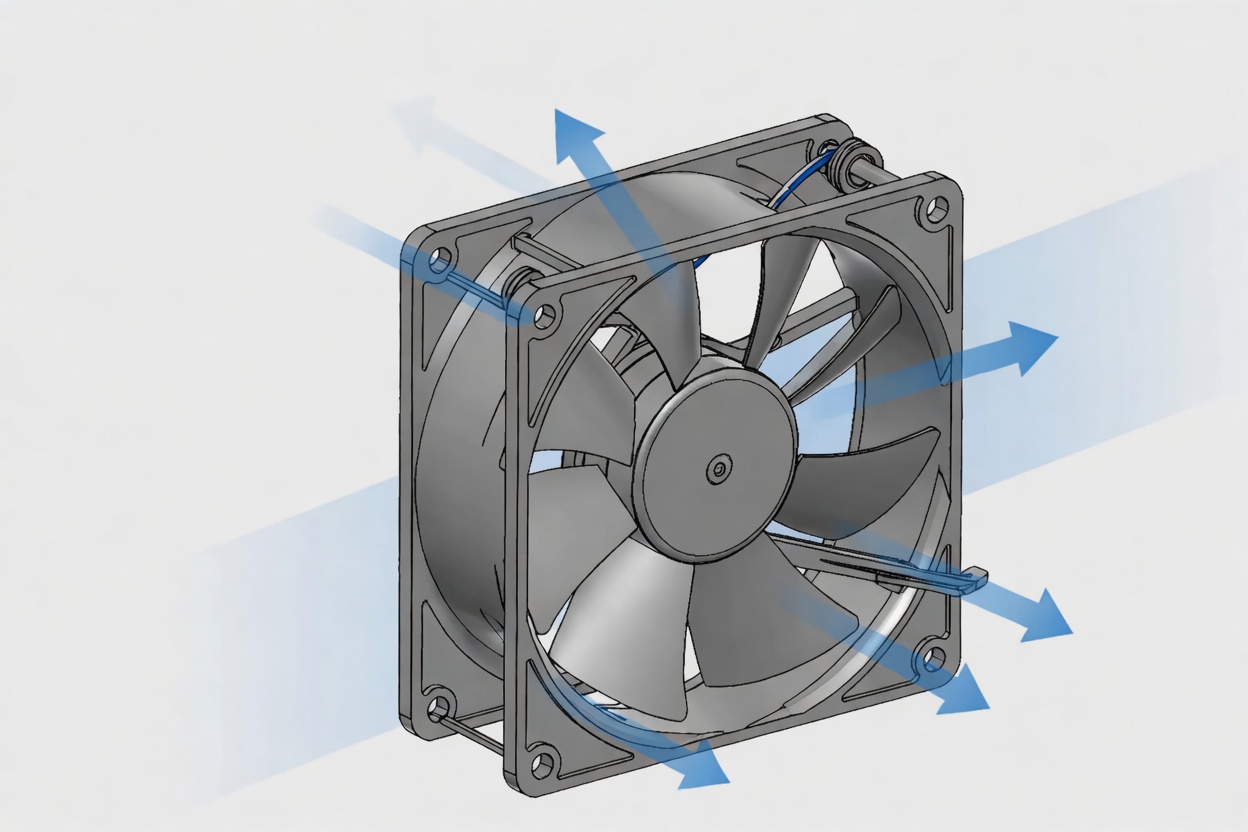
From my experience helping OEMs optimize thermal designs, a 12V DC fan is usually the first active-cooling component we consider when devices get hotter and more compact at the same time. It is a low‑voltage cooling fan that runs on 12 volts of direct current and converts electrical energy into mechanical motion through a brushed or brushless motor. By spinning carefully profiled blades, it forces air across hot components, heatsinks, or through enclosures to maintain safe operating temperatures.
Compared with AC fans, DC fans offer finer speed control, lower energy consumption, and quieter operation, which is why they dominate in electronics, telecom, and battery‑powered systems. In a typical project, we deploy 12V DC fans wherever there is a regulated DC bus available—such as in telecom base stations, industrial controllers, or solar‑powered boxes—because integration is straightforward and safety margins are higher than with mains‑voltage AC fans. [nedc]
Over the last few years, power density and integration levels in electronics have climbed steadily, and the thermal budget is getting tighter every product generation. At the same time, end users expect quieter, more energy‑efficient equipment, from 5G base stations to compact edge servers. This combination makes 12V DC fans a core building block in modern thermal management rather than a simple afterthought. [us-electronics]
Industry reports show that DC cooling fans are part of a global market valued in the multi‑billion‑dollar range, supported by strong demand in telecom, automotive, and industrial electronics. As an authorized partner for brands like SANYO DENKI (San Ace), manufacturers such as CAPITAL can leverage high‑reliability DC fans with proven performance data, which is especially important for long‑life infrastructure deployments. [sxdool]
When I evaluate 12V DC fans for a project, I focus on a short list of critical parameters rather than catalog buzzwords. [us-electronics]
A 12V supply is standard in telecom, automotive, and many industrial control systems, so it is easy to power the fan without extra conversion stages. Low voltage also reduces electrical safety risk during installation and maintenance, which matters in dense racks where technicians work close to live hardware.
Modern brushless DC fans consume significantly less power than comparable AC fans for the same airflow and allow precise speed regulation via voltage or PWM (Pulse Width Modulation) inputs. This means you can dynamically balance cooling performance, acoustics, and energy consumption by linking fan speed to temperature sensors or system load. [us-electronics]
Most 12V DC fans are designed for tight spaces like server chassis, radio units, and PCB‑level cooling. Their compact geometry, combined with optimized blade and frame design, allows you to achieve meaningful airflow and static pressure even in shallow profiles such as 25 mm or less. [modusadvanced]
Because DC motors and advanced bearing systems generate less vibration, noise levels (dBA) can be kept low even under continuous duty. In noise‑sensitive environments—control rooms, medical devices, or office telecom equipment—this is a decisive selection factor. [nedc]
High‑quality ball bearings or advanced sleeve designs, especially from Japanese brands like SANYO DENKI, support continuous 24/7 operation with long mean time between failures (MTBF). For harsh environments or high‑temperature cabinets, upgrading from basic sleeve bearings to ball bearings is usually one of the most cost‑effective reliability decisions. [sanyofan]
From an industry perspective, 12V DC fans show up in any scenario where reliable, compact cooling is mandatory.
- Servers and storage arrays
- Power supply units and rectifiers
- AV and broadcasting equipment
In these systems, fans manage local hotspots around CPUs, FPGAs, and power modules, often in parallel with heatsinks or heat spreaders. [us-electronics]
- 4G/5G base stations and small cells
- Switches, routers, and OLT/ONU units
- Microwave and private network radios
Vendors like ZTE and Huawei use high‑reliability DC fans as part of their thermal strategy to ensure uptime in outdoor cabinets and crowded racks. [modusadvanced]

- In‑vehicle infotainment and communication units
- Battery pack and inverter cooling in low‑voltage subsystems
- Seat or cabin ventilation modules
Automotive‑grade DC fans need to tolerate vibration, temperature swings, and long duty cycles, making motor design and bearing choice critical. [intelmarketresearch]
- Off‑grid solar inverters and controllers
- Battery enclosures and hybrid systems
Here, 12V DC fans are often driven directly from the DC bus and help extend battery life by keeping temperature under control. [kennede]
- PLC cabinets and industrial control panels
- Motor drivers and servo controllers
- Portable diagnostic devices and medical electronics
In industrial and medical contexts, thermal stability equals reliability, and fans are integrated early in the design process to avoid late‑stage redesigns. [modusadvanced]
From an engineering and purchasing standpoint, the benefits cluster around performance, integration, cost, and sustainability. [us-electronics]
- Reliable continuous operation: Designed for 24/7 use in telecom and industrial environments, with stable airflow across a wide temperature range. [sanyofan]
- Easy system integration: Standard 12V bus, common connectors (2‑pin, 3‑pin, 4‑pin), and clear datasheets simplify design‑in and replacements.
- Lower total cost of ownership: Reduced energy consumption and long service life cut operational costs and maintenance visits. [sxdool]
- Greener cooling: High efficiency and compatibility with solar or energy‑optimized systems support sustainability targets. [blog.ebmfan]
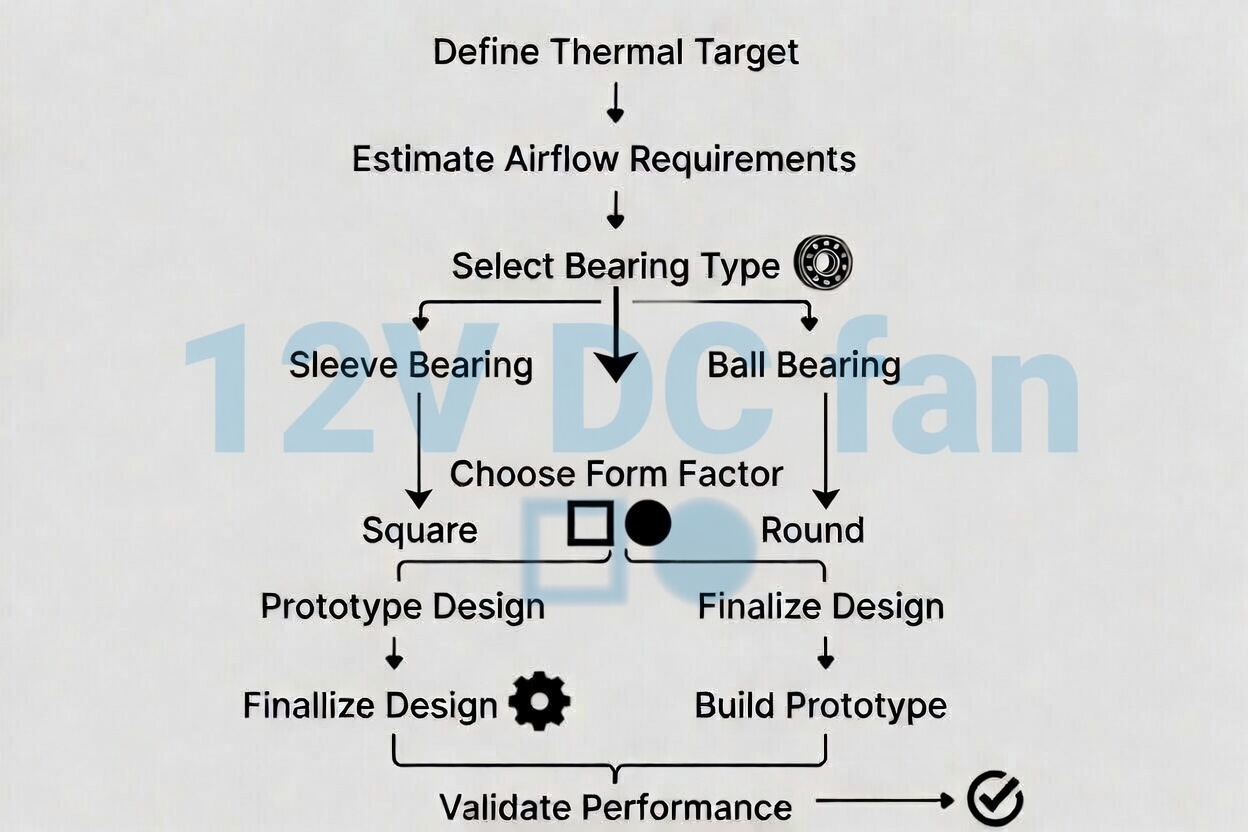
Over dozens of thermal design reviews, a consistent selection framework has proven effective. Below is a practical sequence you can follow.
Start by quantifying how much heat must be removed and what maximum component or ambient temperature is acceptable. Use thermal simulation, test data, or worst‑case power dissipation to define your airflow requirement in CFM (cubic feet per minute). [nedc]
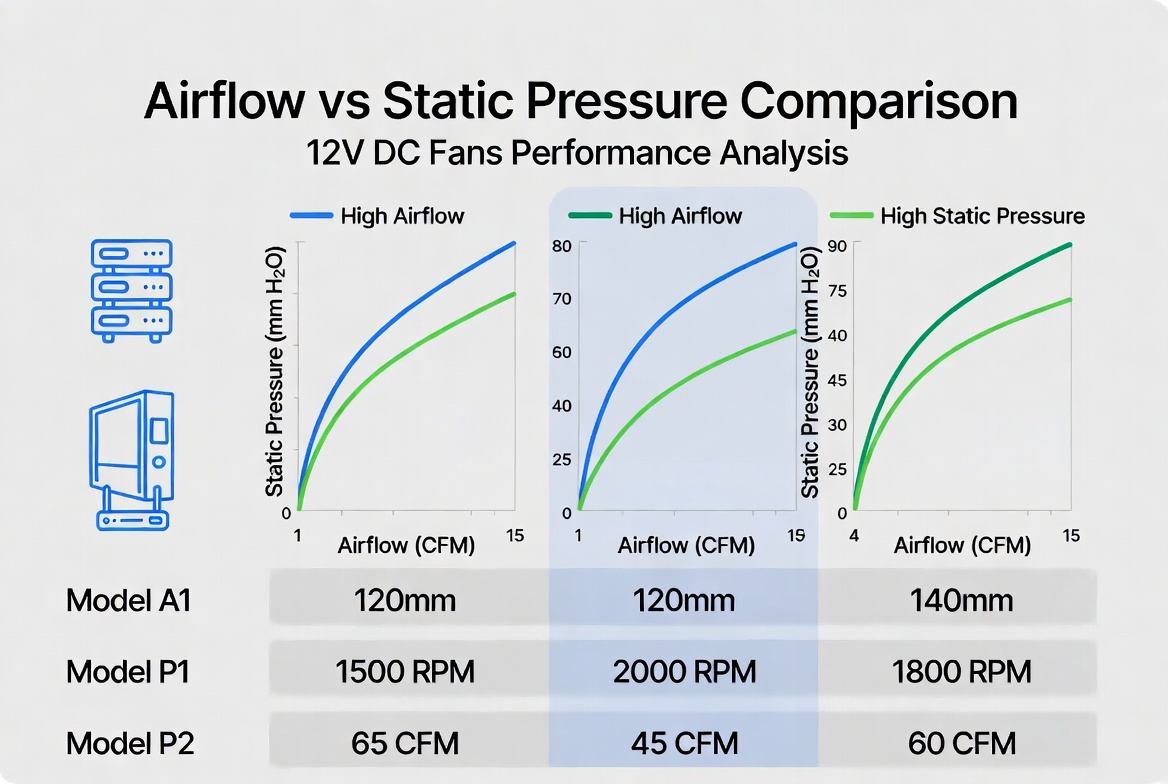
- Airflow (CFM): Determines how much air the fan can move at zero resistance.
- Static pressure (inch H₂O or Pa): Shows how well the fan pushes air through restrictions like filters, heatsinks, and dense PCBs. [modusadvanced]
In closed or heavily baffled enclosures, static pressure is often more critical than raw CFM. When I troubleshoot overheating cabinets, undersized static pressure is a common issue.
Define your maximum permissible noise level (dBA) at the target operating speed. In practice, you may select a fan with higher maximum speed but run it at a reduced duty cycle via PWM to stay within acoustic limits while preserving headroom for hot days or dust buildup. [us-electronics]
- Sleeve bearings: Lower cost, suitable for moderate temperature and horizontal mounting.
- Ball bearings: Better for high temperature, vertical mounting, and long‑life industrial or telecom use. [sanyofan]
For mission‑critical systems such as base stations or backbone routers, I recommend ball‑bearing or higher‑grade options from trusted brands, even at a premium.
Check frame size (e.g., 40×40×20 mm, 80×80×25 mm), mounting holes, and connector type (2‑pin, 3‑pin, 4‑pin PWM) against your PCB and enclosure design. Aligning these early avoids late mechanical rework or wiring changes. [modusadvanced]
| Selection factor | What to check in practice |
|---|---|
| Thermal load | Total power to dissipate, target max temperature. us-electronics |
| Airflow (CFM) | Meets or exceeds calculated airflow requirement. |
| Static pressure | Suitable for filters, heatsinks, and tight enclosures. modusadvanced |
| Noise (dBA) | Below acoustic limit at typical operating speed. |
| Bearing type | Ball bearings for high temp, long life, vibration. sanyofan |
| Voltage & control | 12V nominal; PWM or voltage control as needed. |
| Form factor | Frame size, thickness, and mounting hole pattern. |
| Connector & wiring | 2/3/4‑pin compatibility with your harness/PCB. |
In telecom and industrial projects, 12V DC fans are rarely used in isolation—they are part of a system‑level cooling strategy that includes airflow paths, filters, heatsinks, and control algorithms. Here are three patterns I see repeatedly: [modusadvanced]
1. Front‑to‑back airflow in rack equipment
Fans are arranged in arrays to create a clear airflow channel from cold side to hot side, minimizing recirculation and localized hotspots. [us-electronics]
2. Redundant fan modules for uptime
Carrier‑grade chassis often implement N+1 fans so that a single fan failure does not bring temperatures outside spec, supported by fan failure monitoring. [modusadvanced]
3. Dynamic fan speed control
Temperature sensors on critical components feed into fan controllers that modulate PWM duty cycle, delivering only as much airflow as needed, reducing noise and extending fan lifetime. [us-electronics]
Manufacturers with both their own brand (such as CAPITAL) and agency relationships with SANYO DENKI can provide complete, validated fan assemblies customized for these environments, rather than just loose components. [sanyodenki]
The DC fan market is evolving quickly, and design teams should align with current trends instead of treating fans as commodity parts. [blog.ebmfan]
Market analyses highlight steady growth in DC brushless fans, driven by demand for higher efficiency and lower operating costs in data centers, telecom, and industrial automation. Improved motor control, blade aerodynamics, and low‑loss materials are delivering better CFM per watt year over year. [ystechusa]
Fans increasingly integrate tachometer outputs, PWM control lines, and even smart monitoring via system controllers. This enables predictive maintenance: by tracking speed, current draw, and temperature, systems can detect failing fans before they cause downtime. [modusadvanced]
From sealed, IP‑rated fans for outdoor base stations to high‑pressure models for densely packed AI/edge computing nodes, vendors now offer application‑tuned variants rather than one‑size‑fits‑all designs. Working with specialized suppliers gives OEMs access to these tailored solutions along with engineering support. [intelmarketresearch]
If you are preparing a new design or upgrading an existing platform, this practical process can help you move from "we need cooling" to a concrete fan part number.
1. Characterize the environment
Document ambient temperature range, altitude, humidity, and presence of dust or corrosive agents. This will influence IP rating, bearing choice, and derating. [nedc]
2. Estimate heat dissipation and airflow
Use power budgets and component data to calculate worst‑case thermal loads, then estimate required airflow using thermal modeling or empirical testing. [us-electronics]
3. Choose airflow path and fan placement
Define intake and exhaust locations, internal baffles, and any filters or grills that add resistance. Sketch airflow paths early to avoid dead zones around hot components. [modusadvanced]
4. Shortlist fan families
Using your airflow, static pressure, and noise targets, shortlist several fan series from trusted brands (e.g., SANYO DENKI San Ace, CAPITAL's DC fan lines). Look for complete curves (P‑Q, noise vs. speed) rather than relying on a single CFM number. [sanyofan]
5. Prototype and test
Install candidate fans in real hardware or a thermal mock‑up, then measure temperatures, noise, and power consumption under different loads and ambient conditions. Iterate on fan speed profiles and, if necessary, enclosure vents or heatsinks. [us-electronics]
6. Finalize and plan for lifecycle
Once the fan is validated, lock the part number, qualify at least one second source if possible, and define monitoring strategies (tach detection, alarms) at system level. [modusadvanced]
If your team is designing or upgrading telecom, industrial, or electronic systems, treating the 12V DC fan as a strategic component rather than a commodity will pay off in reliability and total cost of ownership. By partnering with a manufacturer that combines its own DC fan portfolio with agency rights for brands like SANYO DENKI, you gain access to robust products, detailed technical support, and long‑term supply assurance. [sanyodenki]
For projects where downtime is not an option—such as base stations, critical control systems, or high‑value electronics—consulting a dedicated thermal solutions team early in the design phase helps you avoid redesigns and achieve a cleaner, more efficient cooling architecture. [modusadvanced]
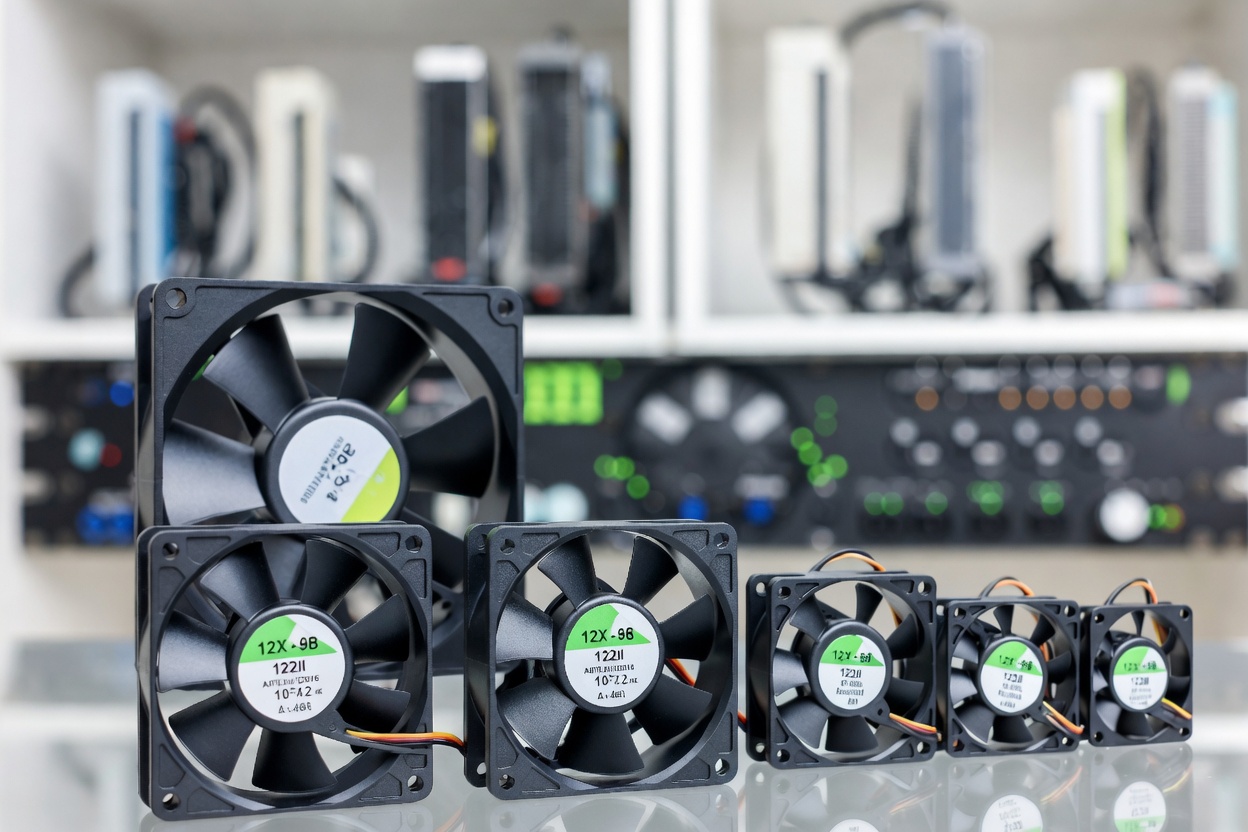
A 12V DC fan converts direct current power into airflow that removes heat from components, heatsinks, or enclosures to keep temperatures within safe limits. It is widely used in electronics, telecom equipment, and battery‑powered systems because of its efficiency and controllability. [us-electronics]
For low‑voltage and space‑constrained applications, a 12V DC fan is typically more energy‑efficient, easier to control, and quieter than a similarly sized AC fan. AC fans are still useful for direct mains‑powered, large‑format cooling, but DC fans dominate in modern compact electronics. [us-electronics]
You estimate airflow by calculating the heat that must be removed and the maximum acceptable temperature rise, then using thermal models or empirical tests to translate that into CFM. Many engineering teams combine simulation with real‑world prototype testing to validate their numbers. [nedc]
Static pressure tells you how well a fan can push air through restrictions like dust filters, grills, and dense heatsinks. If your enclosure has tight airflow paths, choosing a high static‑pressure fan is critical to prevent overheating even when rated CFM looks sufficient. [modusadvanced]
Use PWM when you need dynamic speed control to balance cooling, noise, and energy use under varying loads. By tying PWM duty cycle to temperature sensors, your system runs quietly in normal conditions but can ramp up airflow during peak heat events. [us-electronics]
1. Sofasco: "What Is a 12V DC Fan? Features, Applications, and Benefits Explained." [Link]
2. US Electronics: "Thermal Management in Electronics: Trends and Best Practices." [Link] [us-electronics]
3. NEDC: "The Importance of Thermal Management in Electronic Devices." [Link] [nedc]
4. Modus Advanced: "Thermal Management in Electronic Devices: Design for Manufacturing Best Practices." [Link] [modusadvanced]
5. DC Cooling Fan Market Insights 2026. [Link] [sxdool]
6. YS Tech: "2026 Market Trends Reveal Future of Fans, Blowers, and EC Motors." [Link] [ystechusa]
7. Intel Market Research: "Automotive DC Brushless Cooling Fans Market Insights." [Link] [intelmarketresearch]
8. SANYO DENKI (San Ace) DC Fan Technical Overview (Chinese). [Link] [sanyofan]
9. Kennede: "2026 Best DC 12V Solar Powered Fan Reviews and Buying Guide." [Link] [kennede]


