From idea to market-ready product, our NPI solutions make every stage easier, faster. Discover How We Help
Help Center

Views: 222 Author: Capital Technology Publish Time: 2026-05-17 Origin: Site
As someone who has spent years helping telecom and electronics OEMs solve heat management problems, I can say that squirrel cage blower fans are often the quiet workhorses behind stable systems, long component life, and low maintenance costs. In this guide, I will walk you through how these blowers actually work, where they outperform standard axial fans, and how professional engineers select the right AC or DC blower for demanding applications such as telecom base stations, networking equipment, and industrial control systems. [sofasco]
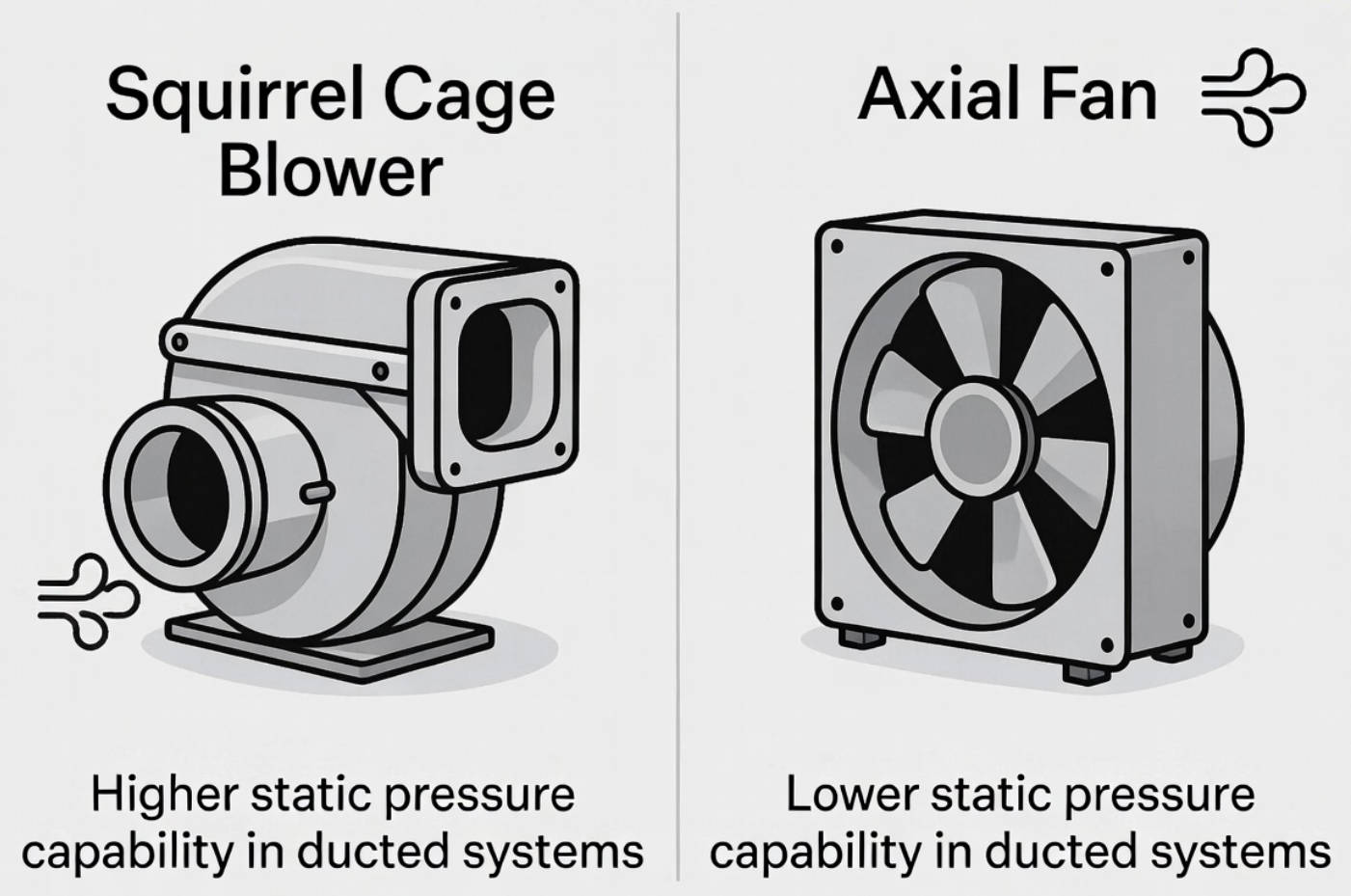
A squirrel cage blower fan is a type of centrifugal fan that uses a cylindrical impeller with multiple blades arranged like the wheel in a hamster cage, which is where the name comes from. Unlike axial fans that push air straight through along the rotation axis, squirrel cage blowers pull air into the center of the wheel and then expel it radially, creating higher static pressure at a given airflow. This makes them especially suitable for applications with ducts, filters, heat sinks, or tightly packed components that create significant airflow resistance. [reitzindia]
From a system integrator's perspective, the key advantage is their ability to maintain reliable airflow in "real" enclosures, not just in ideal open‑air lab conditions. [techcompass.sanyodenki]
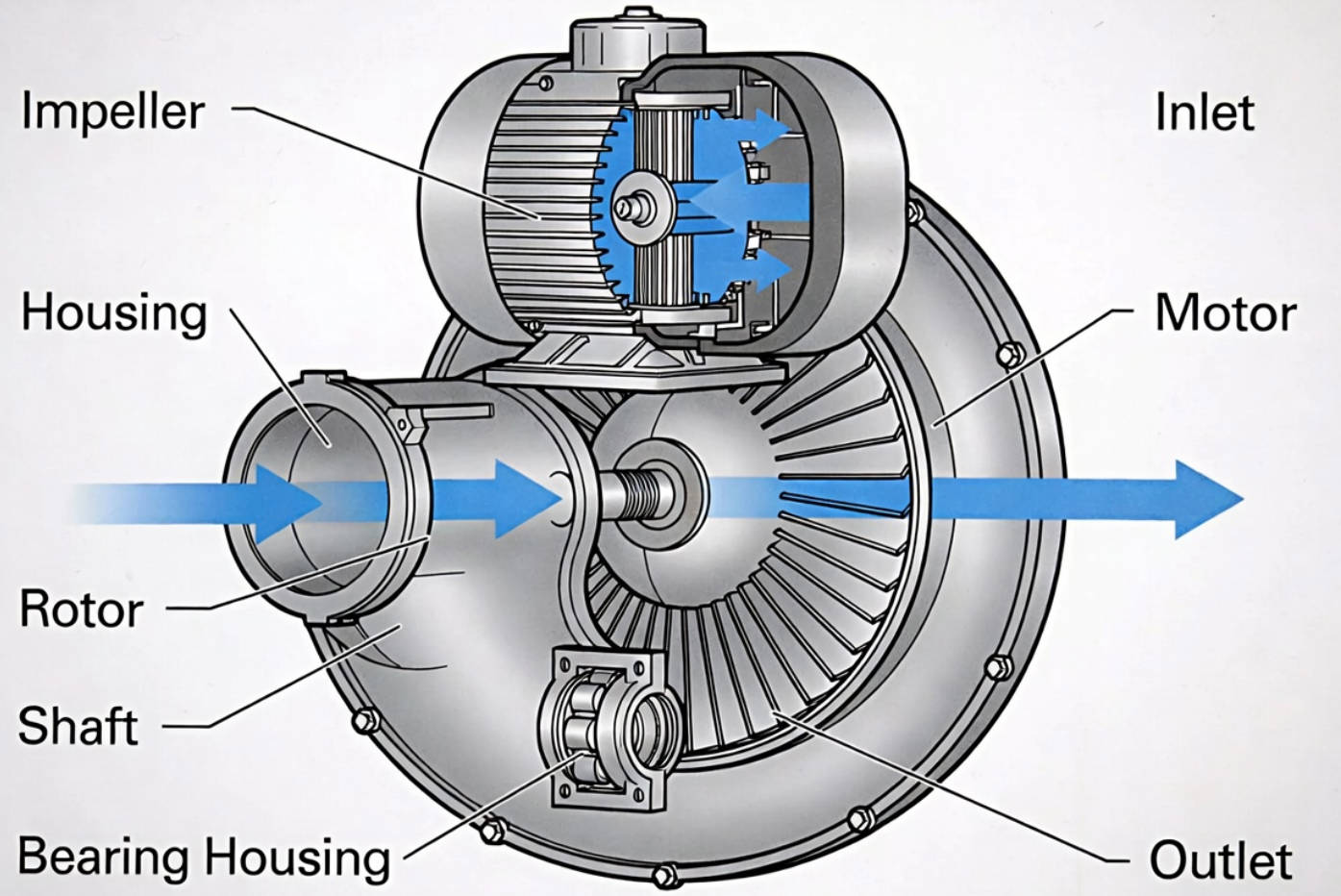
The impeller is a cylindrical wheel with multiple blades that defines the blower's performance curve. Different blade geometries—forward‑curved, backward‑curved, or straight—change efficiency, noise profile, and pressure capability. [raptorsupplies]
From an engineering standpoint, forward‑curved blades are common in compact squirrel cage blowers because they generate high airflow at comparatively low speed, which helps control noise in office, telecom, and indoor industrial environments. [reitzindia]
When the motor spins the impeller, centrifugal force drives the air from the center to the outer rim, building pressure and delivering a steady flow through the outlet. [raptorsupplies]
The housing forms a scroll or cylindrical enclosure around the impeller, guiding air from inlet to outlet and preventing premature leakage. A well‑designed housing reduces turbulence, improves static pressure, and stabilizes noise levels, which is why high‑end manufacturers invest heavily in CFD‑optimized designs. [xawellauto]
In practice, this means that two blowers with similar size and motors can perform very differently if their housing geometry is not optimized for the intended flow path. [reitzindia]
Squirrel cage blowers typically use electric motors that convert electrical energy into mechanical rotation, and the choice between AC and DC is one of the first system‑level decisions you must make. [reitzindia]
Common options include: [techcompass.sanyodenki]
- Single‑phase AC motors for general HVAC and small industrial applications
- Three‑phase AC motors for larger, higher‑power industrial systems
- DC motors (often brushless) for telecom, IT, and embedded systems where efficiency, speed control, and reliability are priorities
DC blower fans are widely used in communication equipment and electronics because they offer fine‑grained speed control (via PWM), higher efficiency, and easier integration with system monitoring. AC blowers fit better where mains power and simple on/off control dominate, such as building HVAC or non‑networked industrial machinery. [techcompass.sanyodenki]
Bearings support the rotating shaft and minimize friction, directly influencing lifetime and noise. High‑quality fans typically use ball bearings designed for continuous operation, and their rated life often defines the effective service life of the entire device. [techcompass.sanyodenki]
From a maintenance perspective, bearing degradation first shows up as increased noise or reduced airflow, which is why reliable vendors specify fan life based on a defined drop in airflow or rise in noise over continuous operation. [techcompass.sanyodenki]
In HVAC systems, squirrel cage blowers handle supply air and return air in ducted systems for residential, commercial, and industrial facilities. Their ability to generate higher static pressure makes them ideal for pushing air through ductwork, filters, and heat exchangers while maintaining comfortable airflow and acceptable noise levels. [reitzindia]
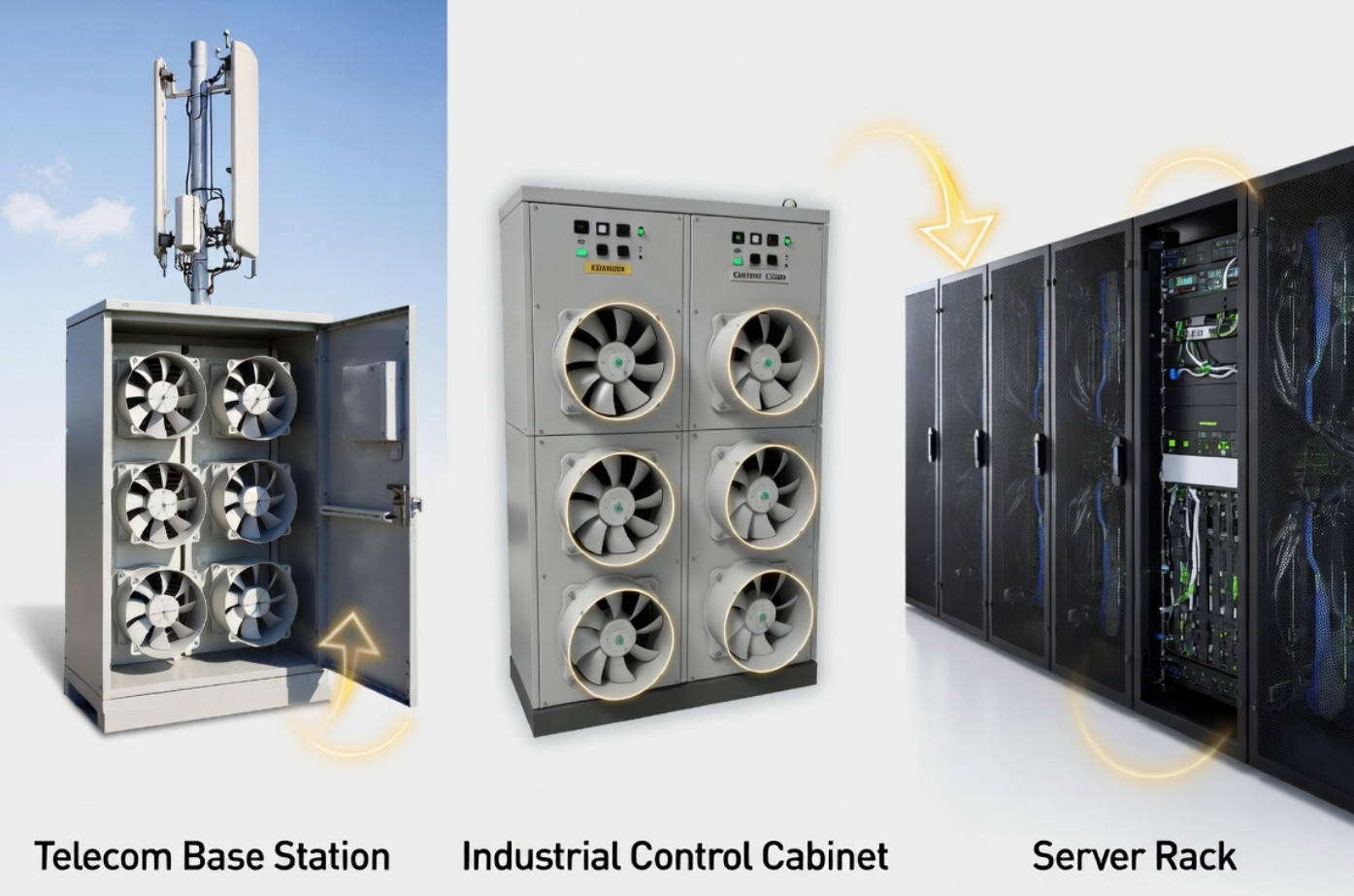
In industrial environments, these blowers are used to exhaust contaminated air, bring in fresh air, or cool enclosures that house drives, PLCs, and power electronics. When devices are installed in cabinets with complex internal layouts, the combination of high static pressure and directional flow gives engineers much more control than a simple axial fan. [gagner-toomey]
Squirrel cage blowers play a central role in automotive HVAC systems by moving air across evaporators and heaters in cabin climate control modules. They are also used in some cooling circuits to enhance airflow over radiators or secondary heat exchangers where package space is tight. [reitzindia]
In server rooms, base stations, and high‑density electronics, squirrel cage blowers provide focused, ducted airflow to critical components such as power modules and processors. Their higher static pressure helps overcome resistance created by closely spaced boards, dense heatsinks, and filtration elements. [gagner-toomey]
In aerospace applications, where weight, reliability, and space are tightly constrained, blower fans are integrated into environmental control systems to manage air circulation and cooling. These use cases demand proven reliability, strict noise limits, and resistance to vibration, which is why component selection and supplier quality are so critical. [sanyodenki]
- High energy efficiency: The centrifugal design converts input power into airflow effectively, especially at moderate to high static pressures. [raptorsupplies]
- Compact form factor: Squirrel cage blowers deliver substantial airflow and pressure in relatively small volumes, which matters in telecom racks, base stations, and compact industrial cabinets. [reitzindia]
- Lower perceived noise: Carefully designed impellers and housings minimize turbulence, making these blowers quieter than comparably powerful axial fans in many ducted applications. [raptorsupplies]
- Pressure range constraints: For extremely high‑pressure needs or very long ducts, specialized fan types may be more appropriate, so an early system‑level pressure calculation is essential. [reitzindia]
- Overheating risk: In high‑temperature or dirty environments, inadequate ventilation around the blower or poor motor selection can lead to overheating and premature failure. [techcompass.sanyodenki]
For OEMs, the takeaway is that a squirrel cage blower is excellent in the right window of airflow vs static pressure, but it must be matched against the real measured impedance of the system, not just theoretical airflow numbers. [techcompass.sanyodenki]
Drawing on SANYO DENKI's published fan selection guidelines and real‑world project experience, a robust selection process typically follows these steps. [sofasco]
You start by estimating the total heat load of your system in watts and determining the maximum acceptable internal temperature. This can be done through thermal simulations, component datasheet analysis, or empirical testing with thermocouples and prototype enclosures. [gagner-toomey]
Engineers often incorporate a safety margin—commonly a factor of 1.5–2×—to ensure reliable operation in worst‑case ambient conditions. [gagner-toomey]
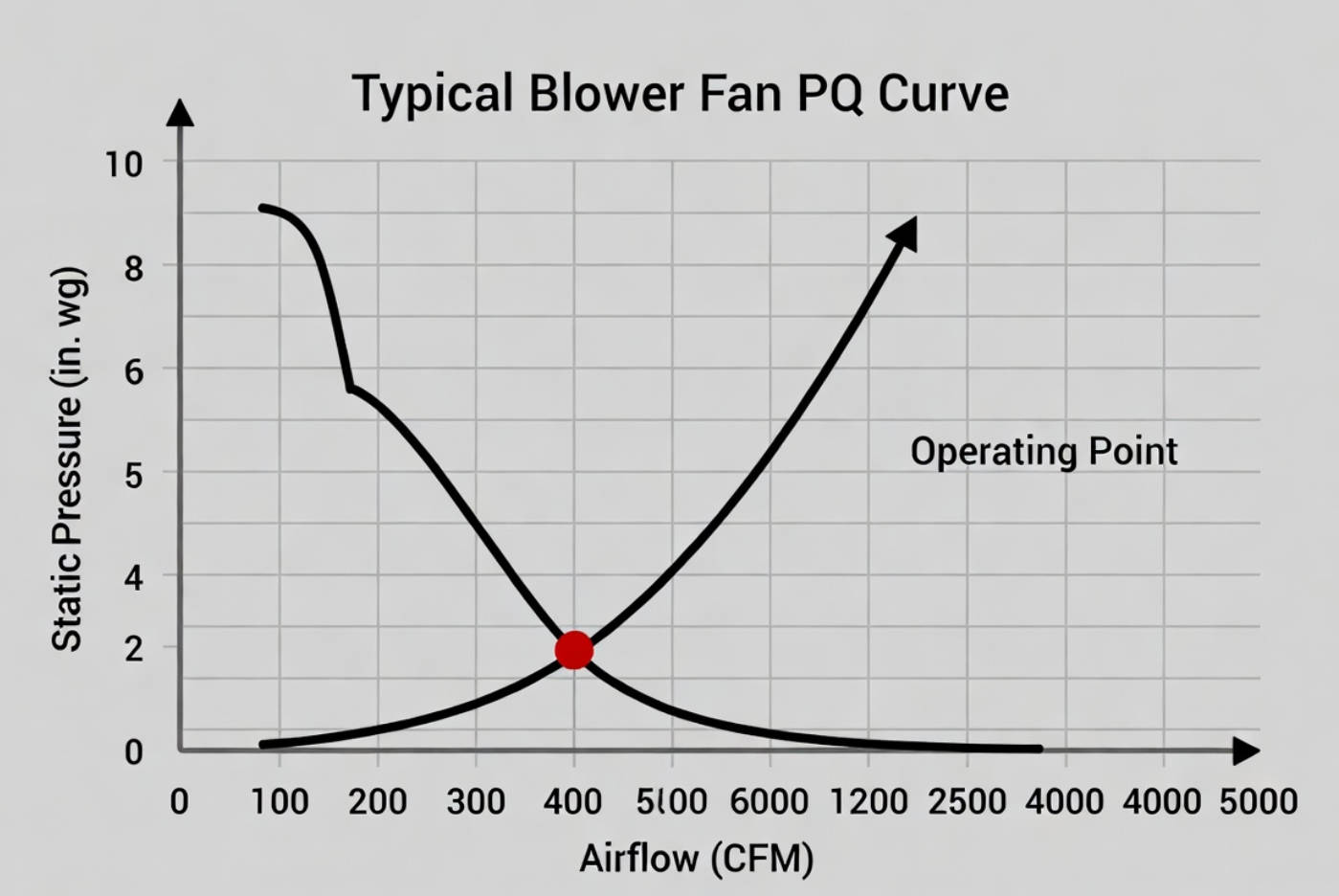
Next, you estimate the required airflow (usually in CFM or m³/min) and the static pressure imposed by filters, heatsinks, grills, and internal obstructions. SANYO DENKI notes that airflow is roughly proportional to fan speed, while static pressure is proportional to the square of speed, which can help extrapolate performance when adjusting RPM. [sofasco]
In practice, you will compare your system impedance curve with the fan's PQ curve (pressure vs airflow) to find an intersection that meets or exceeds your cooling target. [techcompass.sanyodenki]
You then select the power type based on system architecture: [sofasco]
- AC blowers when mains AC is readily available and advanced control isn't a priority
- DC blowers when you need high efficiency, PWM speed control, and integration with monitoring and alarms in IT, telecom, or battery‑powered equipment
Size is chosen to balance performance and space: a fan that is too large wastes space and may complicate mechanical design, while a fan that is too small will not provide sufficient cooling and will often run at noisy, inefficient operating points. [sofasco]
You must consider ambient temperature, humidity, dust, liquids, and potential contamination. For harsh environments, SANYO DENKI recommends environmentally resistant types such as splash‑proof or oil‑proof fans and checking IP ratings carefully. [sofasco]
Noise constraints also matter, especially in office, medical, or indoor telecom scenarios where sound pressure levels in dB(A) must meet user comfort or regulatory requirements. PWM‑controlled fans are one of the most effective tools to keep noise down while maintaining safe temperatures. [sofasco]
The service life of the blower often sets the practical life of the device, especially in sealed or difficult‑to‑access installations. Fan manufacturers typically rate life based on a defined drop in airflow or increase in noise after a continuous operating period, so matching these ratings to your maintenance schedule and service model is critical. [sofasco]
For mission‑critical telecom or industrial systems, selecting fans from manufacturers that perform 100% product inspection and offer customization under warranty significantly reduces risk. [sanyodenki]
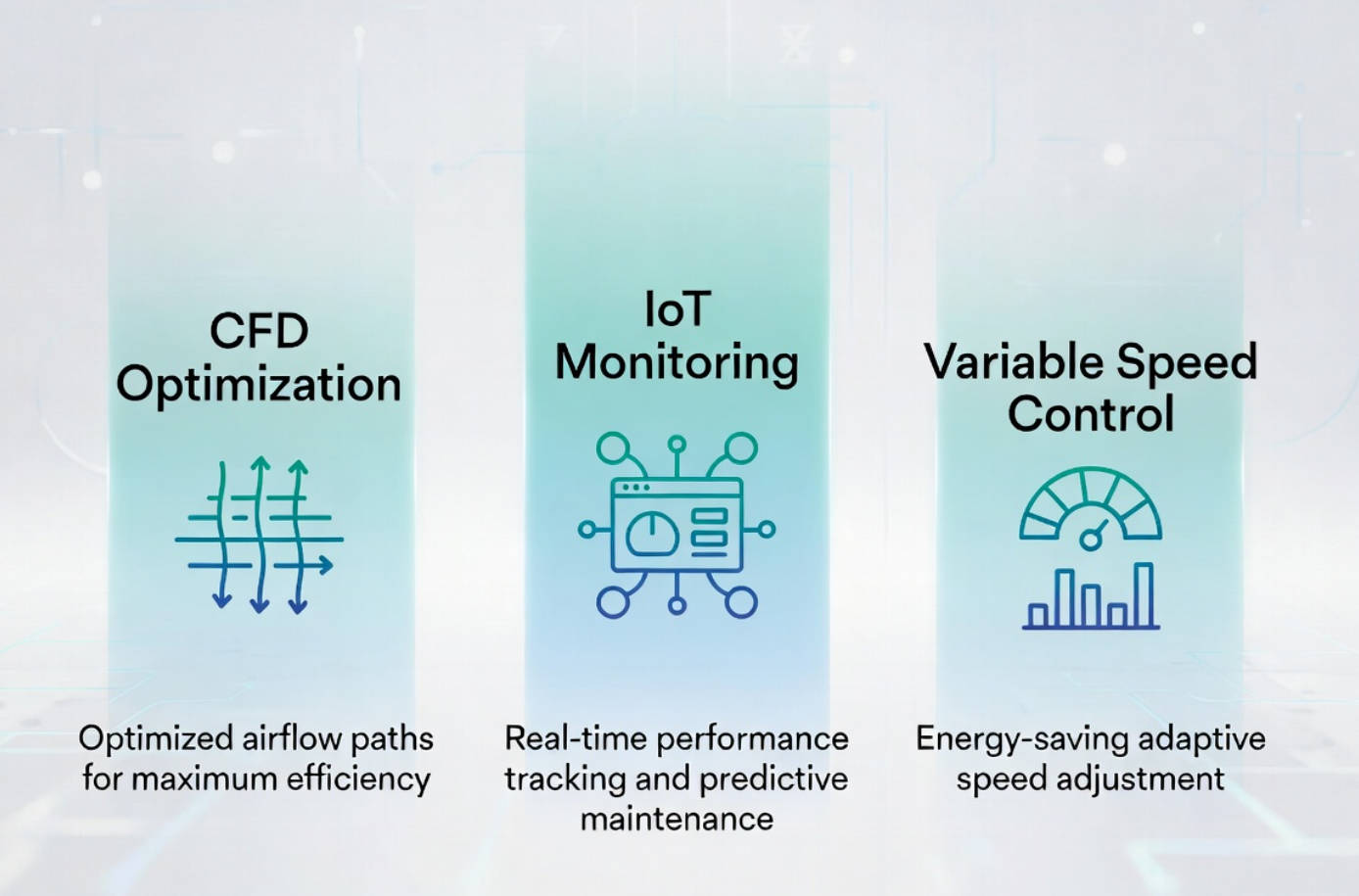
CFD (Computational Fluid Dynamics) is now widely used to optimize blade geometry and housing contours, enabling finer control over airflow, turbulence, and noise. Industrial fan manufacturers report substantial efficiency and performance improvements by iterating designs virtually before tooling. [reitzindia]
IoT‑enabled fans can feed real‑time speed, vibration, and temperature data into monitoring platforms, allowing predictive maintenance and reducing unplanned downtime by an estimated 20% in some industrial setting studies. For operators of telecom networks or automated factories, this shifts cooling fans from low‑visibility components into active data sources for reliability. [xawellauto]
Variable speed control via VFDs for AC fans and PWM for DC fans allows dynamic airflow control aligned to real heat loads, instead of fixed‑speed over‑cooling. This practice saves energy, extends fan life, and supports broader sustainability and carbon‑reduction goals in industrial and ICT infrastructure. [xawellauto]
As a cooling solutions manufacturer with our own DC and AC fan lines and as the chief agent of SANYO DENKI, we see daily how expert fan selection and integration can make or break a project. [made-in-china]
Leading OEMs such as ZTE, HUAWEI, and HYTERA rely on carefully matched blower and axial fan combinations to keep high‑density telecom and communication equipment running within tight thermal margins in diverse climates. By combining SANYO DENKI's advanced fan technology, rigorous inspection, and application‑specific customization with local engineering support, we help customers: [made-in-china]
- Optimize cooling architectures early in the design cycle
- Balance airflow, noise, and power in realistic enclosure conditions
- Meet demanding reliability requirements with proven fan lifetimes and 100% inspected products [sanyodenki]
For engineers, the benefit is not just a component, but a cooling solution backed by technical support, global brand reliability, and field experience in telecom, industrial, and electronics sectors. [made-in-china]
To illustrate how this plays out in practice, imagine designing an outdoor telecom base station:
1. You calculate total heat dissipation from RF modules, power supplies, and digital boards and define a maximum internal temperature above ambient. [gagner-toomey]
2. You model or measure the system impedance created by filters, louvers, and internal layout, then select squirrel cage blowers with PQ curves that cross your operating point with safety margin. [gagner-toomey]
3. You choose DC blowers with PWM control to dynamically adjust speed to real‑time load and ambient temperature, minimizing energy use during off‑peak hours. [gagner-toomey]
4. You specify splash‑proof or wide‑temperature‑range fans with suitable IP ratings to handle outdoor dust, humidity, and occasional water exposure. [sofasco]
5. You align fan life ratings with your maintenance intervals so that replacements can be bundled with scheduled site visits, reducing total lifecycle cost. [sofasco]
This kind of structured selection approach, using proven guidelines from major fan manufacturers, consistently yields more reliable and serviceable installations. [techcompass.sanyodenki]
If you are designing or upgrading equipment that depends on stable, efficient cooling—whether in telecom, industrial control, or high‑density electronics—this is the ideal stage to involve a specialized cooling partner. Drawing on our experience as a DC and AC fan manufacturer and SANYO DENKI's chief agent, we can help you evaluate thermal requirements, select the right squirrel cage blowers, and validate performance with data‑driven recommendations. [made-in-china]
Get in touch with our engineering team to review your current design, share your thermal constraints, and explore optimized blower and fan configurations tailored to your application. [made-in-china]
A squirrel cage blower is a centrifugal device that draws air into the center of a rotating impeller and discharges it radially, generating higher static pressure for ducted or obstructed systems. An axial fan moves air parallel to the shaft and is best suited to low‑impedance, free‑air conditions where static pressure demands are minimal. [raptorsupplies]
DC blowers are preferred when you need high efficiency, precise speed control via PWM, and tight integration with electronics for alarm or monitoring functions, as in telecom or IT equipment. AC blowers are commonly used in building HVAC and general industrial applications where mains AC is available and control requirements are relatively simple. [gagner-toomey]
You estimate airflow by calculating the total heat load in watts, defining an allowable temperature rise, and then determining the air volume required to carry that heat away, usually using vendor guidelines or basic heat transfer equations. In practice, engineers add a safety margin and validate the result with prototype testing and temperature measurements across critical components. [gagner-toomey]
Static pressure represents the resistance your airflow faces as it moves through filters, heatsinks, ducts, and enclosures, and it directly affects how much real airflow you will get from any fan. You must match the blower's PQ curve to your system pressure curve; otherwise, the fan may fail to deliver the expected cooling even if its free‑air CFM rating looks adequate. [gagner-toomey]
Selecting fans with appropriate environmental ratings, quality bearings, and adequate derating is the first step, followed by clean mechanical design that avoids recirculation and high inlet restriction. Using variable‑speed control to avoid unnecessary full‑speed operation and implementing basic dust and contamination management will further extend service life and reduce noise. [xawellauto]
1. Sofasco International. "Squirrel Cage Blower Fan: Components and Functions Explained." [Link] [reitzindia]
2. SANYO DENKI Tech Compass. "Basic Knowledge for Selecting a Cooling Fan." [Link] [sofasco]
3. Raptor Supplies. "Squirrel Cage Fans: A Comprehensive Guide." [Link] [raptorsupplies]
4. Gagner‑Toomey. "4 Best Practices for Selecting Cooler Fans in Electronics Design." [Link] [gagner-toomey]
5. Reitz India. "Advancements in Industrial Draught Fan Technology." [Link] [reitzindia]
6. Xawell Auto. "Future Innovations in 2025 Enhancing Benefits of Best Industry Fan Technology." [Link] [xawellauto]
7. SANYO DENKI. "Distributors | Contacts | SANYO DENKI." [Link] [sanyodenki]
8. Made‑in‑China. "Capital Technology Co., Ltd Profile." [Link] [made-in-china]


