From idea to market-ready product, our NPI solutions make every stage easier, faster. Discover How We Help
Help Center

Views: 222 Author: Capital Technology Publish Time: 2026-06-19 Origin: Site
Content Menu
● Why Server Cooling Strategy Now Starts with the Fan
● How Server Cooling Problems Really Start in the Rack
>> Understanding server cooling in real deployments
>> The impact of overheating on reliability and data integrity
● Key Challenges in Server Cooling Today
● How Effective Server Cooling Reduces Energy Consumption
>> Airflow optimization and containment
>> Liquid and immersion cooling where air alone is not enough
● Air Cooling Fundamentals: Why Fans Matter More Than People Think
>> Key components of air cooling systems
>> Practical steps to optimize air cooling
● DC Fans vs. AC Fans in Server Cooling
>> Core differences between DC and AC fans
>> What we look at when we select fans
● Industry Trend Snapshot: Server Cooling in 2026
● Practical Step‑by‑Step Guide: Assessing Your Cooling Needs
>> How to assess your data center's cooling requirements
>> Calculating the return on investment (ROI)
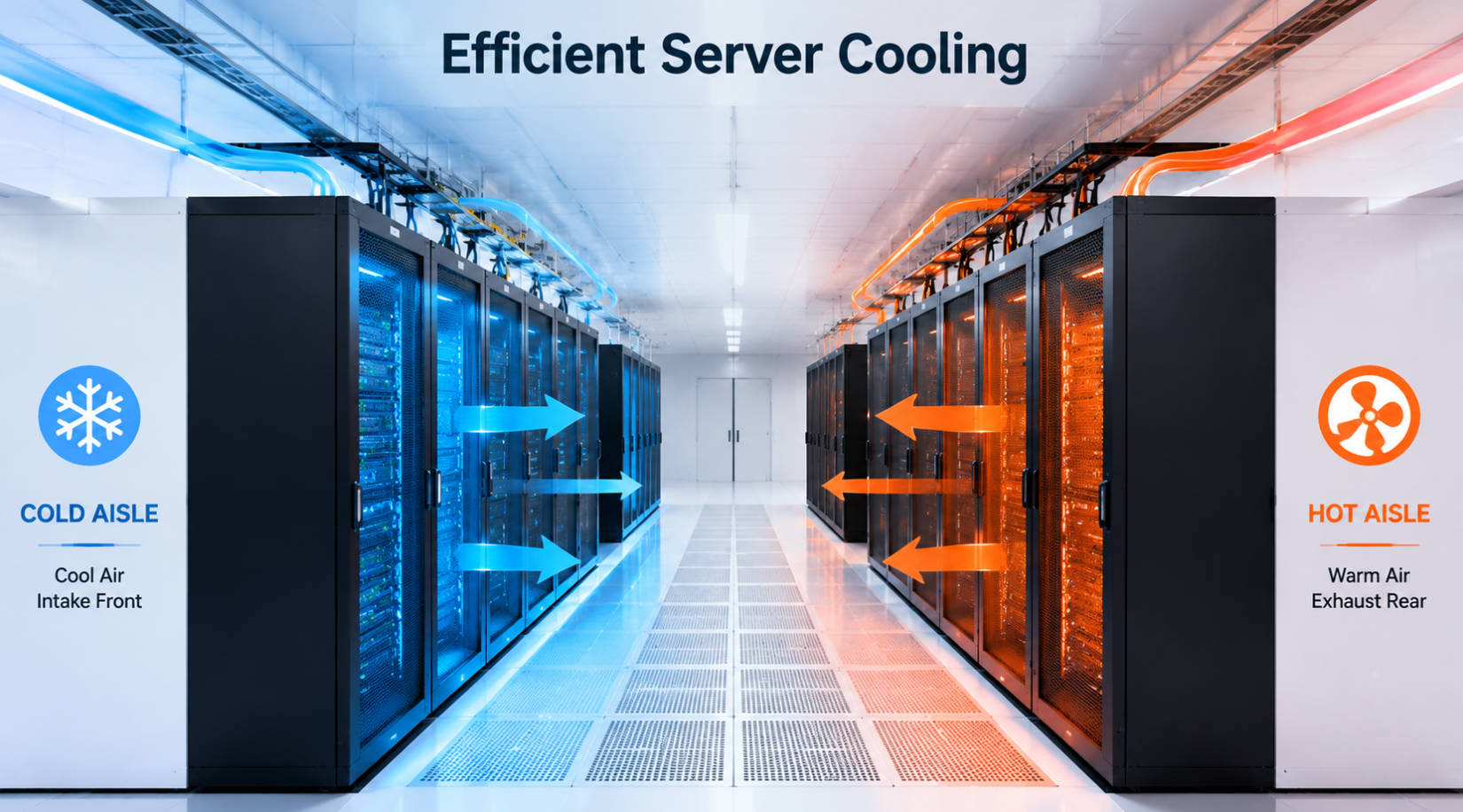
● Why Hot Aisle / Cold Aisle Containment Still Delivers High Value
● Why Leading Brands Care About Fan Partners
● Implementation Checklist for Your Next Server Cooling Upgrade
● Why Work with Capital Technology for Server Cooling Fans
● FAQ
>> 1. How do I know if my current server cooling is sufficient?
>> 2. When should I choose DC fans instead of AC fans?
>> 3. Is hot aisle / cold aisle still necessary if I use liquid cooling?
>> 4. How can better fans reduce my energy costs?
>> 5. Why work with a cooling fan manufacturer instead of buying fans as generic components?
When I walk into a modern data center or telecom room, I no longer start by looking at the CRAC units. I start by looking at airflow paths and fan choices. In high-density racks, the wrong fan strategy can quietly destroy uptime, while the right mix of DC fans and AC fans keeps temperatures stable and energy costs under control. [wheecoolingfan]
At Capital Technology Co., Limited, we see this every week. As the source manufacturer for cooling solutions with our own CAPITAL brand and as the chief agent of SANYO DENKI, our team supports projects for demanding customers like ZTE, HUAWEI, and HYTERA who cannot afford thermal mistakes. This article distills that field experience into a practical guide to server cooling solutions, focusing on fan selection, airflow design, and the real constraints that engineers face on site. [en.szcpt]
On paper, server cooling is about removing heat so equipment stays within recommended ranges. In practice, problems start when rack design, airflow, and fan configuration do not match the actual load profile. [reddit]
From our experience, the most common issues we diagnose are:
- Misaligned airflow direction between server chassis and room design.
- Undersized or low-static-pressure fans inside compact racks.
- Mixed-use racks (IT + power units) without a coherent airflow plan.
- Inconsistent maintenance of filters and fan modules.
Each of these triggers the same symptoms: rising inlet temperatures, higher internal fan speeds, unexpected throttling, and ultimately hardware failure or data errors. [reddit]
Overheating does not always produce immediate shutdowns. It often shows up first as shortened component lifespan, subtle performance drops, and higher error rates. [reddit]
Based on ASHRAE guidance and mainstream data center practice, keeping inlet temperatures within recommended ranges is essential to reduce failure rates and avoid unnecessary overcooling at room level. In other words, good local cooling allows the entire facility to run more efficiently. [ashrae]

The original article correctly highlights several challenges, but in 2026 we see them becoming sharper: [racksolutions]
| Challenge | What we see in the field | Typical mitigation |
|---|---|---|
| Higher rack power density | AI and GPU servers pushing kW per rack sharply upward coresite | Better fans, ducting, and targeted liquid loops |
| Space and layout constraints | Legacy rooms with poor hot/cold separation reddit | Containment retrofit, blanking panels |
| Energy cost and PUE pressure | Cooling now a large part of OPEX racksolutions | Efficient fans, optimized setpoints, controls |
| Supply chain and lead time risk | Difficulty sourcing specific fan models at scale en.szcpt | Multi-brand strategy, early design-in planning |
Inefficient heat transfer, increasing power demand, and hardware placement problems are no longer theoretical—they are daily obstacles that make the difference between a stable site and recurring thermal alarms. [reddit]
In many audits, we improve cooling efficiency before touching any chiller or CRAH unit. The quickest wins often come from airflow optimization: [energystar]
- Implement hot aisle / cold aisle containment to prevent mixing.
- Use blanking panels to block bypass airflow.
- Keep cable management from obstructing intake or exhaust.
- Position DC or AC fans to support front-to-back flow through the rack, not fight against it.
Energy-efficiency guidance from programs such as ENERGY STAR emphasizes that good containment and airflow management can significantly reduce energy waste by avoiding overcooling the whole room. [blog.se]
For extreme densities, air cooling has natural limits. In those projects, we often see a transition toward direct liquid cooling for the hottest components or selective immersion cooling for dedicated high-performance clusters. [mainstream-corp]
However, even these advanced methods usually work alongside fans, not instead of them. Pumps move heat away from chips, but fans still move heat out of enclosures and rooms, making fan selection a foundational decision.
From an engineering standpoint, a reliable air-cooled system typically includes: [reddit]
- Server cooling fans in each chassis or rack.
- CRAH/CRAC units controlling room conditions.
- Airflow management elements such as containment and ducting.
- Monitoring for temperature, humidity, and fan status.
The article on your site already introduces these components, but from a field perspective, the quality and configuration of the fans are often the most practical lever engineers actually control during upgrades. [reddit]
In projects with CAPITAL and SANYO DENKI fans, we typically follow a structured approach:
1. Map current airflow paths and measure rack inlet and exhaust temperatures.
2. Identify hot spots and dead zones; add or reposition fans to target them.
3. Implement hot/cold aisle strategy where feasible, even in partial form. [energystar]
4. Introduce multi-speed or PWM-controlled DC fans to scale airflow with real demand. [coolingfanmanufacturers]
5. Adjust CRAC setpoints only after local airflow has been optimized.
Customers often see both temperature stability and energy savings after what looks like relatively small fan and airflow changes. [energystar]
From an application engineer's perspective, the choice between DC fans and AC fans is one of the most important early decisions: [coolingfanmanufacturers]
- DC fans
- Operate at lower DC voltages (often 12 V, 24 V, 48 V).
- Offer precise speed control (PWM, voltage adjustment).
- Typically used inside servers, telecom equipment, and compact enclosures.
- AC fans
- Operate on mains voltage (e.g., 110–240 V AC).
- Often used in larger cabinets, outdoor enclosures, or where simple on/off control is enough.
- Suitable for environments where AC power feeds are readily available.
Cooling experts often recommend DC fans when airflow must be closely matched to dynamic loads, and AC fans when the requirement is more static and the priority is simplicity. [coolingfanmanufacturers]
In real projects, our engineers use a consistent checklist:
- Airflow and static pressure requirements for the rack or chassis.
- Operating temperature range for the application.
- Noise level tolerances, especially in office or mixed-use spaces.
- Expected lifetime and bearing technology.
- Control and monitoring needs (tach output, alarms, PWM).
- Ingress protection where dust, moisture, or outdoor use is involved.
A low-current, high-efficiency DC fan can reduce power consumption and stress on power supplies, while a high-reliability AC fan can simplify integration for certain cabinets. [wheecoolingfan]
The server cooling and data center cooling market is growing rapidly, driven by AI and high-density workloads. Recent industry analyses project the cooling market to rise significantly from 2025 to 2026, reflecting stronger investment in both air and liquid cooling technologies. [coresite]
Surveys of data center decision-makers show a notable increase in planned adoption of liquid cooling, up from earlier years, as organizations respond to power density and sustainability pressures. At the same time, airflow management and fan optimization remain essential, because even liquid-cooled deployments still require efficient removal of heat from the room. [spglobal]
Building on your existing content, here is a field-tested sequence we use with customers: [reddit]
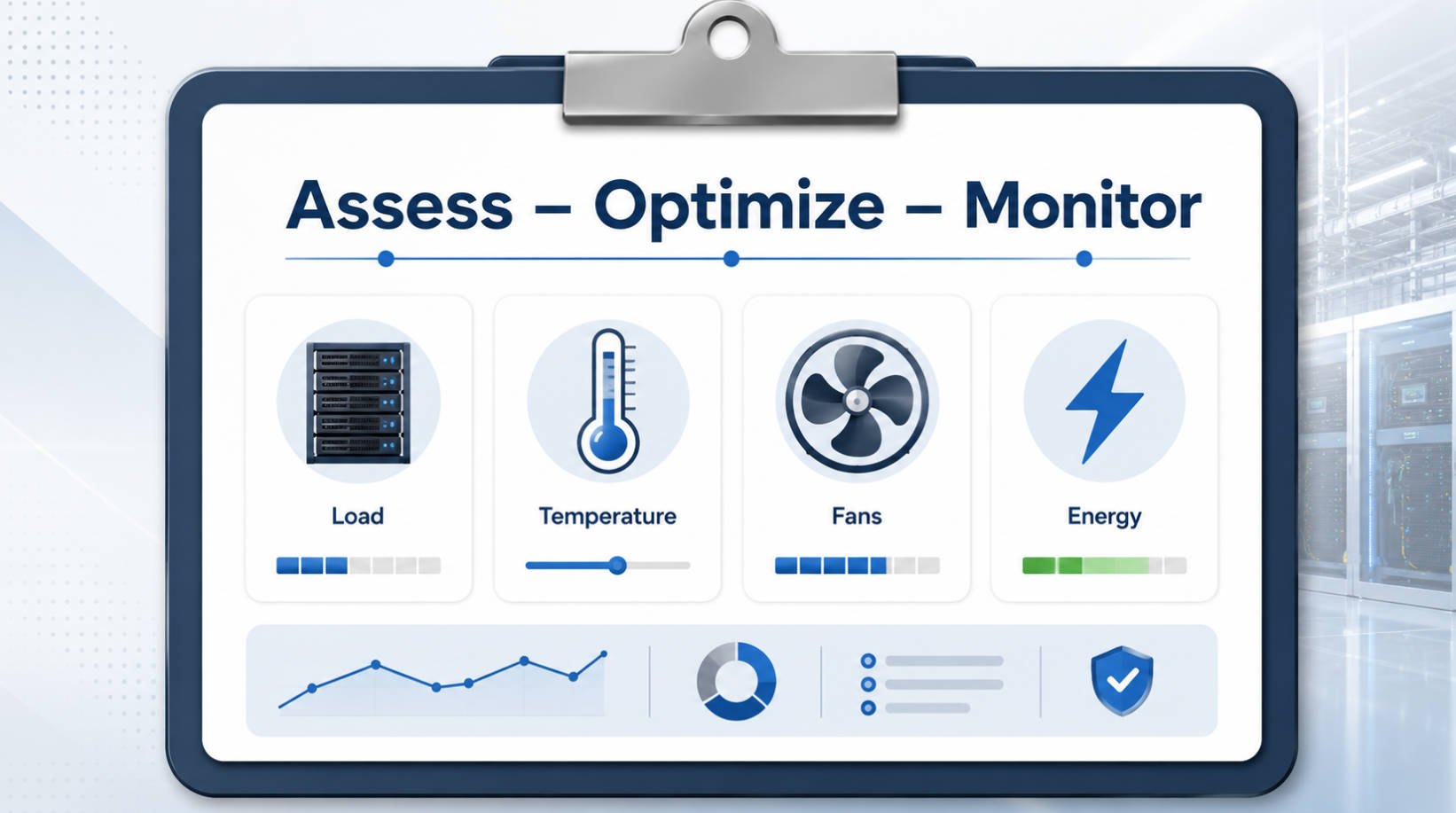
1. Measure load and density
- Document power per rack and identify high-density zones.
2. Map airflow and temperatures
- Use sensors or portable probes to find hot spots and dead zones.
3. Check current fan configuration
- Note fan types (DC/AC), speeds, control modes, and placement.
4. Review facility layout
- Evaluate containment, raised floor design, and cable management.
5. Evaluate environmental conditions
- Consider climate, altitude, and any outdoor exposure.
6. Define reliability and noise targets
- Align cooling design with SLA and acoustic requirements.
This structured assessment helps you decide whether optimized air cooling, hybrid liquid-air, or partial immersion is appropriate for your environment. [mainstream-corp]
Cooling upgrades must be justified. We typically calculate ROI using: [mainstream-corp]
- Energy savings from lower fan power and improved PUE.
- Reduced failure and replacement costs for servers and components.
- Avoided downtime costs, especially for telecom and industrial applications.
- Extended hardware lifecycle, which reduces capex pressure.
Realistically, many customers see cooling improvements pay for themselves over a manageable timeframe once energy and reliability benefits are factored together. [racksolutions]
Hot aisle/cold aisle design remains one of the most effective and cost-efficient ways to improve server cooling. By aligning racks so that cold intakes face each other and hot exhausts face each other, and then physically containing these aisles, you reduce mixing and make your cooling system more predictable. [tateglobal]
Studies and industry experience show that well-executed containment can:
- Reduce cooling energy consumption.
- Support higher rack power density.
- Reduce hot spots and improve hardware reliability. [blog.se]
This is why, even in conversations about liquid and immersion cooling, we still start by asking: What does your airflow and containment look like today?
As a manufacturer with its own CAPITAL products and as the chief agent of SANYO DENKI, Capital Technology sits in a unique position between design engineers, global brands, and end users. [finance.yahoo]
Enterprises like ZTE, HUAWEI, and HYTERA work with us because they need:
- Stable, traceable supply of DC and AC fans for server and telecom platforms.
- Engineering support to match fan models to new chassis designs.
- Access to SANYO DENKI technology as well as CAPITAL's flexible manufacturing. [en.szcpt]
In practice, a strong cooling partner provides not only products, but also application knowledge, design feedback, and post‑deployment optimization support.
Before finalizing a server cooling project, our engineers typically run through this checklist:
1. Confirm maximum expected rack power for the next 3–5 years.
2. Validate airflow direction and ensure consistent front‑to‑back flow.
3. Select DC or AC fans with sufficient airflow and static pressure.
4. Implement or improve hot aisle / cold aisle containment.
5. Integrate monitoring for temperature and fan status.
6. Compare pre‑ and post‑upgrade temperature and energy data.
7. Plan spare fan inventory and maintenance intervals with suppliers.
Following this process reduces risk and gives facilities teams clear documentation of why each cooling choice was made.
Capital Technology Co., Limited combines factory-level manufacturing with distribution of SANYO DENKI, one of the most respected names in cooling systems. Our portfolio covers: [finance.yahoo]
- DC fans and AC fans for server, telecom, and industrial equipment.
- Centrifugal fans, radiators, filters, and related cooling components.
- Application support for communication, rail, server, photovoltaic, medical, CNC, and general industrial equipment. [en.szcpt]
Leveraging nearly a century of SANYO DENKI brand value with over a decade of CAPITAL cooling experience, we support customers from early design to mass production and long-term maintenance. For server cooling projects, that means you can rely on both technical depth and supply stability. [publish.sanyodenki]
If you are planning a new server room, upgrading an existing data center, or integrating cooling into telecom and industrial systems, share your rack density, environment, and project timeline with Capital Technology. Our engineering team can help you select the right combination of DC and AC fans and design a practical, efficient server cooling solution tailored to your real constraints. [en.szcpt]
Look at inlet temperatures, fan speeds, and any thermal alarms on your servers. If you see frequent throttling, high fan RPMs, or hot spots between racks, your cooling is likely insufficient. A basic airflow and temperature survey is usually the first step. [ashrae]
Choose DC fans when you need precise speed control, integration with server power systems, and flexible response to changing load conditions. They are typically the best choice inside servers, telecom equipment, and compact high‑density enclosures. [coolingfanmanufacturers]
Yes. Liquid cooling removes heat from components more efficiently, but you must still move that heat out of the rack and room. Proper airflow management and containment remain important even in hybrid or liquid‑assisted environments. [spglobal]
High‑efficiency fans with appropriate static pressure and smart speed control can deliver the needed airflow with less power, especially when paired with optimized containment and higher room setpoints. This reduces both cooling energy and wear on cooling equipment. [racksolutions]
A specialized manufacturer can help you match fan models to your actual thermal and mechanical constraints, provide long‑term availability, and support you through design changes. For mission‑critical operators, this reduces risk compared with ad‑hoc sourcing. [coolingfanfactory]
1. ACDCECFAN. "Why Effective Server Cooling Is Crucial for Data Center."
<https://www.acdcecfan.com/server-cooling/> [reddit]
2. Capital Technology Co., Limited – Official Site.
<https://www.en.szcpt.com> [en.szcpt]
3. ASHRAE. "Data Center Resource Page (Datacom Series)."
<https://www.ashrae.org/technical-resources/bookstore/datacom-series> [ashrae]
4. Uptime Institute. "Global Data Center Survey Results 2025."
<https://uptimeinstitute.com/resources/research-and-reports/uptime-institute-global-data-center-survey-results-2025> [uptimeinstitute]
5. ENERGY STAR. "Move to a Hot Aisle/Cold Aisle Layout."
<https://www.energystar.gov/products/data_center_equipment/16-more-ways-cut-energy-waste-data-center/move-hot-aislecold-aisle-lay> [energystar]
6. TATE Global. "Hot Aisle Containment: Enhancing Data Centre Efficiency."
<https://www.tateglobal.com/emea/insights-resources/knowledge-hub/hot-aisle-containment-enhancing-data-centre-efficiency/> [tateglobal]
7. Schneider Electric. "For Data Center Energy Efficiency, Hot-Aisle Beats Cold-Aisle Containment."
<https://blog.se.com/datacenter/architecture/2011/09/15/for-data-center-energy-efficiency-hot-aisle-beats-cold-aisle-containment/> [blog.se]
8. Cooling Fan Manufacturers. "DC vs. AC Axial Fans | Key Differences Explained."
<https://www.coolingfanmanufacturers.com/FAQ/Detail/66> [coolingfanmanufacturers]
9. RackSolutions. "Data Center Cooling: Trends and Insights for 2026."
<https://www.racksolutions.com/news/blog/data-center-cooling-trends-and-insights-for-2026/> [racksolutions]
10. Mainstream Fluid and Air. "What Is the Best Cooling for Data Centers? Exploring Cutting-Edge Options."
<https://mainstream-corp.com/what-is-the-best-cooling-for-data-centers-exploring-cutting-edge-options/> [mainstream-corp]
11. CoreSite. "Data Center Outlook 2026: Power and Cooling Challenges and Solutions Are Top of Mind."
<https://www.coresite.com/blog/data-center-outlook-2026-power-and-cooling-challenges-and-solutions-are-top-of-mind> [coresite]
12. SANYO DENKI Co., Ltd. Company Profile.
<https://finance.yahoo.com/quote/6516.T/profile/> [finance.yahoo]
13. SANYO DENKI Company Profile 2026–2027.
<https://publish.sanyodenki.com/library/books/companypro2026-2027_en/book/data/companypro2026-2027_en.pdf> [publish.sanyodenki]
14. Capital Technology Co., Limited – Product Page (Cooling fans).
<https://www.en.szcpt.com/product/8/> [en.szcpt]


