From idea to market-ready product, our NPI solutions make every stage easier, faster. Discover How We Help
Help Center

Views: 222 Author: Capital Technology Publish Time: 2026-06-10 Origin: Site
Content Menu
● Understanding Radial and Axial Fans
● What Is a Radial (Centrifugal) Fan?
● Radial vs Axial Fans: Core Differences
>> Performance Comparison of Radial and Axial Fans
● Practical Selection Steps for Engineers and Buyers
● Considerations: Noise, Reliability, and Maintenance
● DC and AC Fans: Matching Power and Control Needs
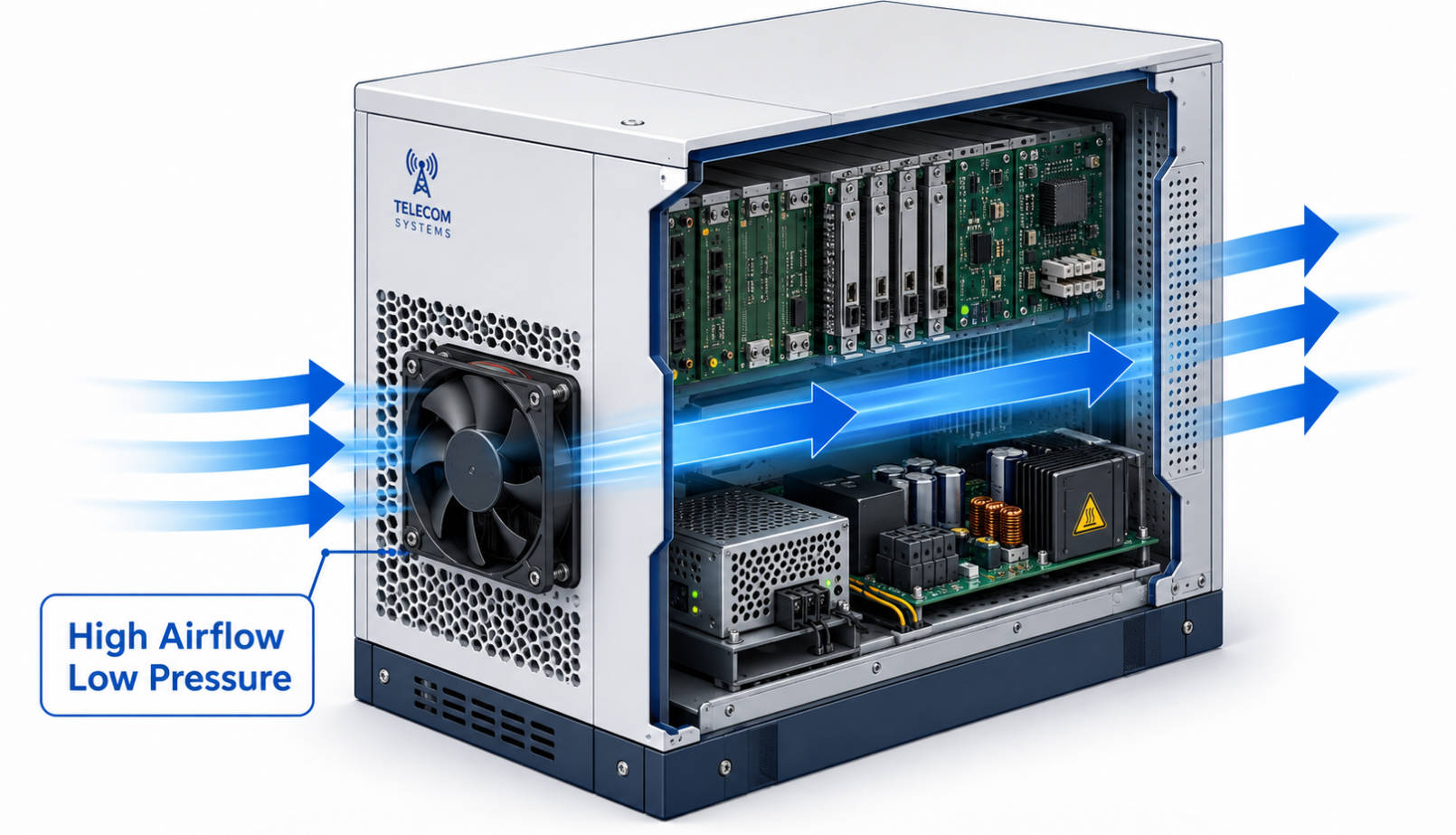
● Case Example: Cooling a Telecom Base Station Cabinet
● Expert Tips for Optimizing Fan Selection and Installation
● How Capital Technology Supports Your Cooling Strategy
● Call to Action: Design Your Next Cooling System with Confidence
● FAQs
>> 1. FAQ: What is the main difference between a radial fan and an axial fan?
>> 2. FAQ: Which fan type should I use for high-resistance systems with filters and long ducts?
>> 3. FAQ: Are axial fans always more efficient than radial fans?
>> 4. FAQ: How do I decide between a DC fan and an AC fan?
>> 5. FAQ: When should I involve a fan manufacturer or agent in my design process?
Selecting between a radial fan (centrifugal fan) and an axial fan is one of the most consequential decisions you can make for any cooling or ventilation system, especially in telecom, industrial electronics, and power equipment. In my work with OEMs and integrators, I've seen that choosing the wrong fan type can lead to chronic overheating, noise complaints, and unnecessary maintenance costs—while the right choice delivers stable performance and long service life. [sciencedirect]
Radial and axial fans are the two most common air-movement technologies used in cooling, ventilation, and dust extraction applications. Both move air using rotating impellers, but their flow direction, pressure capability, and best-fit scenarios differ significantly. [aircontrolindustries]
From an engineering perspective, your decision should be driven by required airflow (CFM), static pressure, and system impedance—not just fan size or price. [pelonistechnologies]
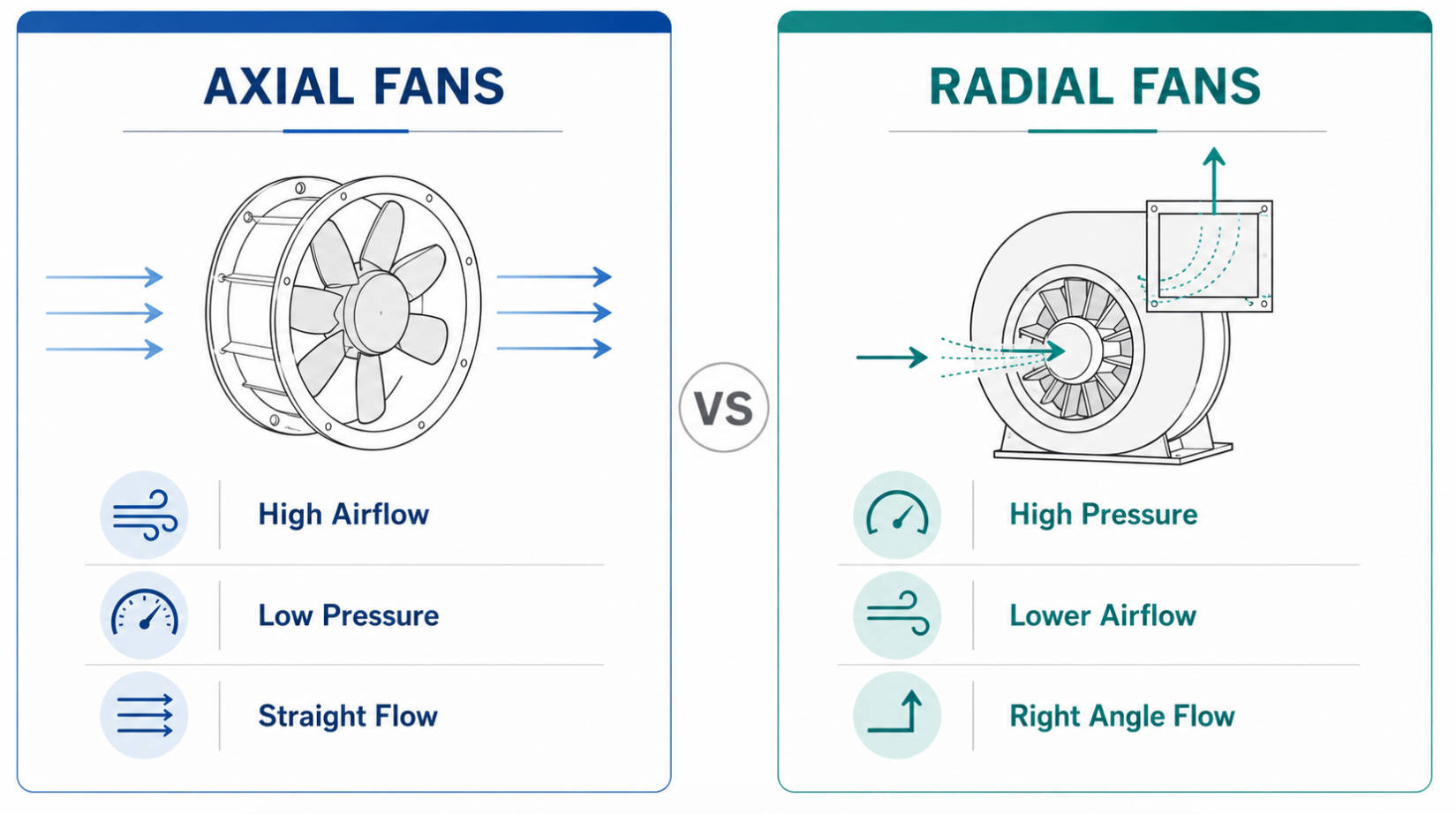
An axial fan moves air parallel to the shaft of the fan, like a propeller. These fans are widely used in electronics cooling, cabinet ventilation, HVAC, and power supplies where large volumes of air must be moved at relatively low pressure. [mag.ebmpapst]
Key characteristics of axial fans:
- Airflow direction: Parallel to the fan axis. [sciencedirect]
- Typical performance: High airflow, low static pressure. [aircontrolindustries]
- Efficiency: High efficiency when operating in free or low-resistance systems. [mag.ebmpapst]
In DC fan applications, axial fans are often the default choice for telecom base stations, routers, and industrial PCs because they offer a good balance of airflow, noise level, and energy consumption. [pelonistechnologies]
A radial fan, also called a centrifugal fan or blower, draws air in along the fan axis and discharges it perpendicular to the inlet. The impeller blades accelerate the air outward, converting rotational energy into pressure and making radial fans ideal where higher static pressure is required. [sciencedirect]
Key characteristics of radial fans:
- Airflow direction: Intake along the axis, discharge at 90 degrees to the inlet. [aircontrolindustries]
- Typical performance: Lower airflow volume but much higher static pressure. [mag.ebmpapst]
- Best use cases: Systems with long or complex ducting, filters, or high impedance. [sciencedirect]
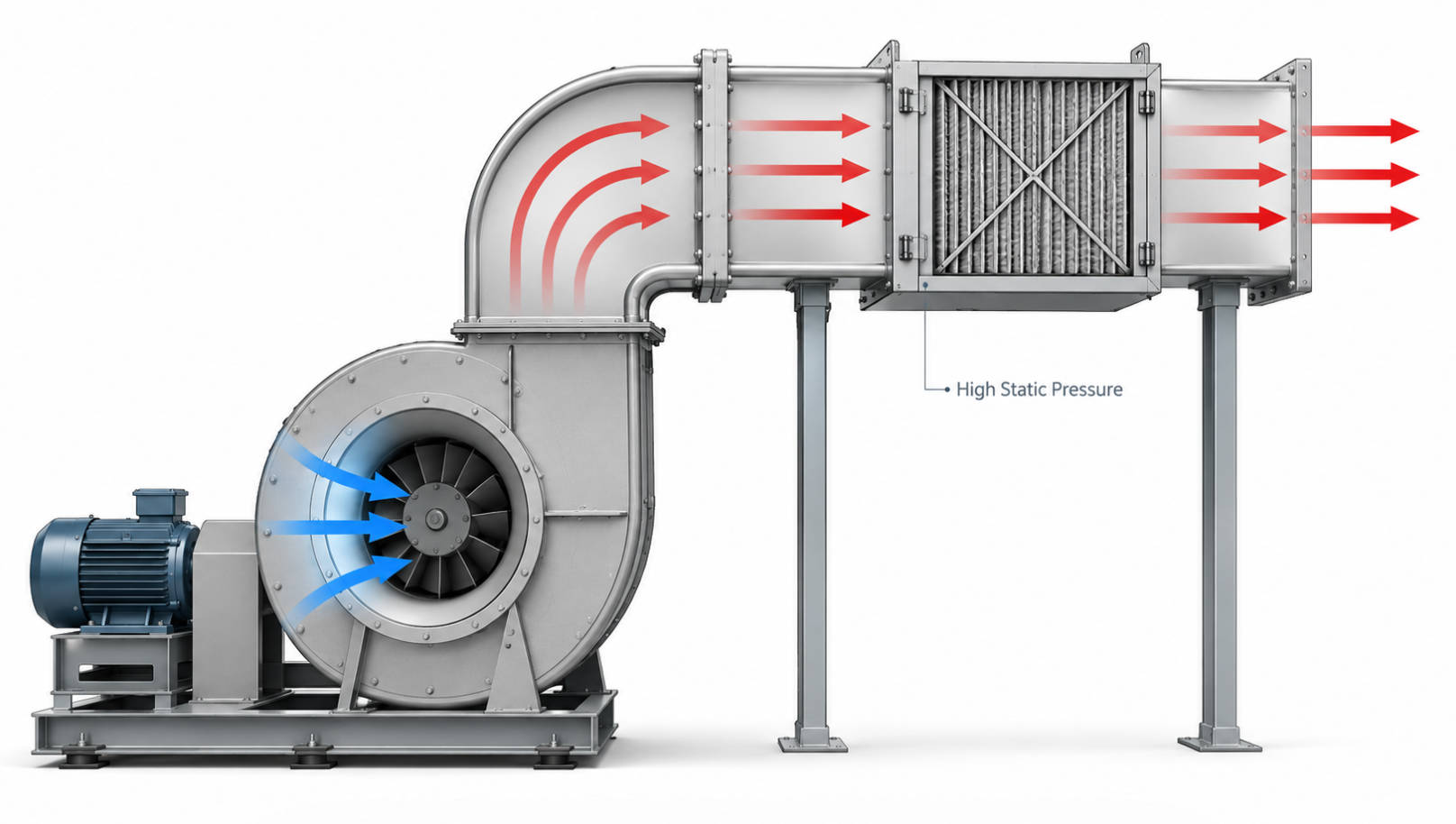
In practice, radial fans are common in industrial filtration, dust collection, and enclosed power electronics where air must be pushed through dense filters or long ducts. [aircontrolindustries]
To design a reliable system, it helps to compare the two fan types on the key engineering dimensions that matter most. [mag.ebmpapst]
| Factor | Axial Fans | Radial (Centrifugal) Fans |
|---|---|---|
| Airflow direction | Parallel to fan axis sciencedirect | Perpendicular to fan inlet sciencedirect |
| Static pressure | Low; suited to low-impedance systems sciencedirect | High; ideal for high-impedance systems sciencedirect |
| Airflow volume | Large volume at low pressure sciencedirect | Smaller volume at higher pressure sciencedirect |
| Efficiency | High efficiency at high airflow and low restriction sciencedirect | High efficiency where high pressure is needed sciencedirect |
| Typical applications | Room or cabinet ventilation, cooling towers, exhaust systems sciencedirect | Long duct runs, dust collection, industrial filtration sciencedirect |
If you visualize the airflow, axial fans "push air through" open spaces, while radial fans "push against" resistance, such as filters, bends, and narrow channels. [sciencedirect]
From a cooling design standpoint, axial fans are typically the best fit when you need high airflow and relatively low pressure. This is common in telecom cabinets, server racks, and communication equipment where air passes through relatively open pathways. [pelonistechnologies]
Axial fans are ideal if:
- You need to move large volumes of air through short paths with minimal ducting. [aircontrolindustries]
- Your application involves cabinet ventilation, open enclosures, or free-air cooling. [mag.ebmpapst]
- Noise level and energy efficiency are key design constraints. [pelonistechnologies]
As a supplier to brands like ZTE, HUAWEI, and HYTERA, Capital has repeatedly seen axial DC fans used in base station outdoor cabinets where designers aim for high airflow and compact fan modules. [en.szcpt]
Radial fans become the smarter choice when your system faces significant airflow resistance. This includes dense filters, tight ducts, and complex airflow paths, all of which increase system impedance. [pelonistechnologies]
Radial fans are ideal if:
- Air must travel through long ducts or multiple bends. [sciencedirect]
- Your design includes HEPA filters, dust collectors, or high-resistance grilles. [aircontrolindustries]
- You need stable airflow even when filters gradually clog over time. [pelonistechnologies]
In industrial projects, I often recommend radial blowers for dust collection systems, power converter enclosures, and industrial control cabinets where pressure demands exceed what axial fans can deliver reliably. [mag.ebmpapst]
To help teams standardize their fan selection process, many industrial guides recommend a step-by-step methodology. [aircontrolindustries]
Step 1: Perform a thermal analysis
Determine how much heat your equipment produces and calculate the required airflow volume to keep component temperatures within safe limits. [pelonistechnologies]
Step 2: Determine system impedance
Evaluate how much pressure is required to move air through your ducts, filters, and internal obstructions. [aircontrolindustries]
Step 3: Match fan type to pressure–flow needs
- If you need high CFM and low pressure, prioritize axial fans. [sciencedirect]
- If you need moderate CFM and high pressure, prioritize radial fans. [mag.ebmpapst]
Step 4: Check constraints and regulations
Consider noise limits, energy consumption, available space, and safety standards before finalizing your fan type and model. [pelonistechnologies]
This process not only reduces trial-and-error during prototyping, it also aligns your decision with best practices used across industrial fan selection. [aircontrolindustries]
While airflow and pressure are critical, successful projects also balance acoustic performance, reliability, and lifecycle cost. [mag.ebmpapst]
Noise performance:
Axial fans generally offer lower noise at comparable airflow when system resistance is low. However, when you force an axial fan to operate against high impedance, turbulence and noise increase dramatically, often more than with a correctly sized radial fan. [pelonistechnologies]
Reliability and maintenance:
By using a fan type aligned with the system's real pressure needs, you avoid overloading the motor and bearings, extend service life, and reduce unscheduled downtime. Radial fans in dusty environments combined with proper maintenance schedules (bearing checks, filter cleaning, system cleaning) can deliver long, predictable service. [aircontrolindustries]
Beyond geometry, you also need to choose between DC fans and AC fans depending on your system's power architecture and control strategy. [en.szcpt]
DC fans:
- Ideal for telecom, networking, and industrial electronics where DC rails already exist. [rcgsdl]
- Support PWM speed control and tach feedback, enabling thermal management and energy savings. [pelonistechnologies]
AC fans:
- Common in power equipment, industrial enclosures, and legacy systems supplied by mains power. [en.szcpt]
- Offer robust, simple operation for applications where variable speed is less critical. [en.szcpt]
Capital Technology's portfolio covers both DC axial fans and AC fans under its CAPITAL brand, while also acting as a chief agent of SANYO DENKI, giving customers access to a wide spectrum of fan technologies in one place. [en.szcpt]
To illustrate how these choices play out in practice, consider a typical outdoor telecom base station. [pelonistechnologies]
- The cabinet houses power modules, RF units, and communication boards with varying heat loads. [pelonistechnologies]
- Air must be drawn through intake filters, across hotspots, and exhausted reliably in diverse climates. [pelonistechnologies]
A common design approach uses DC axial fans at the cabinet doors or walls to provide high airflow and easy replacement. In high-dust environments or where filters significantly restrict airflow, system designers may add radial blowers inside the cabinet to ensure stable pressure across filters and ducts. [mag.ebmpapst]
Capital's experience supplying ZTE, HUAWEI, and HYTERA shows that combining high-efficiency axial fans for bulk airflow with radial fans for critical high-impedance paths can deliver both thermal headroom and long-term reliability. [en.szcpt]

Drawing on best practices from industrial fan guides and technical writing standards, several practical tips can significantly improve system performance. [walkwithpic]
- Avoid sharp bends right after the fan outlet, especially with radial fans, to minimize turbulence and pressure loss. [aircontrolindustries]
- Standardize fan sizes and voltage levels across product lines to simplify inventory and maintenance. [aircontrolindustries]
- Use intelligent fan control (e.g., temperature-based speed control) to reduce noise, extend fan life, and lower power consumption. [pelonistechnologies]
- Document your thermal design and fan selection rationale so future teams can troubleshoot and upgrade systems more efficiently. [proedit]
These practices not only help engineers but also align with technical content best practices such as clear labeling, structured explanations, and modular documentation. [walkwithpic]
As a cooling fan manufacturer and chief agent of SANYO DENKI, Capital Technology Co., Limited offers both standard fan products and custom thermal solutions for global OEMs. [en.szcpt]
What we provide:
- A full range of DC and AC axial fans, radial blowers, filter units, and accessories. [en.szcpt]
- Application-specific support for telecom, industrial control, power, and communication equipment. [en.szcpt]
- Professional technical advice to match fan type, size, and control method to your project's thermal profile. [en.szcpt]
With established cooperation as a supplier to brands like ZTE, HUAWEI, and HYTERA, Capital brings both field experience and product depth to each customer engagement. [en.szcpt]
If you are in the process of evaluating radial vs axial fans for your next project—or rethinking an existing cooling design—now is the ideal time to align fan selection with your real-world thermal and reliability goals. [aircontrolindustries]
You can contact Capital Technology Co., Limited to:
- Review your current thermal design and fan selection. [en.szcpt]
- Get recommendations on DC vs AC, axial vs radial, and appropriate control strategies. [en.szcpt]
- Explore CAPITAL and SANYO DENKI product options tailored to your application. [en.szcpt]
By partnering early in your design cycle, you can reduce development risk and achieve a cooling solution that is efficient, reliable, and aligned with your long-term product roadmap. [aircontrolindustries]
The main difference lies in their airflow direction and pressure capability. Axial fans move air parallel to the shaft for high airflow at low pressure, while radial fans discharge air perpendicular to the inlet to deliver higher pressure at lower airflow. [sciencedirect]
For high-resistance systems with filters, bends, or long ducts, a radial (centrifugal) fan is usually more appropriate because it can maintain stable airflow at higher static pressures. Axial fans in such conditions may become noisy and inefficient if pushed beyond their optimal pressure range. [sciencedirect]
Not always; efficiency depends on how closely the fan's operating point matches its design envelope. Axial fans are typically more efficient at high airflow and low pressure, while radial fans can be more efficient in high-pressure applications. [sciencedirect]
Choose DC fans if you need speed control, monitoring (tach signals), and integration with low-voltage electronics, such as telecom or IT equipment. Choose AC fans when you have direct mains power and prioritize robustness and simple operation over fine control. [rcgsdl]
You should involve a fan manufacturer or agent like Capital Technology early in the thermal design and system impedance analysis stages. Early collaboration helps you avoid under- or over-specifying fans, reduce redesign cycles, and ensure long-term reliability. [aircontrolindustries]
1. Air Movement Solutions – Industrial Fan Selection Guide, Air Control Industries.
https://www.aircontrolindustries.com/us/air-movement-solutions-us/industrial-fan-selection-guide/ [aircontrolindustries]
2. How to Select a Cooling Fan – Pelonis Technologies.
https://www.pelonistechnologies.com/blog/how-to-select-a-cooling-fan [pelonistechnologies]
3. Axial, Diagonal, Centrifugal: Which Fan Fits Which Application? – ebm‑papst Magazine.
https://mag.ebmpapst.com/en/insights/axial-diagonal-centrifugal_2447/ [mag.ebmpapst]
4. Capital Technology Co., Limited – AC Fan Product Page and Company Profile.
https://www.en.szcpt.com/product/44/ [en.szcpt]
5. Technical Writing Best Practices for 2024 – SciencePod.
https://sciencepod.net/technical-content/ [sciencepod]
6. Technical Writing Best Practices – WalkWithPic.
https://www.walkwithpic.com/blog/technical-writing-best-practices [walkwithpic]


