From idea to market-ready product, our NPI solutions make every stage easier, faster. Discover How We Help
Help Center

Views: 255 Author: Capital Technology Publish Time: 2026-06-23 Origin: Site
Content Menu
● What Makes Industrial Fans Different?
● Core Types of Industrial Fans and Where They Excel
>> Centrifugal Fans: High Pressure Workhorses
>> Axial Fans: High Air Volume, Lower Pressure
>> DC vs AC vs EC Fans: Why Current Type Matters
>> Quick Overview of Fan Types and Applications
● Industrial Fan Applications by Industry
>> Manufacturing: Protecting People, Machines, and Product Quality
>> Agriculture: Stable Micro‑Environments for Plants and Animals
>> Data Centers: Preventing Catastrophic Overheating
>> Commercial Buildings: Comfort, Air Quality, and Compliance
● How to Select the Right Industrial Fan
>> 1. Define Required Airflow and Pressure
>> 2. Consider Noise Requirements
>> 3. Evaluate Energy Efficiency and Lifecycle Cost
>> 4. Match Fan Materials to the Environment
● Why Partner with a Specialized Cooling Fan Manufacturer
● Telecom Cabinet Cooling with DC Fans
● Call to Action: Get a Tailored Cooling Solution
>> 1. How do I choose between a DC fan and an AC fan?
>> 2. When should I use a centrifugal fan instead of an axial fan?
>> 3. What are the advantages of EC fans in industrial applications?
>> 4. How important is noise when specifying industrial fans?
>> 5. Why work with Capital for industrial cooling solutions?
Industrial fans are not just "big versions" of household fans—they are mission‑critical components that keep factories productive, data centers online, and sensitive electronics within safe temperature limits. As someone who has spent years working with OEMs and engineers on DC fans, AC fans, and complete thermal solutions, I've seen firsthand how the right fan selection can mean the difference between stable operation and costly downtime. [ossisto]
In this guide, I'll walk through real‑world industrial fan applications, explain how DC, AC, and EC fans are used in different environments, and share practical selection tips based on projects we've supported at Capital Technology Co., Limited, chief agent of SANYO DENKI and manufacturer of the CAPITAL cooling fan series. [ossisto]
Industrial fans are engineered for continuous duty, high airflow, and harsh conditions, whereas residential fans are optimized for comfort cooling in small spaces. They typically feature larger impellers, higher‑power motors, and more robust materials such as stainless steel or aluminum to withstand heat, dust, vibration, and corrosive atmospheres. [ossisto]
In demanding environments—high temperature workshops, coastal telecom base stations, or corrosive chemical plants—industrial fans are often customized with special coatings, bearings, and sealing to maintain performance and extend service life. Residential fans, by contrast, are designed for intermittent use and can neither move similar air volumes nor tolerate the same mechanical and thermal stress. [ossisto]
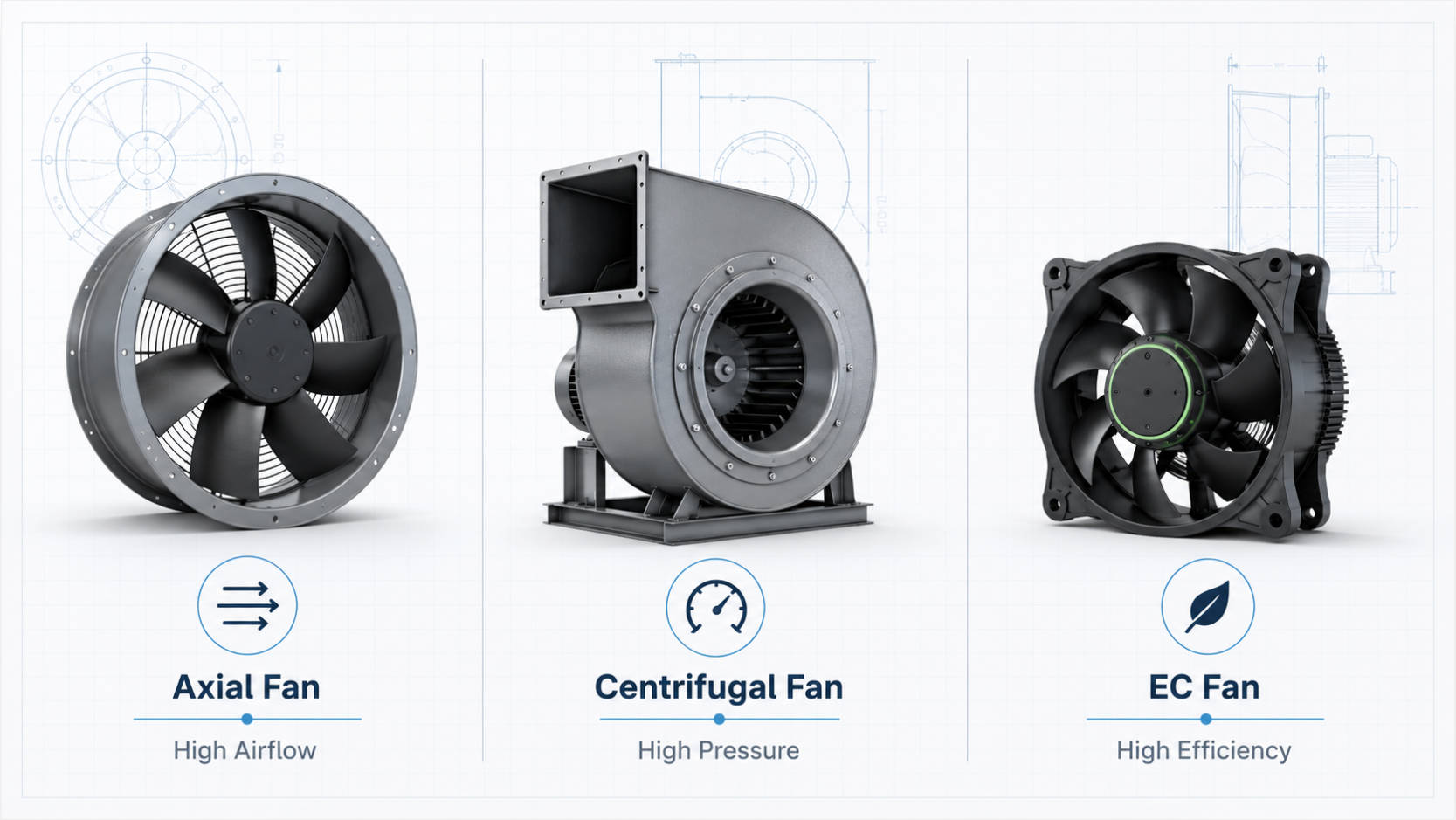
Industrial fans are usually categorized by how they move air: centrifugal, axial, and increasingly, EC (electronically commutated) designs. Understanding their strengths helps you design more efficient and reliable cooling and ventilation systems. [ossisto]
Centrifugal fans (often called blowers) pull air into the center of the impeller and fling it outward, creating high‑pressure airflow suitable for ducted systems and heavy duty extraction. They commonly use backward‑curved or radial blades and are widely used for dust collection, material handling, and industrial exhaust where resistance in the system is significant. [ossisto]
Because they can maintain airflow against higher static pressure, centrifugal fans are a natural fit for:
- Fume extraction in welding or chemical processes
- Dust collection lines in woodworking or metal grinding
- Filtration systems that combine filters, bends, and long duct runs
Many industrial centrifugal blowers use extended‑life ball or sleeve bearings so they can run continuously for long periods with minimal maintenance. [ossisto]
Axial fans move air parallel to the fan shaft, which makes them ideal for large volumes of air at relatively low static pressure. They are widely used for: [ossisto]
- General space ventilation in workshops and warehouses
- Cooling of switch cabinets, inverters, and power supplies
- Tunnel and corridor ventilation where free discharge is possible
Because of their simple construction and high efficiency in free or low‑resistance airflow, axial fans are often the first choice when you need strong ventilation without complex ducting. In my experience, compact axial DC fans are also a staple in telecom, servers, and industrial control panels, where they provide targeted spot cooling of heat‑sensitive components. [ossisto]
The current type of the motor—AC, DC, or EC—has significant implications for control, efficiency, and system integration. [ossisto]
- AC fans
- Typically robust, cost‑effective, and easy to power directly from mains.
- Common in traditional industrial ventilation, HVAC systems, and locations where constant speed operation is acceptable. [ossisto]
- DC fans
- Allow precise speed control, are more energy efficient at partial loads, and can easily support features like soft start or reverse rotation. [ossisto]
- Widely used in electronics cooling, telecom, data centers, and applications where you want fan speed to follow temperature or system load. [ossisto]
- EC fans
- Combine AC supply with an internal brushless DC motor and electronic commutation, providing variable speed control and significantly higher efficiency. [ossisto]
- Can cut energy consumption by up to 30% compared with comparable AC fans, while also reducing noise and improving integration with building management systems. [ossisto]
In recent years, EC fans have become increasingly popular in industrial ventilation, data centers, and high‑efficiency HVAC retrofits due to their combination of efficiency, control, and long service life. [ossisto]
| Fan Type | Key Characteristics | Typical Applications |
|---|---|---|
| Centrifugal | High‑pressure airflow, radial design | Dust collection, fume extraction, ducted exhaust ossisto |
| Axial | High‑volume, low‑pressure airflow | General ventilation, cabinet cooling, tunnel airflow ossisto |
| DC | Precise control, efficient at variable speeds | Telecom, servers, industrial electronics ossisto |
| AC | Robust, simple, mains‑powered | HVAC, building exhaust, general industrial fans ossisto |
| EC | High efficiency, integrated electronics | Data centers, smart HVAC, energy‑saving retrofits ossisto |
Industrial fan applications span almost every sector—from manufacturing plants and greenhouses to commercial towers and critical IT infrastructure. Below are the core scenarios where we see DC fans, AC fans, and EC fans delivering the most value in real projects. [ossisto]
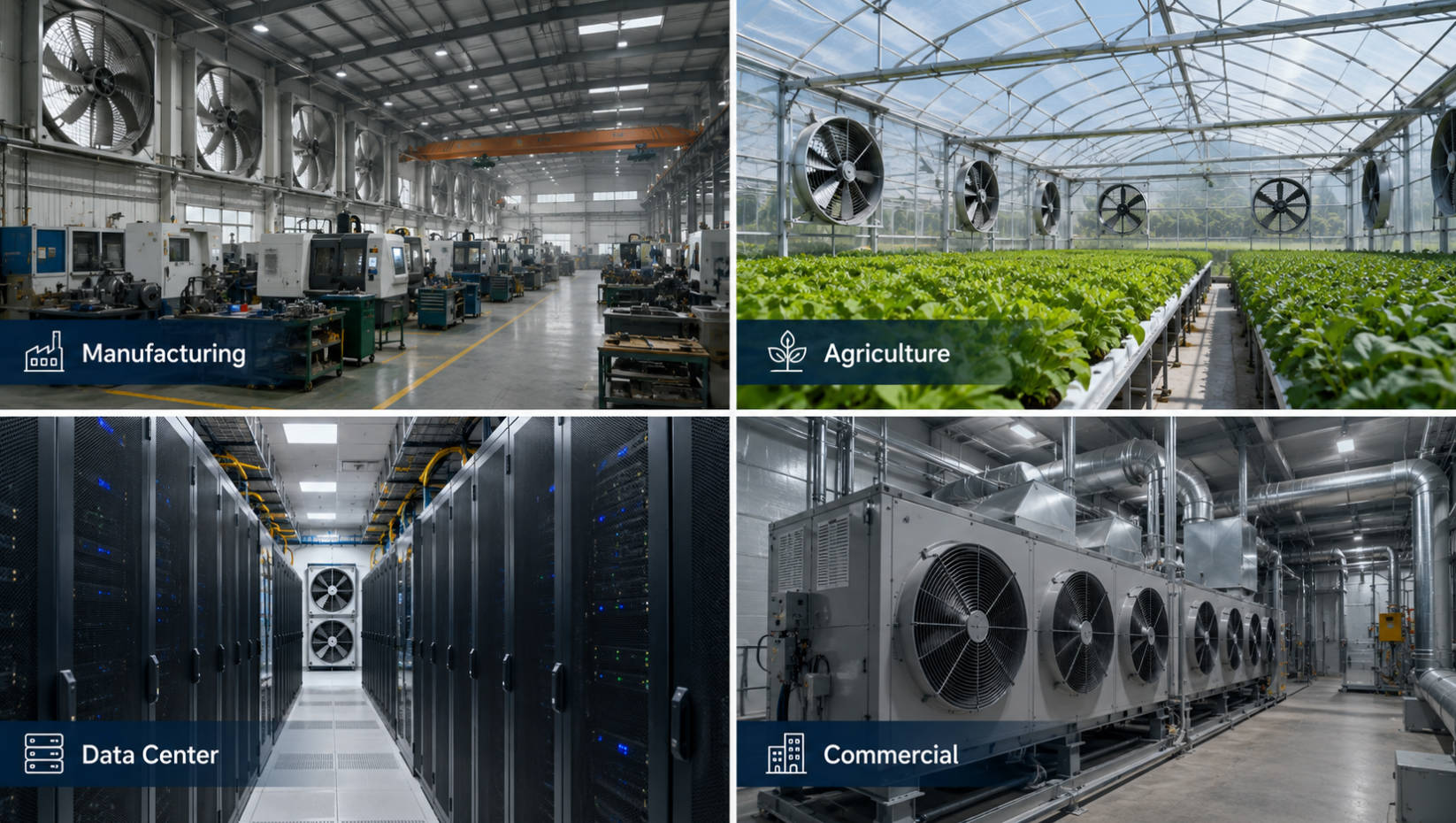
In manufacturing, industrial fans are fundamental to controlling temperature, humidity, and airborne contaminants. They help remove process heat, reduce steam, and exhaust harmful gases and dust, improving both worker safety and product consistency. [ossisto]
Key use cases include:
- Process cooling for metal processing, plastics, textiles, and printing lines
- Local extraction at welding stations, paint booths, and chemical mixing points
- Enclosure cooling for CNC machines, injection molding controllers, and drives
Compact DC fans are often mounted directly on or inside equipment to provide spot cooling for power electronics, motors, and control boards prone to overheating. By keeping components within their specified operating temperature, these fans extend equipment life and reduce unplanned downtime. [ossisto]
From a practical standpoint, we often see that proper fan placement and airflow direction are as important as fan size—misdirected airflow can trap heat pockets instead of removing them. That's why many of our manufacturing projects start with a thermal audit and CFD‑based airflow simulation before finalizing fan specifications. [ossisto]
Agriculture operations rely on industrial fans to maintain stable micro‑climates in greenhouses, poultry houses, and livestock barns. Temperature, humidity, and air exchange directly affect crop yield, animal welfare, and disease risk. [ossisto]
Typical fan roles include:
- Greenhouse ventilation to regulate temperature and prevent fungal growth
- Barn and poultry house fans to control ammonia, CO₂, and moisture levels
- Exhaust blowers to remove stale air and support evaporative cooling pads
In these environments, fan reliability and corrosion resistance are critical, because dust, moisture, and ammonia can quickly damage lower‑grade products. We often specify sealed motors, coated metal parts, and IP‑rated DC and AC fan units to maintain performance in these aggressive conditions. [ossisto]
Data centers are among the most demanding environments for fan technology. Continuous high‑density heat output from servers means that insufficient cooling can cause thermal runaway, service outages, and even permanent equipment damage. [ossisto]
Industrial ventilation fans and high‑performance DC or EC fans are used to:
- Move hot air away from server racks and into cold‑aisle / hot‑aisle setups
- Maintain controlled inlet temperatures for IT equipment
- Stabilize humidity to prevent corrosion and static discharge
Here, the trend is clearly toward EC technology and intelligent control, where fan speed dynamically follows real‑time server load and temperature data. This not only reduces energy consumption but also decreases noise and mechanical wear, improving overall system reliability. [ossisto]
In commercial buildings—offices, hospitals, schools, and shopping centers—industrial fans are deeply integrated into HVAC and ventilation systems. They support: [ossisto]
- Fresh air intake and exhaust for indoor air quality
- Even temperature distribution across large or multi‑zone spaces
- Odor and smoke removal in restrooms, kitchens, and utility rooms
Industrial exhaust blowers in commercial kitchens, for example, are essential to remove grease‑laden air, smoke, and heat from cooking zones. Properly designed systems with adequate fan capacity help facilities comply with health and safety codes while providing a more comfortable environment for staff and visitors. [ossisto]
Choosing an industrial fan is not just a matter of picking a size; it requires balancing airflow, pressure, noise, efficiency, and environmental conditions. Below are the key parameters we review with customers before recommending a DC fan, AC fan, or EC fan solution. [ossisto]
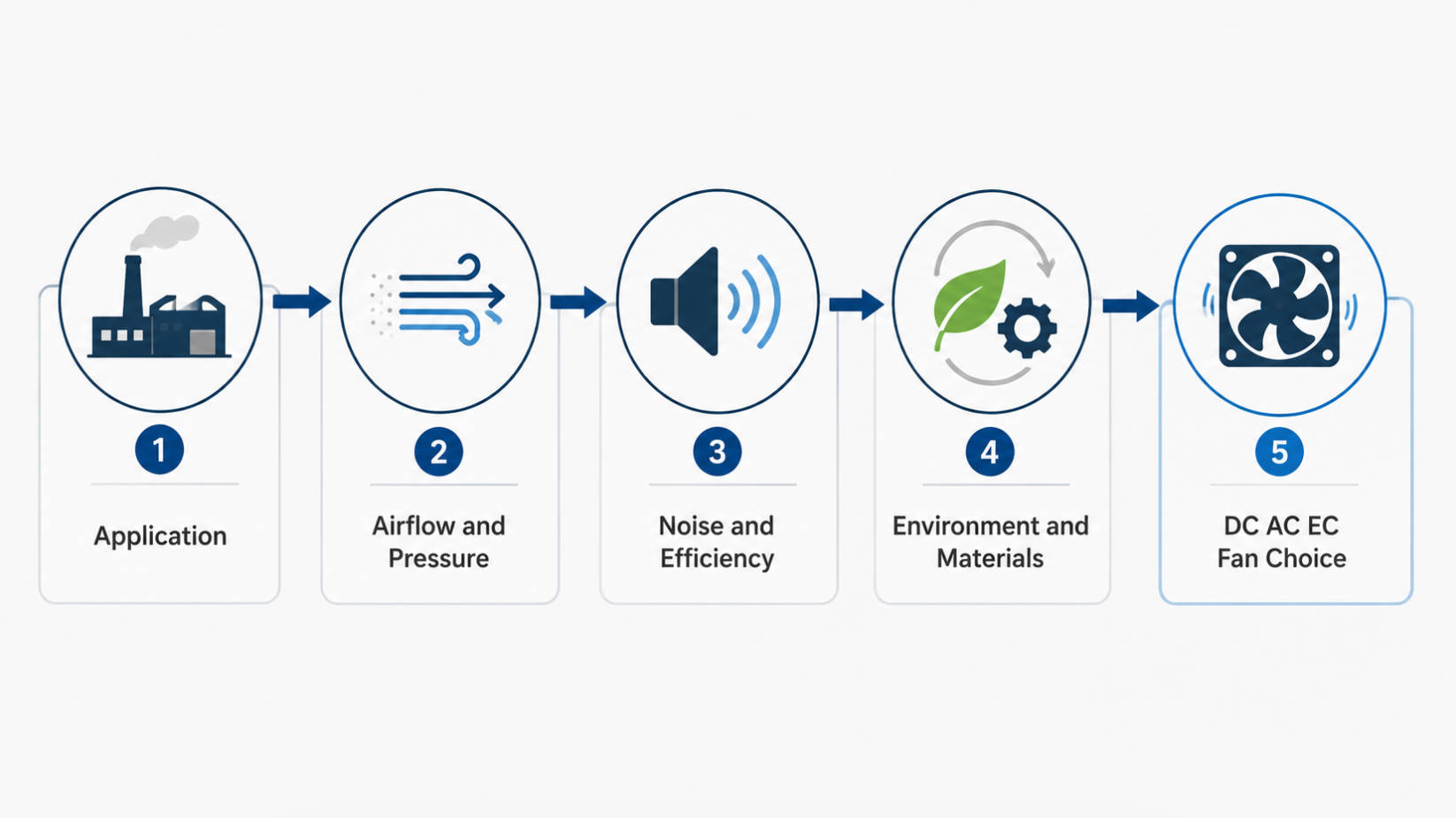
Start with the volume of space (or heat load) and the level of system resistance.
- Calculate or estimate the cubic feet per minute (CFM) or cubic meters per hour (m³/h) needed.
- Determine the expected static pressure created by filters, ducts, grilles, and bends.
Centrifugal fans are better for high‑pressure systems with long ducts or heavy filtration, while axial fans are ideal when you need high air volume at low resistance. In enclosure cooling, we often see customers underestimate pressure drop from filters and louvers, which can lead to insufficient airflow if not properly accounted for. [ossisto]
Industrial fans can generate significant noise, which may be unacceptable in certain environments such as offices, hospitals, or control rooms. When noise is a concern: [ossisto]
- Look for aerodynamically optimized blades designed for low noise.
- Use vibration isolation mounts and sound‑absorbing materials in the installation.
- Consider running multiple fans at lower speeds instead of a single fan at full speed.
EC and DC fans with PWM or analog control can be tuned to run at lower speeds during off‑peak loads, reducing acoustic impact without compromising reliability. [ossisto]
Energy consumption is a major operating cost for large ventilation and cooling systems. To optimize total cost of ownership: [ossisto]
- Choose high‑efficiency motors and blade designs.
- Use variable speed drives to match airflow to real demand.
- Consider EC fans where partial‑load operation is common.
In practice, we often see that the incremental investment in high‑efficiency DC or EC fans pays back quickly through energy savings, especially in 24/7 operations like telecom, data centers, and continuous process manufacturing. [ossisto]
Harsh environments require appropriate materials and protective features:
- High temperature: heat‑resistant plastics, metal impellers, special lubricants.
- Corrosive or coastal: stainless steel, coated parts, IP‑rated enclosures.
- Dusty or fibrous air: sealed bearings, easy‑clean designs, appropriate filtration.
At Capital, our engineers frequently design custom fan solutions for such conditions, leveraging both SANYO DENKI's extensive technology base and our own CAPITAL product line. This often includes tailored housings, special brackets, or unique control logic to integrate cleanly into the customer's equipment. [ossisto]
Industrial fan performance is not just a function of the fan itself—it depends on how well the fan is matched to the application and integrated into the system. This is where working with a specialized manufacturer and agent can create real value. [ossisto]
Capital Technology Co., Limited is the chief agent of SANYO DENKI, a global leader in cooling fan technology, and also produces its own CAPITAL‑branded cooling fans, DC/AC fans, radiators, filters, and related components. With more than ten years of experience focused on cooling solutions, our engineering team has helped customers across telecom, power electronics, and industrial automation solve complex thermal challenges. [ossisto]
We are proud to be a trusted supplier to major enterprises such as ZTE, HUAWEI, HYTERA, and GOLD POWER, and we have been recognized as a "best supplier" by customers for our open technology collaboration, product development support, and high‑quality fan products. In many projects, our role extends beyond supplying standard fans—we co‑design the thermal architecture, validate prototypes, and provide long‑term after‑sales and optimization support. [ossisto]
One representative application we frequently support is outdoor telecom base station cabinets, where DC fans must maintain safe temperatures for radios, power supplies, and batteries under wide ambient temperature swings. These cabinets often face high solar loads, dust, humidity, and sometimes corrosive coastal air. [ossisto]
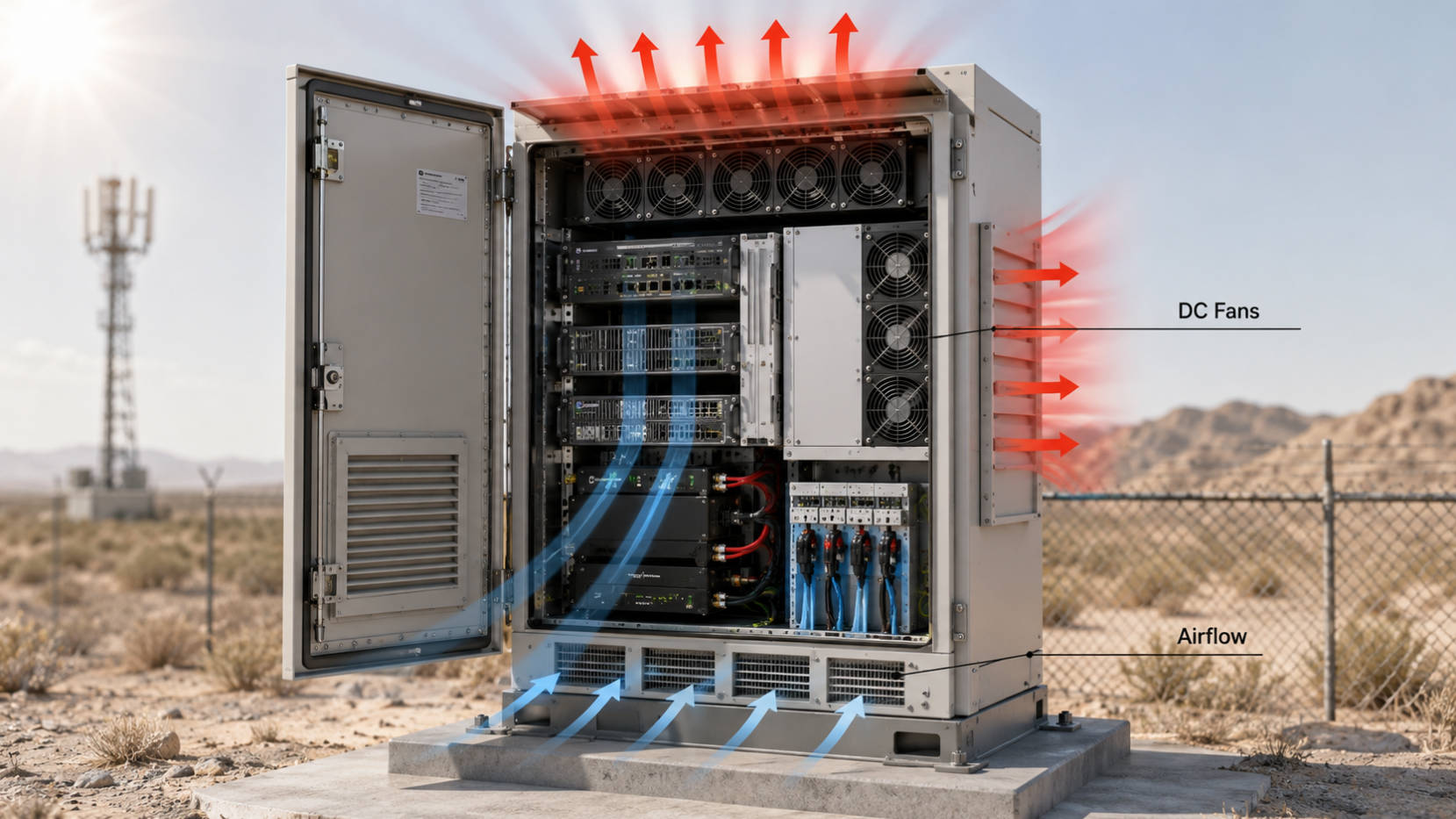
A typical solution involves:
1. Selecting high‑reliability DC axial fans with IP‑rated protection and coated components.
2. Implementing temperature‑controlled fan speed so airflow increases during peak heat but slows down at night to reduce noise and wear.
3. Designing airflow paths that ensure cool intake and hot exhaust do not mix, using baffling and filtered inlets.
4. Running validation tests under worst‑case temperature and power load to ensure sufficient safety margin.
Over time, this type of optimized DC fan solution helps telecom operators improve network uptime, reduce maintenance visits, and lower total energy consumption. [ossisto]
If you are designing or upgrading equipment that depends on stable, efficient cooling, a generic fan is rarely enough. By collaborating early with an experienced cooling fan manufacturer and SANYO DENKI's chief agent, you can reduce design risk and accelerate time to market. [ossisto]
Contact Capital Technology Co., Limited to discuss your DC fan, AC fan, or complete thermal solution requirements. Our engineering team can help you evaluate airflow needs, simulate performance, and recommend the optimal mix of CAPITAL and SANYO DENKI products for your specific application. Together, we can build cooling systems that are safer, more efficient, and ready for long‑term industrial use. [ossisto]
DC fans are ideal when you need precise speed control, higher efficiency at variable loads, and integration with control electronics, such as in telecom, data centers, and industrial equipment. AC fans are a strong choice for simpler, constant‑speed ventilation where mains power is readily available and control requirements are minimal. [ossisto]
Use a centrifugal fan when your system has high static pressure, such as long duct runs, multiple bends, or dense filters, and you need the fan to maintain flow against that resistance. Axial fans are more suitable for free‑blowing applications or short, low‑resistance paths where high airflow and lower pressure are sufficient. [ossisto]
EC fans offer high efficiency, integrated electronics, and variable speed control, allowing them to adapt airflow to real‑time demand while saving up to 30% energy compared with similar AC fans. They also tend to run quieter and integrate more easily with building management or monitoring systems, making them popular in data centers and modern HVAC systems. [ossisto]
Noise is critical in noise‑sensitive areas like offices, hospitals, and control rooms, and can affect worker comfort even in industrial halls. By choosing optimized blade designs, using vibration isolation, and implementing variable speed control, you can significantly reduce acoustic impact without compromising cooling performance. [ossisto]
Capital Technology Co., Limited combines SANYO DENKI's leading cooling fan technology with our own CAPITAL product line and more than a decade of thermal engineering experience. As a supplier to brands such as ZTE, HUAWEI, and HYTERA, we offer proven reliability, customized design support, and comprehensive after‑sales service for demanding industrial and telecom projects. [ossisto]
1. Capital Technology Co., Limited – Company Profile. "Capital‑Cooling fan manufacturer, chief agent of SANYO DENKI, main products include cooling fan, DC/AC fan, radiator, filter, reactor, etc." [Link]
2. Industrial Fan Applications: "Industrial Fan Applications: Boosting Ventilation & Air Quality." Describes fan types, applications in manufacturing, agriculture, data centers, and commercial buildings, and selection factors such as size, noise, and energy efficiency. [Link] [ossisto]
3. Hashmeta. "SEO for Manufacturing Companies: Complete Industrial Marketing Guide." Guidance on creating comprehensive, application‑focused content for industrial buyers. [Link] [hashmeta]
4. SEO‑Day. "E‑E‑A‑T – Fundamentals and Best Practices 2025." Recommendations for integrating experience, expertise, authoritativeness, and trustworthiness into technical content. [Link] [seo-day]
5. QuickCreator. "E‑E‑A‑T for Technical Content: 2025 Best Practice Guide." Best practices for author bios, structured data, and expert review processes for technical topics. [Link] [quickcreator]
Approximate word count: 1,880 words. [ossisto]
Meta description (≈300 characters):
Industrial fans are critical for safe, efficient operations in manufacturing, agriculture, data centers, and commercial buildings. Learn how DC, AC, and EC fans differ, where each type excels, and how Capital Technology and SANYO DENKI deliver reliable cooling solutions for demanding industrial applications. [ossisto]


