From idea to market-ready product, our NPI solutions make every stage easier, faster. Discover How We Help
Help Center

Views: 222 Author: Astin Publish Time: 2026-04-23 Origin: Site
As an engineer who has spent years designing thermal solutions for telecom, industrial, and ICT equipment, I've seen vane axial fans quietly become the backbone of reliable cooling in mission‑critical systems. In this guide, I'll walk you through what vane axial fans are, how they work in real‑world applications, and how to choose the right model for your project—using practical criteria that OEMs and system integrators rely on every day. [researchandmarkets]
A vane axial fan is an axial‑flow fan that uses a rotating impeller and stationary guide vanes to move air in a straight line with relatively high airflow and medium to high static pressure. The vanes straighten and recover the swirling airflow, improving efficiency and pressure performance compared with simple propeller fans.
Because of this, vane axial fans are widely used in ventilation, cooling, and process air applications where you need strong airflow through ducts, filters, or dense equipment layouts. [content.greenheck]
From the perspective of both designers and maintenance teams, vane axial fans combine performance, efficiency, and practicality. Several characteristics explain their popularity: [nextmsc]
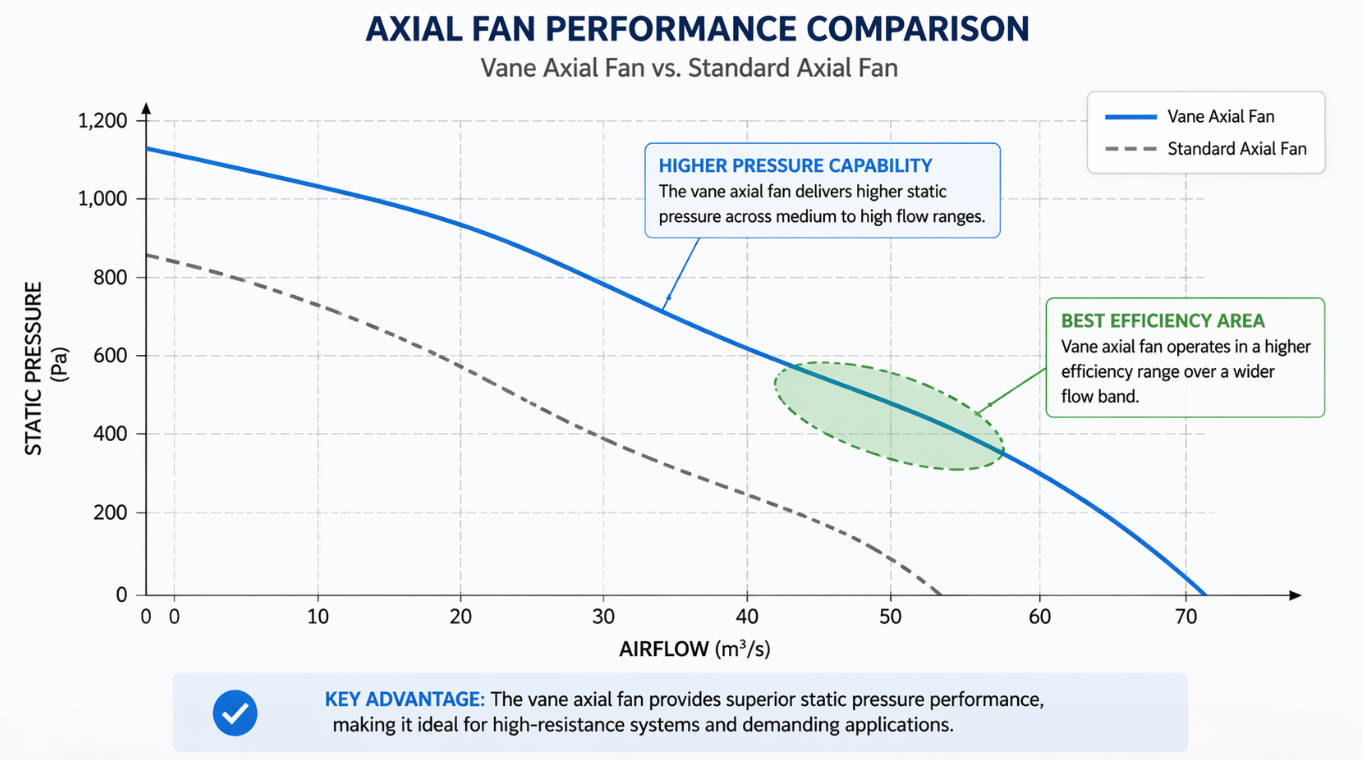
- High efficiency: They move a large volume of air while consuming relatively low power, helping OEMs meet energy‑efficiency and regulatory targets. [researchandmarkets]
- Compact form factor: Their inline, cylindrical design fits easily into ducts, enclosures, and tight equipment racks. [content.greenheck]
- Versatile usage: Suitable for ventilation, cooling, drying, fume extraction, and process air handling across industrial and commercial environments. [linkedin]
- Low maintenance: With few exposed moving parts and robust housings, vane axial fans typically offer long service intervals when properly specified.
- Lower noise for given performance: Compared with many centrifugal options at similar duty points, they can deliver required airflow with more favorable noise characteristics in many setups. [ystechusa]
- Broad configurability: Available in multiple sizes, motor options (AC, DC, EC), and mounting styles for different industries. [researchandmarkets]
In my own projects, vane axial fans are often the "sweet spot" when a simple DC axial fan cannot overcome system resistance, but a full centrifugal blower would be over‑engineered or too bulky.
At its core, a vane axial fan converts electrical energy into directed airflow with the help of an impeller and flow‑straightening vanes. The process is straightforward: [content.greenheck]
1. The motor rotates the impeller at a defined speed, creating a pressure difference across the blades.
2. The impeller accelerates air in the axial direction, adding both static and velocity pressure.
3. The airflow leaving the impeller has a swirling component; guide vanes (or vane sections in the housing) straighten this flow and recover useful pressure. [content.greenheck]
4. The housing guides this stabilized air into ducts or open spaces, reducing turbulence and mechanical losses.
This combination of axial flow and vane guidance is what allows vane axial fans to deliver higher pressures than basic axial fans, especially when paired with properly designed inlet and outlet cones. [content.greenheck]

Understanding each major component helps you evaluate fan quality and suitability for your application.
- Impeller: A multi‑bladed wheel that adds energy to the air. The blade profile and pitch determine airflow, pressure capability, and noise characteristics. Adjustable‑pitch impellers can fine‑tune performance at site. [content.greenheck]
- Shaft: A steel or alloy shaft mechanically connecting the impeller to the motor, designed to resist bending, vibration, and fatigue.
- Motor: The drive unit that provides rotational torque, typically AC induction, DC brushless, or high‑efficiency EC motors. The choice directly affects efficiency, controllability, and lifetime. [ystechusa]
- Housing: The cylindrical casing that supports the fan structure and directs airflow while protecting internal components from dust, debris, and environmental stresses.
- Guide vanes / diffuser: Stationary elements that straighten airflow and recover static pressure, improving overall efficiency at a given duty point. [content.greenheck]
When comparing models, engineers will often examine impeller design, motor efficiency class, bearing system, and housing material before making a selection.
In practice, vane axial fans show up anywhere you need high airflow with meaningful pressure capability along the duct path. Typical application domains include: [linkedin]
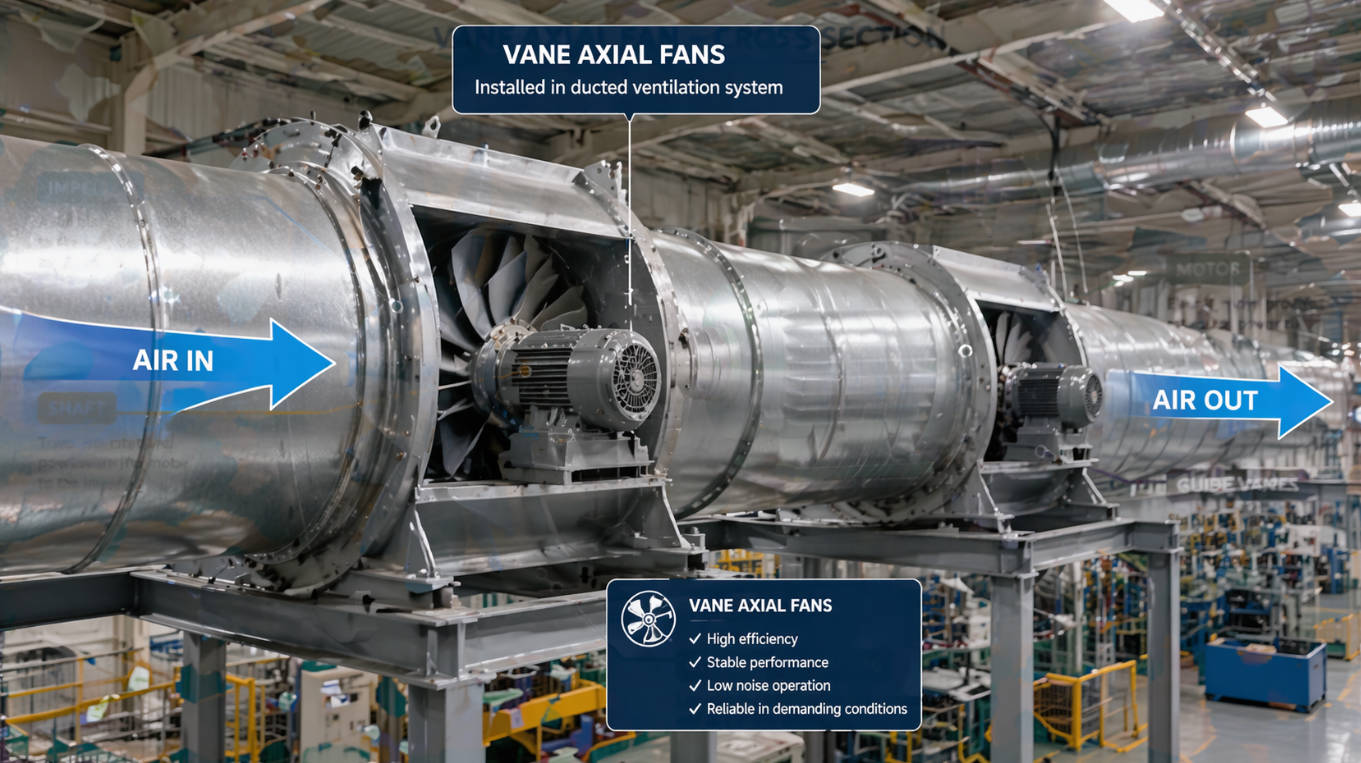
- Industrial ventilation for factories, assembly halls, warehouses, stadiums, and atriums. [linkedin]
- HVAC systems in commercial buildings, data centers, and telecom facilities where ducted air distribution is essential. [linkedin]
- Process cooling and drying—such as ovens, cooling towers, drying tunnels, evaporative systems, and process air lines. [content.greenheck]
- Heat, smoke, and fume extraction systems in industrial safety and fire protection setups. [content.greenheck]
- Equipment cooling for power electronics, large power supplies, industrial drives, and communications infrastructure where airflow must overcome restrictive chassis geometries. [ystechusa]
The growing demand for high‑efficiency and smart ventilation solutions in HVAC, power, and manufacturing is expected to keep axial fan and vane axial fan markets on a steady growth path through 2030. [nextmsc]
Choosing a vane axial fan isn't just about picking a size that "fits." A systematic selection method improves reliability, noise, and total cost of ownership. [aerotekequip]
Start from your system curve, not from the fan catalog.
- Determine required airflow (e.g., CFM or m³/h) based on thermal design, ventilation codes, or process requirements. [aerotekequip]
- Calculate or estimate static pressure losses across ducts, filters, heat sinks, grilles, and other restrictions. [coolingfanmanufacturers]
- Select a fan whose performance curve intersects your duty point in its efficient operating region, not at the extreme ends. [aerotekequip]
When users skip this step and "oversize" arbitrarily, they often end up with excessive noise and energy waste, or worse—insufficient cooling under peak load.
Your available power and control requirements will strongly influence motor choice. [coolingfanmanufacturers]
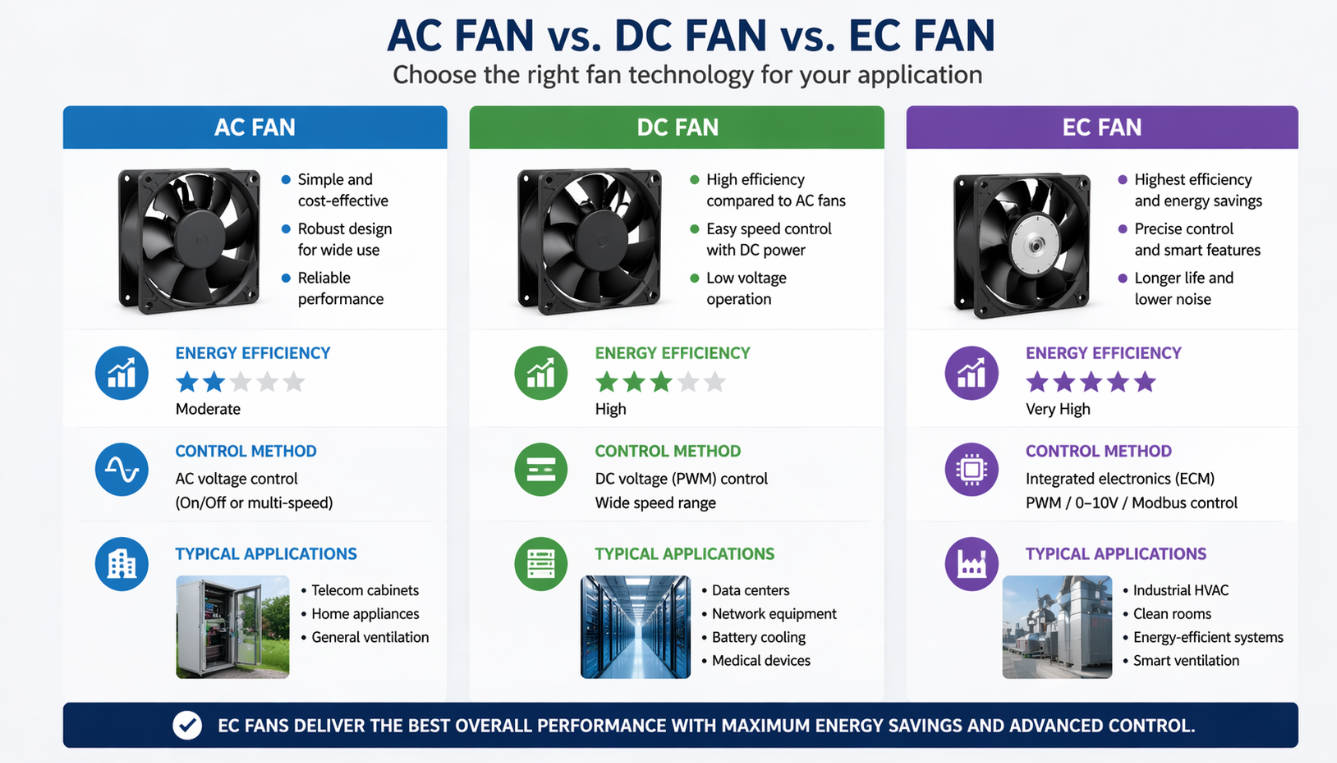
- AC motors (e.g., 110/220/380 V) are robust and simple, ideal for fixed‑speed industrial ventilation and building systems. [ystechusa]
- DC motors (12 V, 24 V, 48 V) are common in telecom, automotive, and embedded systems where low‑voltage rails already exist. [coolingfanmanufacturers]
- EC motors (electronically commutated) combine AC input with DC brushless efficiency and integrated electronics, supporting advanced speed control and higher system efficiency. [researchandmarkets]
Match the motor to your grid, DC bus, or PSU and confirm current draw, peak inrush, and EMI/EMC requirements.
Mechanical integration issues are one of the most frequent causes of late‑stage design changes.
- Check fan diameter, length, and required clearances at inlet and outlet for proper airflow. [aerotekequip]
- Confirm mounting patterns (flanges, brackets, or bolt holes) and compatibility with duct or panel layouts. [coolingfanmanufacturers]
- Ensure sufficient structural support and vibration isolation where needed, especially for large‑diameter industrial units. [content.greenheck]
In many modern applications—5G base stations, medical equipment, office HVAC—acoustics can be as important as cooling capacity. [ystechusa]
- Compare sound power or sound pressure levels at the duty point, not just at free‑delivery conditions. [aerotekequip]
- Consider using PWM or voltage control to reduce speed during partial load, significantly lowering noise without sacrificing thermal safety margins. [coolingfanmanufacturers]
- Optimize duct design, filters, and grilles to reduce turbulence and tonal noise peaks. [content.greenheck]
A fan that performs well in a lab may fail early in harsh field conditions.
- Identify operating temperature range, humidity, dust, and potential exposure to corrosive gases. [leipole.com]
- Specify expected lifetime (e.g., L10 at 40,000–70,000 hours) based on your industry standards. [researchandmarkets]
- Check ingress protection (IP rating), insulation class, and applicable safety certifications for your region and market (such as CE, UL, or CCC). [leipole.com]
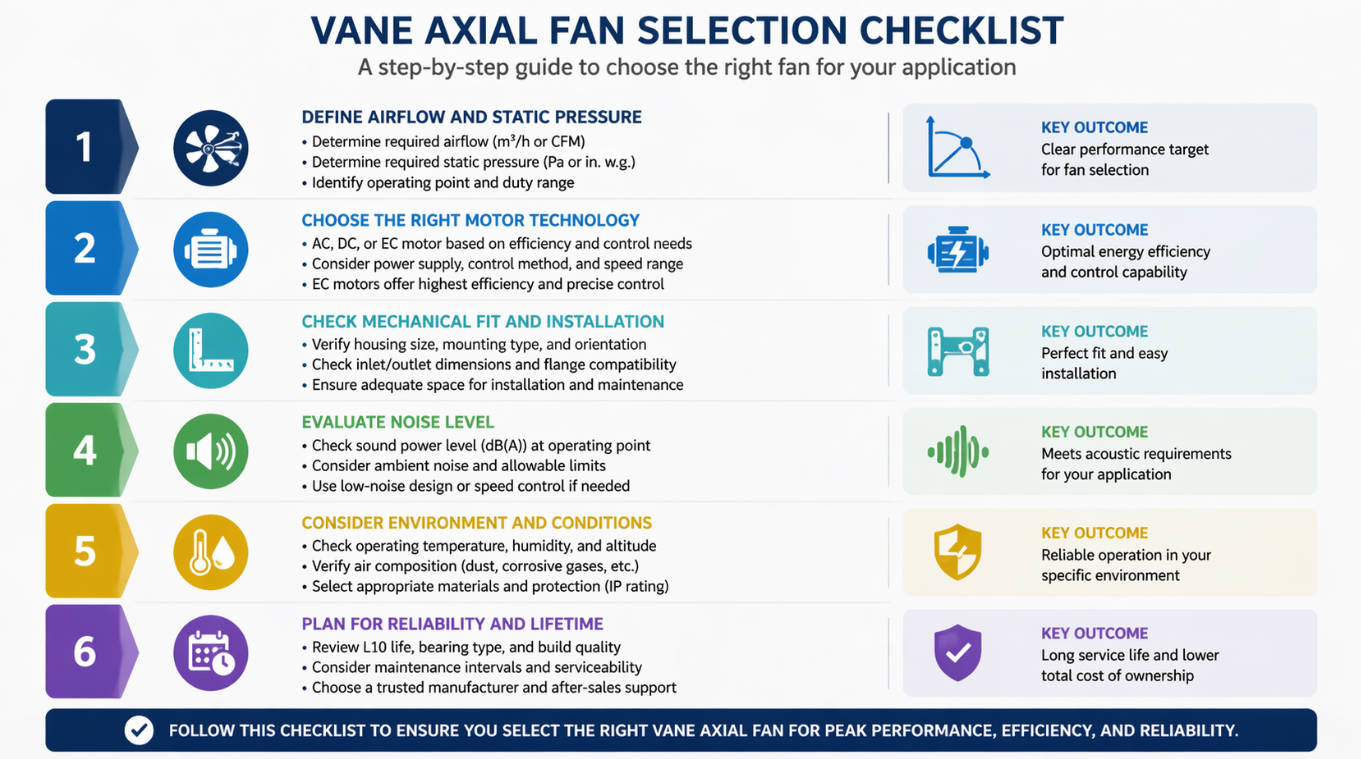
| Selection Aspect | Why It Matters | What to Check |
|---|---|---|
| Airflow & Static Pressure | Ensures sufficient cooling and ventilation under real load | Required m³/h or CFM, Pa/inH₂O at system duty point aerotekequip |
| Power & Motor Type | Impacts efficiency, control options, and compatibility | AC vs DC vs EC, voltage level, speed control method ystechusa |
| Mechanical Fit | Avoids redesign and performance degradation | Fan size, duct/flange interface, clearance and supports aerotekequip |
| Noise Performance | Critical in comfort or precision environments | dB(A) at operating point, spectral content, control strategy ystechusa |
| Environment & Lifetime | Protects uptime and reduces maintenance cost | Temperature, dust, IP rating, bearing system, L10 life ystechusa |
If you are designing new equipment for 2026 and beyond, it is not enough to meet today's airflow requirements—you need to anticipate future regulatory and customer expectations. Recent industry data highlights several key trends: [nextmsc]
- Efficiency focus: The global axial fan market is projected to grow with strong emphasis on high‑efficiency ventilation and advanced speed control, supported by growth in smart HVAC and industrial automation. [nextmsc]
- EC and smart fans: More manufacturers are integrating EC motors and IoT‑enabled monitoring into fan systems, enabling predictive maintenance and optimized control in data centers and factories. [cognitivemarketresearch]
- Green and low‑noise design: Major fan makers now highlight eco‑design, reduced energy consumption, and acoustic optimization as core product features rather than add‑ons. [leipole.com]
For OEMs and system integrators, adopting vane axial fans with EC motors and intelligent control can be a straightforward way to align with these trends while reducing lifecycle costs.
From an engineering risk perspective, the quality of your vane axial fan supplier directly affects system performance, uptime, and safety. The original article rightly emphasizes the importance of selecting established manufacturers, but there are additional nuances worth highlighting.
When partnering with a trusted manufacturer, you can expect:
- Verified performance: The fan will deliver its rated CFM and static pressure under specified test conditions, minimizing the gap between simulations and field behavior. [content.greenheck]
- Longer service life: Premium components (bearings, insulation, coatings) and controlled manufacturing translate into more predictable lifetimes and fewer unplanned shutdowns. [leipole.com]
- Compliance and safety: Proven suppliers provide complete documentation, test reports, and certifications to support industry and regional standards. [leipole.com]
- Engineering support: Application engineers can help optimize selection, mounting, and control strategies, reducing your internal development time. [aerotekequip]
If your products serve mission‑critical sectors—telecom networks, rail, medical, or power infrastructure—relying on a price‑only sourcing strategy for fans introduces hidden risk into your entire system.
Even the best fan will underperform if installed or maintained poorly. Based on field experience, keep these practical recommendations in mind: [coolingfanmanufacturers]
1. Ensure proper inlet and outlet conditions
- Avoid sharp bends, sudden contractions, or obstructions immediately before and after the fan.
- Use inlet cones and outlet diffusers where appropriate to reduce turbulence and recover static pressure. [content.greenheck]
2. Align with airflow direction markings
- Double‑check arrows on the housing before final tightening, especially in complex duct networks.
3. Provide adequate vibration control
- Use appropriate isolation mounts or flexible connections for large fans or systems subject to structural vibration.
4. Implement smart control where possible
- Use PWM, voltage control, VFDs, or EC fan interfaces to modulate speed based on temperature or system load. [ystechusa]
5. Plan proactive maintenance
- Inspect for dust load, unusual noise, imbalance, or temperature rise in periodic intervals aligned with your operating profile.
These simple steps frequently extend service life and stabilize thermal behavior without major design changes.
Consider a telecom base station cabinet with dense power electronics and limited depth:
- A simple DC axial fan may deliver high free‑airflow but struggle against filter and grille pressure losses.
- A centrifugal blower can generate sufficient pressure but may consume more space and complicate duct routing.
- A properly selected vane axial fan offers a compact, inline solution that meets both airflow and pressure requirements while integrating smoothly with front‑to‑back airflow design. [content.greenheck]
This is why many thermal engineers see vane axial fans as the "bridge" between compact axial units and bulkier centrifugal fans in modern electronic and industrial systems.
If you are designing or upgrading a system that demands efficient, stable, and low‑maintenance airflow, vane axial fans should be on your shortlist. The next step is to translate your real‑world requirements—airflow, pressure, space, noise, and environment—into a concrete fan specification and matching AC, DC, or EC solution. [researchandmarkets]
Work with a specialized thermal management partner and share your system details (schematics, load profiles, and environmental data). This allows us to help you select or customize vane axial and axial fans that deliver reliable performance, meet your certification needs, and support long‑term cost efficiency.
A standard axial fan uses only a rotating impeller to move air, while a vane axial fan adds stationary guide vanes that straighten airflow and recover static pressure, improving efficiency and pressure capability. This makes vane axial fans better suited for ducted systems with higher resistance. [content.greenheck]
Choose a vane axial fan when you need relatively high airflow with medium to high pressure in a compact, inline form factor—especially in ducted ventilation or equipment cooling. If your system requires very high pressure or severe changes in flow direction, a centrifugal blower may still be more appropriate. [content.greenheck]
You can start from thermal calculations (heat load and allowable temperature rise) or from ventilation standards for your industry. Then, determine system resistance through duct calculations or measurements and select a fan whose performance curve meets the required duty point under realistic conditions. [aerotekequip]
In many applications, yes. EC fans typically offer higher efficiency, integrated speed control, lower operating costs, and easier compliance with tightening energy regulations. Over the life of the equipment, the energy savings and improved controllability often outweigh the initial price difference. [ystechusa]
Routine maintenance usually involves inspecting bearings, checking for abnormal noise or vibration, verifying electrical connections, and cleaning accumulated dust from blades and guards. Following manufacturer-recommended intervals and environmental guidelines helps achieve the rated service life. [leipole.com]
1. "Everything You Need to Know About Vane Axial Fan," Sofasco – product and application overview, definitions, and component descriptions. <https://sofasco.com/blogs/article/everything-you-need-to-know-about-vane-axial-fan>
2. Research and Markets, "Axial Fan Market Report 2026" – global axial fan market growth and efficiency trend data. <https://www.researchandmarkets.com/reports/6090009/axial-fan-market-report> [researchandmarkets]
3. Nextmsc, "Axial Fans Market Insight, Share and Value Analysis 2025–2030" – global axial fan market size and forecast. <https://www.nextmsc.com/report/axial-fans-market-rc2919> [nextmsc]
4. Greenheck, "Vane Axial – Application and Design" – technical discussion of vane axial fan performance, outlet cones, and application considerations. <https://content.greenheck.com/public/DAMProd/Original/10003/VaneAxial_Application_Perf_Supplement.pdf> [content.greenheck]
5. Aerotek Equip, "Choosing the Right Axial Fan: Key Factors for Industrial and Commercial Applications" – selection criteria and practical considerations. <https://aerotekequip.com/choosing-the-right-axial-fan-key-factors-for-industrial-and-commercial-applications/> [aerotekequip]
6. Cooling Fan Manufacturers, "How to Choose a DC Axial Fan | Selection Guide" – guidance on airflow, pressure, noise, and mounting in DC fan selection. <https://www.coolingfanmanufacturers.com/FAQ/Detail/69> [coolingfanmanufacturers]
7. Y.S. Tech / industry sources on fan, blower, and EC motor trends – 2026 thermal cooling market overview and high‑efficiency focus. <https://www.ystechusa.com/2026-market-trends-reveal-future-of-fans-blowers-and-ec-motors-in-thermal-cooling-i-84.html> [ystechusa]
8. Industry market and manufacturer insights on premium fan design, eco‑efficiency, and leading axial fan producers. <https://leipole.com.sg/insights/top-8-axial-fans-manufacturers-leading-the-industry-in-2026/> [leipole.com]
9. Market analyses on vane axial flow fan adoption and smart, IoT‑enabled fan developments in North America and globally. <https://www.linkedin.com/pulse/united-states-vane-axial-flow-fan-market-investment-outlook-r9zpf> [linkedin]
10. Cognitivemarketresearch, "Vaneaxial Fan Assemblys Market Analysis 2026" – commentary on smart fans and predictive maintenance trends. <https://www.cognitivemarketresearch.com/vaneaxial-fan-assemblys-market-report> [cognitivemarketresearch]


