From idea to market-ready product, our NPI solutions make every stage easier, faster. Discover How We Help
Help Center

Views: 222 Author: Capital Technology Publish Time: 2026-05-15 Origin: Site
Selecting between an axial fan and a centrifugal fan is one of the most important thermal design decisions you will make, especially in high‑reliability electronics, telecom, and industrial equipment. From my experience working with OEMs in 5G, data centers, and industrial control, the "right" fan is rarely just about airflow—it is about pressure, noise, lifespan, and total cost of ownership. [fan-perfect]
Axial fans move air parallel to the fan shaft, like a propeller, delivering high airflow at relatively low static pressure, which makes them ideal for open environments and low‑resistance systems. Centrifugal fans (or blowers) take air in axially and discharge it at 90 degrees (radially), generating higher pressure at lower flow, which suits ducted, filtered, or congested systems. [cbifans]
From a design perspective, axial fans are structurally simpler and more compact, while centrifugal fans are bulkier but handle higher system impedance, dirt, and harsh conditions more reliably. [sameskydevices]
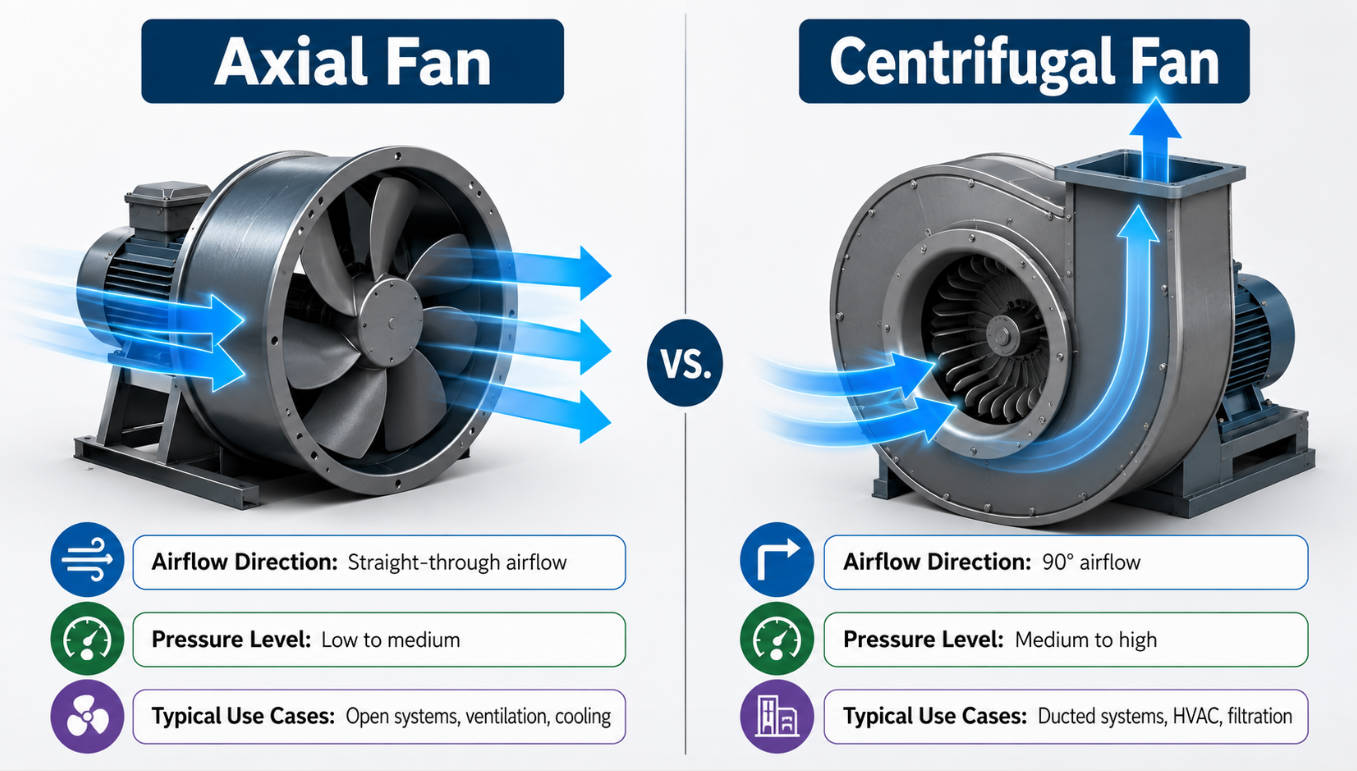
In an axial fan, the blades act like rotating airfoils; as they spin, they pull air in and push it straight through along the axis. Because the airflow path is simple and resistance is usually lower, axial fans can reach very high flow rates—up to hundreds of thousands of m³/h in industrial models—while maintaining good efficiency in low‑pressure conditions. [proventofan]
In practice, we deploy axial DC and AC fans in:
- Telecom base stations and 5G equipment where compact size and high airflow density are critical.
- Server and storage systems where multiple fans share the load in a push–pull configuration.
- Consumer and light industrial products (power supplies, inverters, battery cabinets) that need efficient through‑flow cooling without complex ducting. [electronicdesign]
Centrifugal fans use a rotating impeller to accelerate air outward; the air enters near the shaft and is flung into a scroll housing, exiting at a right angle to the inlet. This geometry allows the fan to generate significantly higher static pressure than a same‑size axial fan, at the cost of size and usually higher noise. [fan-perfect]
You will typically select a centrifugal fan when:
- Air must be pushed through long ducts, dense filters, or tight heat‑sink fins.
- The installation environment is dusty, oily, or corrosive, and you need robust, often self‑cleaning airflow paths. [cbifans]
- You need stable performance across a wider operating range, for example in process cooling or industrial ventilation where pressure and flow change over time. [fy-motors]
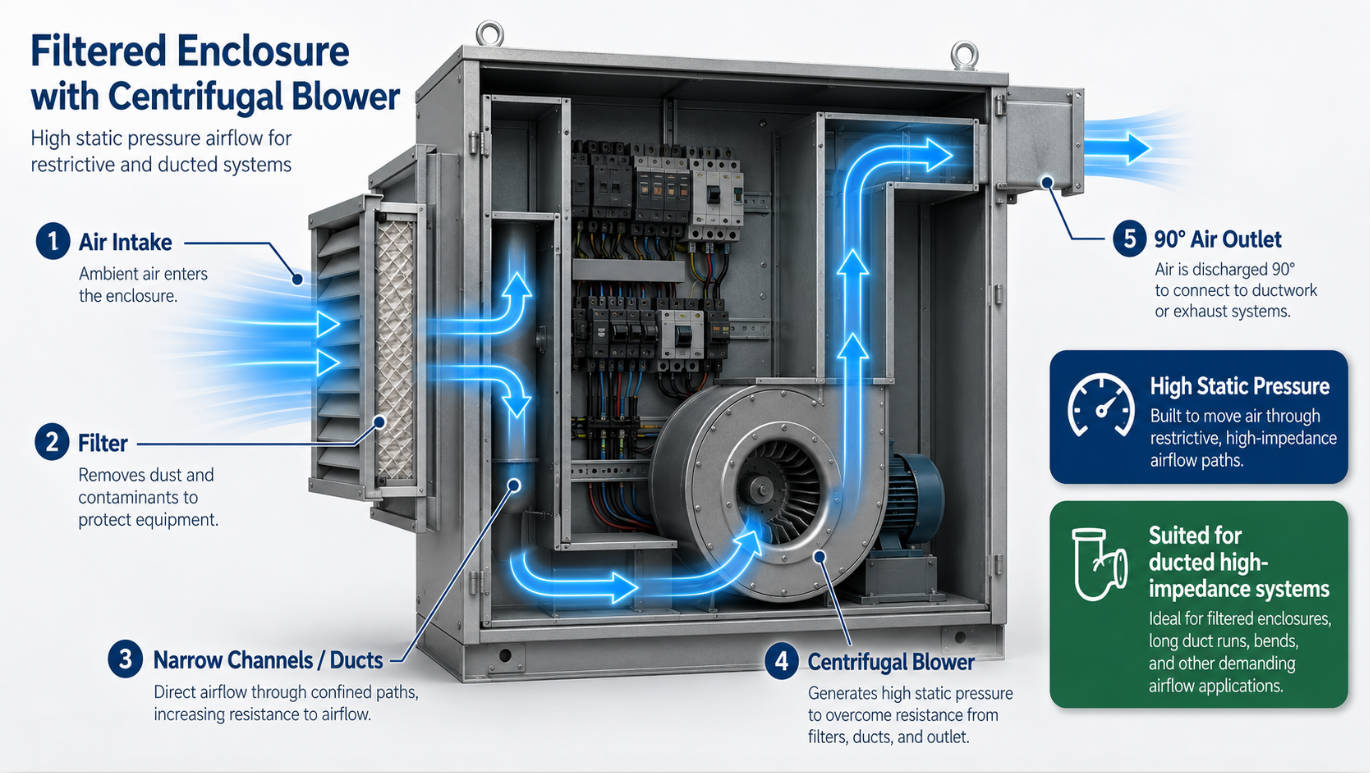
Below is a practical, design‑oriented comparison that goes beyond textbook definitions.
| Aspect | Axial Fan | Centrifugal Fan |
|---|---|---|
| Airflow direction | Parallel to shaft (straight‑through) fan-perfect | 90° radial discharge fan-perfect |
| Typical use | High volume, low–medium pressure cbifans | High pressure, low–medium volume cbifans |
| Static pressure range | Best below ~400–500 Pa in many systems proventofan | Can operate efficiently up to several thousand Pa cbifans |
| Efficiency sweet spot | Low‑resistance, open systems cbifans | Systems with filters, ducts, obstructions cbifans |
| Noise tendency | Generally quieter airflow path sunonusa | Often noisier at comparable duty sunonusa |
| Size/weight | More compact, simpler structure fan-perfect | Heavier, more complex housing fan-perfect |
According to recent industry evaluations, axial fans are often 20–30% more energy‑efficient than centrifugal units in large low‑pressure systems, whereas centrifugal fans become more efficient when the system pressure and duct length increase. [proventofan]
From an EE and thermal‑designer viewpoint, efficiency, acoustics, and lifetime are where projects succeed or fail.
- In low‑pressure environments (for example, ventilation through a relatively open grille), axial fans typically deliver the same airflow with less power input than centrifugal fans. [fy-motors]
- In high‑pressure or ducted systems, an axial fan must run close to its limit, often losing efficiency and increasing noise, while a centrifugal fan maintains higher efficiency across a wider operating range. [proventofan]
- Axial fans tend to produce less audible noise at a given airflow because their path is more direct and turbulence is lower. [sunonusa]
- Centrifugal fans can be quieter at lower speeds but often become more tonal and louder as pressure and flow demands increase. [sunonusa]
Brand, bearing technology, and thermal design have a larger impact on life than fan type alone. For example, leading brands like SANYO DENKI use advanced bearing systems, robust motor designs, and tight quality control to achieve long service life even in harsh 24/7 applications. In our experience as a chief agent and cooling solution provider, that reliability is often more critical than a marginal efficiency difference. [made-in-china]
On paper, both fan types can look acceptable. In real projects, the system impedance curve decides the winner.
1. Quantify heat and allowable temperature rise
- Measure or calculate total power dissipation and target maximum component/enclosure temperature. [electronicdesign]
2. Determine required airflow (CFM or m³/h)
- Use basic thermal calculations or CFD to estimate airflow needed to keep temperatures within spec. [electronicdesign]
3. Estimate system static pressure
- Account for grills, filters, heat‑sinks, ducts, and layout; high density and long paths imply higher pressure. [products.sanyodenki]
4. Match to fan type and performance curve
- For low pressure and high airflow, prioritize axial DC/AC fans.
- For higher pressure (e.g., dense filters, narrow channels, or long ducts), a centrifugal blower is usually more appropriate. [products.sanyodenki]
5. Add margin and choose operating point
- As SANYO DENKI's own selection guidelines suggest, select a fan with 1.5–2× the maximum airflow you calculate, so it runs in the one‑third to two‑thirds range of its curve for better reliability and noise performance. [products.sanyodenki]
This is exactly the process we follow when we help customers like telecom OEMs or industrial controller manufacturers upgrade their cooling from generic fans to engineered DC and AC solutions from CAPITAL and SANYO DENKI. [en.szcpt]
Because you work with DC Fans (直流风扇) and AC Fans (交流风扇), the axial–centrifugal question intersects with the power architecture of your system.
- Advantages: Fine speed control via PWM or voltage, better efficiency at partial load, easier integration with intelligent thermal management (temperature sensors, system firmware). [forum.digikey]
- Typical usage: Servers, telecom racks, base stations, embedded controllers, where airflow must be actively tuned to real‑time load.
- Advantages: Simple wiring to AC mains, widely used in larger cabinets, HVAC, and industrial machinery, often selected when control complexity is low but reliability and cost are key. [cbifans]
- Typical usage: AC‑powered cabinets, industrial control panels, and general ventilation where constant‑speed operation is acceptable.
In practice, many of our customers start with low‑cost AC axial fans and later migrate to high‑reliability DC axial or centrifugal fans from brands like SANYO DENKI when they face field failures, noise complaints, or thermal derating in hotter climates. [techcompass.sanyodenki]
In high‑density telecom cabinets (e.g., ZTE, HUAWEI, HYTERA applications), airflow paths are narrow and obstacles are many. Here we see two patterns:
- Axial fan walls at the front or rear, creating high volume through‑flow for the entire chassis.
- Targeted centrifugal blowers for localized cooling of particularly hot modules or densely packed boards. [techcompass.sanyodenki]
Over time, many operators have shifted to premium DC axial fans with advanced bearings and monitoring signals to reduce downtime and maintenance. [en.szcpt]
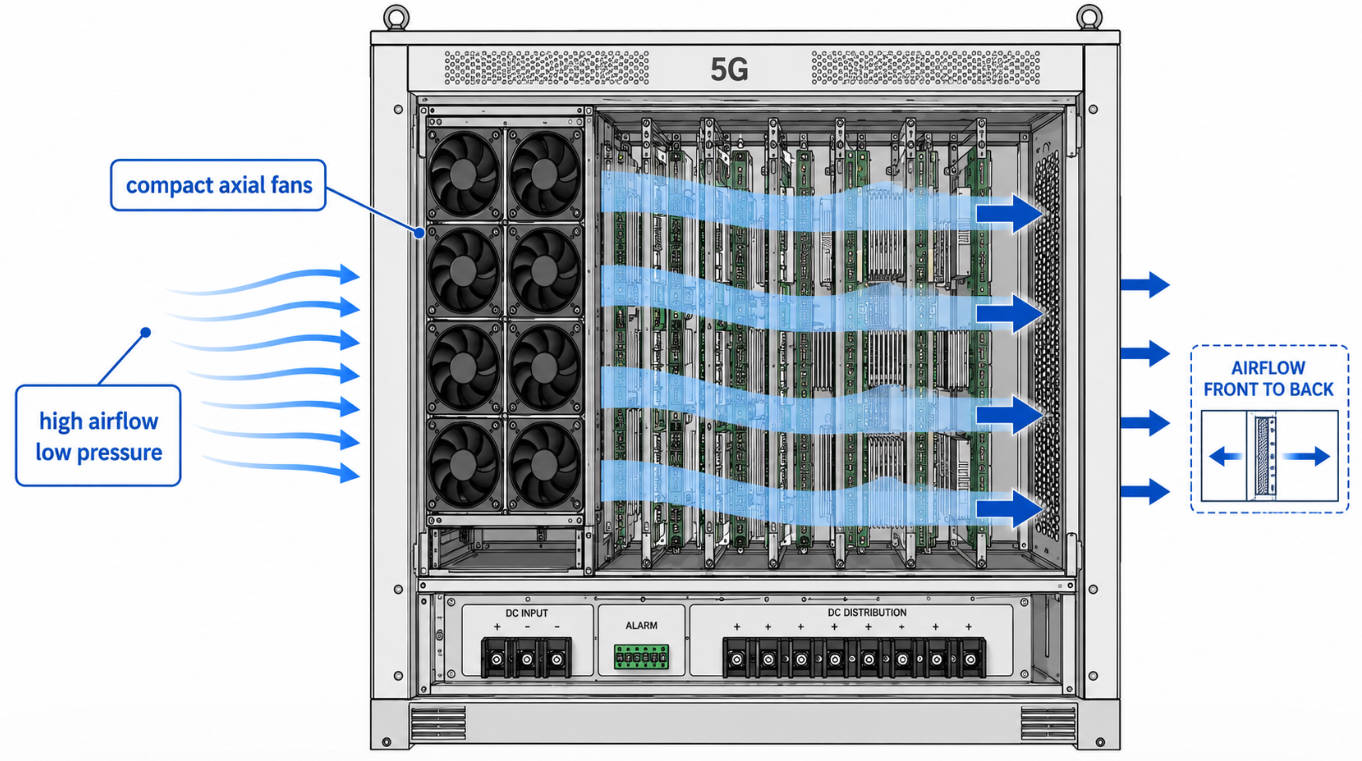
For data center racks and power systems, axial fans dominate because they provide excellent front‑to‑back cooling with minimal pressure drop when the rack is designed properly. Centrifugal units are chosen more for CRAC, CRAH units or ducted exhaust where high static pressure and filtration are mandatory. [fy-motors]
In dusty, oily, or chemically aggressive areas, centrifugal fans often win because their housing and blade design can be optimized for self‑cleaning and contaminant handling. Axial fans are still used, but with filters, protective grills, and IP‑rated designs, which we often source and configure from SANYO DENKI's harsh‑environment product lines. [fan-perfect]
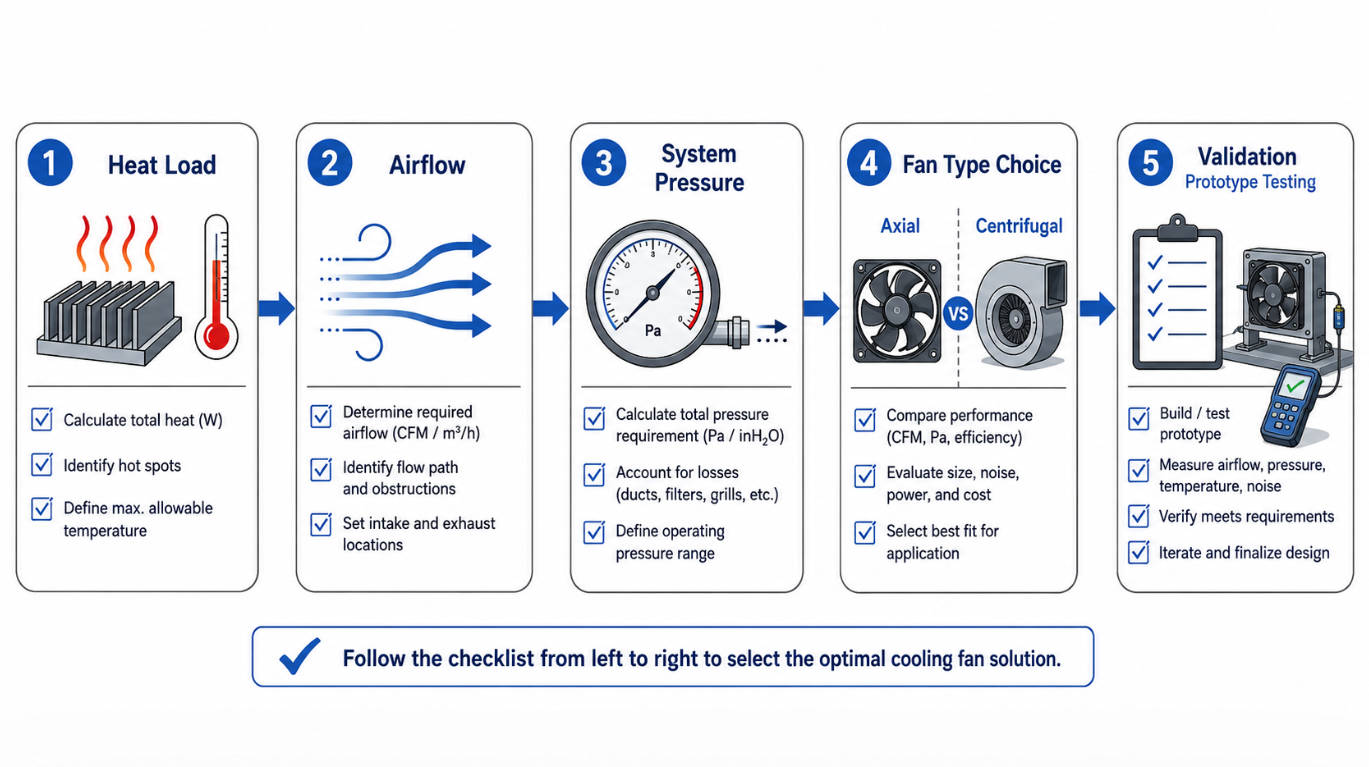
From user feedback and engineer discussions, a clear, actionable checklist significantly improves UX. Here is a practical version that aligns with what component engineers and procurement teams actually use:
1. Define constraints
- Power budget, space, noise limit, and acceptable surface temperature.
2. Classify the system
- "Open/low impedance" → Start with axial fan candidates.
- "Ducted/high impedance/filtered" → Start with centrifugal fan candidates. [cbifans]
3. Choose DC or AC
- Need speed control, alarms, or lower energy consumption → DC fan.
- Simple, fixed‑speed, mains‑driven system → AC fan. [forum.digikey]
4. Check performance curves
- Overlay your system impedance curve with the fan's P‑Q curve (pressure vs airflow) from the datasheet. [electronicdesign]
5. Validate with prototypes
- Test in your real enclosure using thermocouples and sound measurements; adjust fan model or quantity as needed. [forum.digikey]
This process is where a specialized cooling partner like Capital Technology Co., Limited can add value by supplying application‑specific fan recommendations and SANYO DENKI case‑proven solutions, instead of leaving you to guess from catalog tables. [made-in-china]
Recent industry data and technical comparisons highlight several trends that engineers should be aware of:
- Higher efficiency impeller designs: Optimized blade profiles in both axial and centrifugal fans achieve 75–90% efficiency in their respective sweet spots, reducing total energy consumption in large installations. [proventofan]
- Noise‑optimized geometries: Manufacturers are reshaping blades, housings, and struts to cut turbulence and reduce tonal noise, particularly for axial fans used in office and data‑center environments. [sunonusa]
- Smart control and monitoring: DC fans now increasingly support tachometer outputs, alarms, and PWM or digital control, enabling predictive maintenance and dynamic thermal management. [techcompass.sanyodenki]
For you as a system designer, these trends mean that a premium fan plus intelligent control often outperforms oversizing a cheaper fan type, whether axial or centrifugal. [fy-motors]
From our user's perspective, experience and authoritative implementation matter as much as technical specs. Capital Technology Co., Limited is a source manufacturer and solution provider with its own CAPTIAL brand and as the chief agent of SANYO DENKI in the cooling fan field. [made-in-china]
That translates into practical benefits for your projects:
- End‑to‑end support: From fan selection, airflow simulation reference, and prototype support, to long‑term supply and technical after‑sales service. [en.szcpt]
- Access to proven case studies: SANYO DENKI publishes numerous case studies on cooling fans in servo drives, industrial equipment, and IT systems, which we leverage to recommend architectures that are already validated in the field. [techcompass.sanyodenki]
- Stable supply and quality: Working directly with a top‑tier agent reduces the risk of counterfeit parts, inconsistent performance, and unexpected lifecycle changes. [made-in-china]
Whenever you are unsure between axial and centrifugal, or between DC and AC, a brief discussion with our engineering team typically results in fewer fans, lower noise, or higher reliability—often all three at once. [en.szcpt]
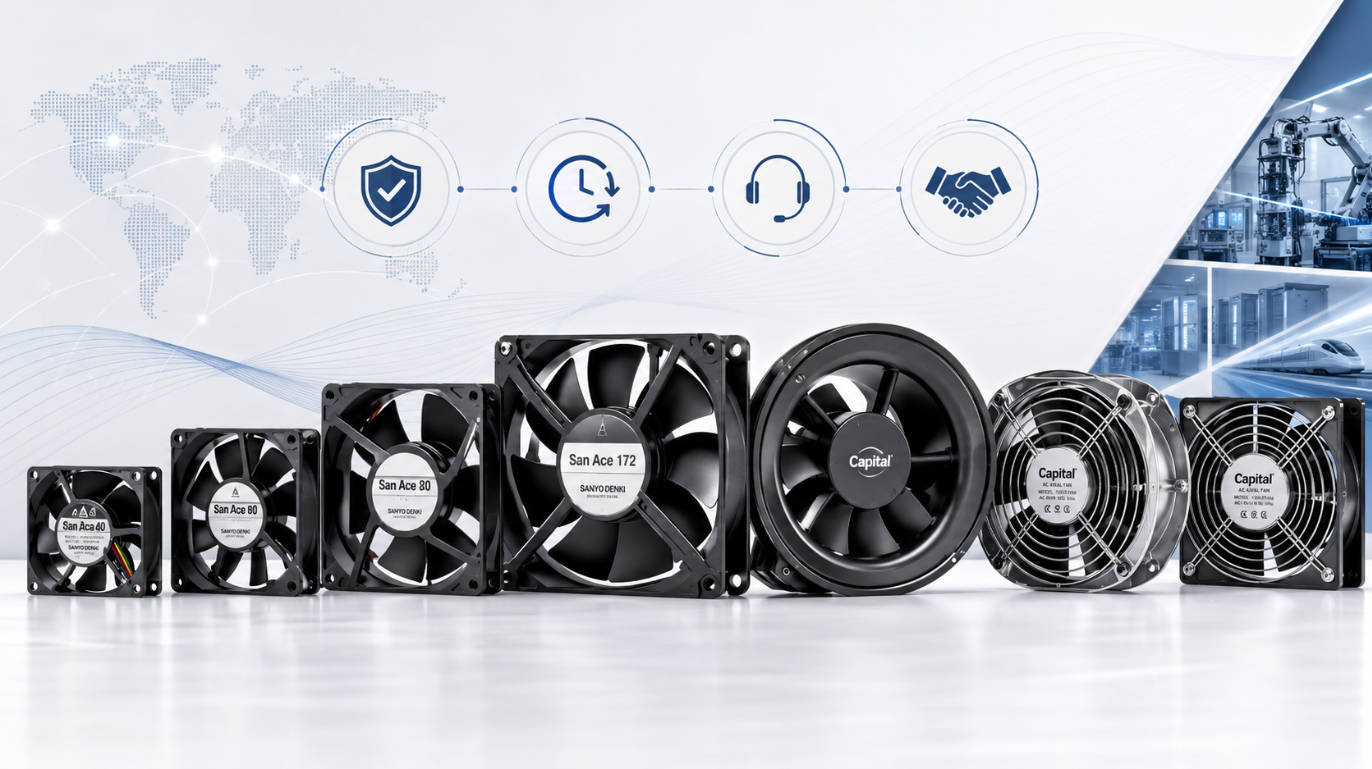
If your next project involves DC or AC fans for telecom, networking, industrial control, IT, or energy systems, the fastest way to de‑risk your thermal design is to have an expert review it. Based on our experience supporting leading brands such as ZTE, HUAWEI, and HYTERA, we can recommend a tailored axial or centrifugal solution using our CAPITAL products and SANYO DENKI's San Ace series. [made-in-china]
Contact our engineering team to share your enclosure drawings, power budget, and noise targets—and receive a customized cooling proposal, including fan selection, quantity, and operating strategy.
If your system is relatively open with short airflow paths and low resistance, start with an axial fan; if you have filters, long ducts, or dense heat‑sinks, a centrifugal fan is usually more suitable. [products.sanyodenki]
No. Axial fans often consume 20–30% less energy in large, low‑pressure systems, but centrifugal fans become more efficient and stable when static pressure and system resistance increase. [proventofan]
Choose DC fans if you need speed control, lower energy consumption at partial load, or alarm/tach signals, which are crucial in telecom, IT, and advanced industrial equipment. Use AC fans when you want a simple, fixed‑speed solution on the AC mains. [forum.digikey]
Following SANYO DENKI's guideline, it is good practice to select a fan with 1.5–2× the maximum airflow you calculate so it operates around one‑third to two‑thirds of its maximum rating for better reliability and lower noise. [products.sanyodenki]
An authorized partner like Capital Technology Co., Limited, the chief agent of SANYO DENKI, provides verified products, direct technical support, and access to proven case studies, reducing your project risk and lifetime cost compared with generic fan sourcing. [en.szcpt]
1. Sofasco, "Axial vs Centrifugal Fan: Know the Difference."
<https://sofasco.com/blogs/article/axial-vs-centrifugal-fan-know-the-difference> [fan-perfect]
2. CBI Fans, "Axial Fan vs Centrifugal Fan: All You Need To Know."
<https://www.cbifans.com/en/blog/axial-fan-vs-centrifugal-fan-all-you-need-to-know> [cbifans]
3. Provent Fan, "Axial Fan vs Centrifugal Fan: Differences & How to Choose."
<https://www.proventofan.com/centrifugal-fan-vs-axial-fan/> [proventofan]
4. SUNON USA, "Axial & Centrifugal Fans: Distinct Differences."
<https://www.sunonusa.com/axial-centrifugal-fans-distinct-differences/> [sunonusa]
5. JM Industrial, "Axial Fan vs Centrifugal Fan: Performance Comparison."
<https://www.jmindustrial.com/blog/axial-fan-vs-centrifugal-fan-performance-comparison/> [jmindustrial]
6. Digi‑Key, "What to Look for When Choosing a Cooling Fan."
<https://forum.digikey.com/t/what-to-look-for-when-choosing-a-cooling-fan/55606> [forum.digikey]
7. Electronic Design, "How to Choose a Cooling Fan in Five Easy Steps."
<https://www.electronicdesign.com/technologies/analog/article/21805288/how-to-choose-a-cooling-fan-in-five-easy-steps> [electronicdesign]
8. Capital Technology Co., Limited – Company Profile.
<https://www.made-in-china.com/showroom/46dea583c6df8fee/> [made-in-china]
9. Capital Technology / SANYO DENKI – Company Profile.
<https://www.en.szcpt.com> [en.szcpt]
10. SANYO DENKI, "Guideline in Selecting a Fan | San Ace COOLING."
<https://products.sanyodenki.com/info/sanace/en/technical_material/select.html> [products.sanyodenki]
11. SANYO DENKI, "Case Study Site for Cooling Fans and Other Products."
<https://techcompass.sanyodenki.com/en/case/index.html> [techcompass.sanyodenki]
12. Samesky Devices, "Axial Fans vs. Centrifugal Fans – What's the Difference?"
<https://www.sameskydevices.com/blog/axial-fans-vs-centrifugal-fans-what-is-the-difference> [sameskydevices]
13. FY Motors, "Industrial Axial Fans vs Centrifugal Blowers – 40-Point Technical Comparison."
<https://www.fy-motors.com/industrial-axial-fans-vs-centrifugal-blowers-40-point-technical-comparison/> [fy-motors]


