From idea to market-ready product, our NPI solutions make every stage easier, faster. Discover How We Help
Help Center

Views: 222 Author: Capital Technology Publish Time: 2026-05-29 Origin: Site
Content Menu
● Target readers and core keywords
● Why fan selection is critical for system reliability
● Step 1: Define your cooling requirements
>> 1.1 Calculate heat dissipation and temperature rise
>> 1.2 Estimate required airflow and static pressure
● Step 2: Choose between DC fan and AC fan
>> 2.1 When DC axial fans are the better choice
>> 2.2 When AC axial fans make more sense
>> 2.3 DC vs AC: quick decision table
● Step 3: Axial vs centrifugal (blower) fans
>> 3.1 Axial fans: high airflow, low pressure
>> 3.2 Centrifugal / blower fans: higher pressure capability
● Step 4: Read and use fan performance curves correctly
>> 4.2 Matching fan to system impedance
● Step 5: Noise, efficiency, and EMI considerations
>> 5.1 Balancing noise and airflow
>> 5.2 Energy efficiency and lifetime
>> 5.3 EMI and sensitive electronics
● Step 6: Mechanical integration and installation best practices
● Step 7: Monitoring, control, and maintenance strategy
● DC vs AC fans in telecom and networking cabinets
● Practical fan selection checklist
● FAQs
>> 1. How do I decide between a DC fan and an AC fan?
>> 2. What is the most common mistake in fan selection?
>> 3. How can I reduce fan noise without sacrificing cooling?
>> 4. How often should I service or replace cooling fans?
>> 5. Why do my components still run hot even though the fan CFM seems adequate?
Choosing the right cooling fan is no longer just a line-item decision; it is a strategic engineering choice that directly impacts product reliability, lifetime, and even your brand reputation. As a thermal solutions manufacturer working daily with DC fans, AC fans, and complex OEM projects, I have seen excellent designs fail simply because the fan was selected on size and price instead of system requirements. This guide combines hands-on engineering experience with industry best practices to help you select the right fan for your application—and avoid the most expensive mistakes. [reddit]

This article is written for design engineers, hardware engineers, and technical purchasers who need to specify DC fans, AC fans, or axial / centrifugal fans for electronics, telecom, industrial, and networking equipment. Primary keywords include "how to select the right fan," "DC fan vs AC fan," "axial vs centrifugal fan," and "cooling fan selection guide." [sunon]
Improper fan selection does not just reduce airflow; it can trigger a chain of failures across your system. Typical consequences I see in the field include: [electronics-cooling]
- Unstable operating temperature leading to frequent thermal throttling or shutdown. [reddit]
- Premature component aging, especially for power devices, batteries, and RF modules. [sunon]
- Unexpected noise complaints in office or medical environments because the fan must run at maximum speed to compensate for poor sizing. [reddit]
- Higher energy costs, when an oversized or low-efficiency fan runs far from its optimal efficiency point. [sunon]
From an OEM perspective, reworking a thermal design after deployment is always more expensive than doing the airflow calculation and fan selection correctly in the prototype stage. [electronics-cooling]
Before discussing fan models or brands, you must quantify what your system actually needs. [electronics-cooling]
At minimum, you should know:
- Total power dissipation in watts (W) inside the enclosure. [sunon]
- Maximum allowed internal air temperature rise above ambient (for example, 15–20 °C). [electronics-cooling]
A common engineering approach is:
- Estimate total heat load from all components (datasheets, test measurements, or power budget). [sunon]
- Decide how much temperature rise your most temperature‑sensitive components can tolerate before performance or lifetime degrades. [electronics-cooling]
This enables you to calculate the required airflow (CFM or m³/h) needed to keep the temperature within limits. [sunon]
Once you have total heat and acceptable temperature rise, you can estimate the minimum airflow your system must move. However, airflow alone is not enough. You must also consider static pressure created by: [sunon]
- Filters and protective grilles.
- Dense PCB layouts and cable bundles.
- Narrow ducts, vents, and restrictive mechanical design. [reddit]
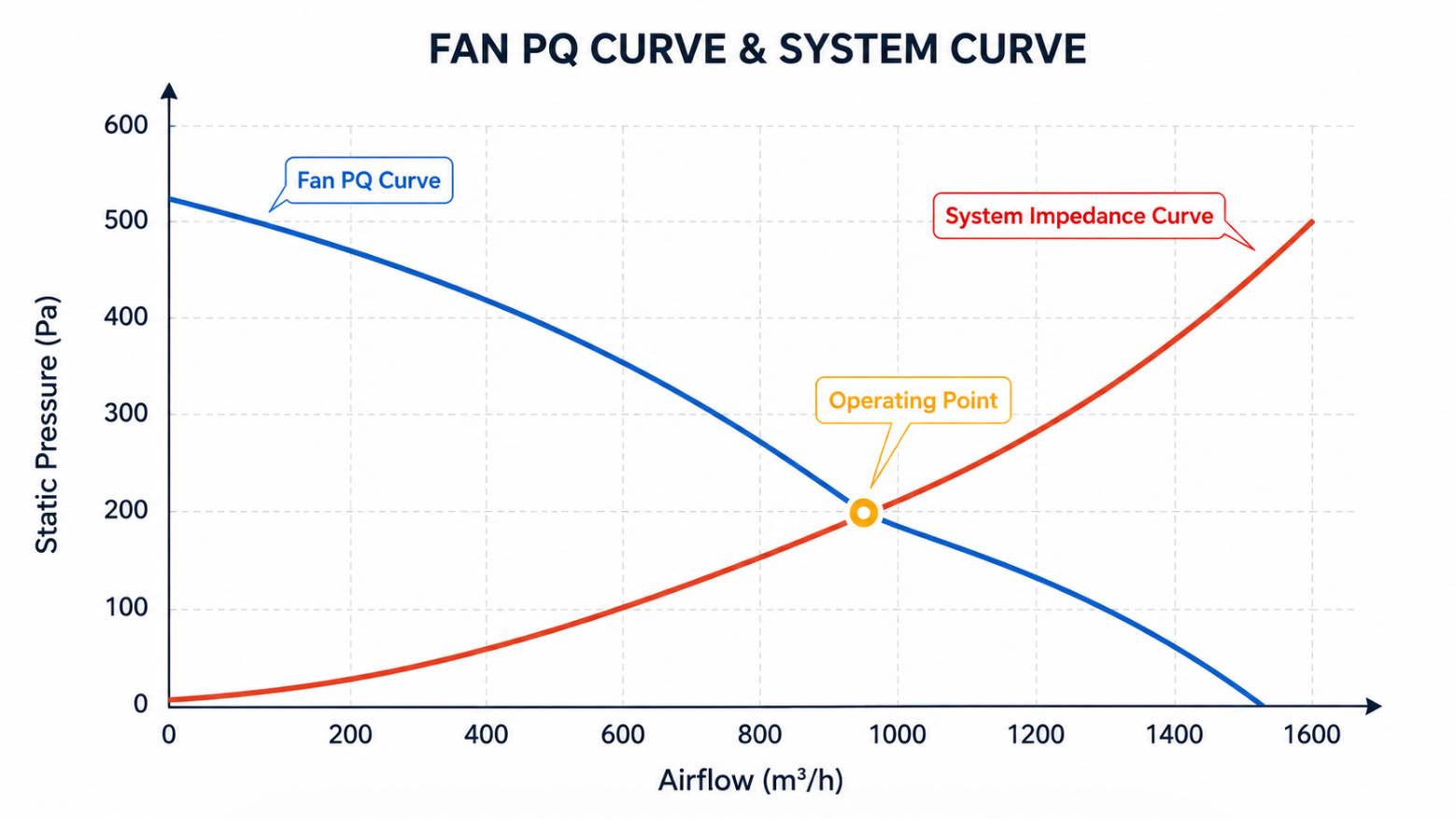
The real operating point of your fan is where the system impedance curve intersects the fan PQ curve (pressure vs. airflow), not what is printed as "maximum CFM" on the catalogue. [reddit]
One of the earliest—and most important—decisions is selecting DC fans or AC fans as the base technology.
DC axial fans operate on low-voltage DC, typically 12 V, 24 V, or 48 V, and are widely used in telecom, server, and battery-powered equipment. They are usually built with brushless DC (BLDC) motors, which provide high efficiency, long life, and precise speed control. [forum.digikey]
Choose DC fans when you need:
- Low-voltage operation in systems powered from DC buses or batteries.
- Fine speed control using PWM or voltage control to match airflow to real-time temperature.
- Lower noise in office, medical, or indoor telecom scenarios where acoustic comfort matters. [forum.digikey]
- Better energy efficiency, especially in 24/7 equipment where power consumption accumulates quickly.
- Lower EMI for sensitive communication or RF equipment. [forum.digikey]
In my experience with telecom and networking cabinets, using a properly controlled DC fan array allows us to reduce speed during low load conditions, which cuts noise and power while extending fan lifetime significantly.
AC axial fans are designed for high-voltage AC (for example, 110 V, 220 V, 380 V) and are common in industrial machinery, HVAC, and traditional control cabinets. [forum.digikey]
You should favor AC fans when you need:
- Simple, fixed-speed cooling that does not require complex control logic.
- Direct connection to mains power without DC conversion stages.
- Robust airflow for large enclosures, panels, or industrial systems. [coolingfanmanufacturers]
- Long, proven field history in heavy-duty environments such as factory automation, power distribution, and infrastructure. [coolingfanmanufacturers]
For example, in a large industrial control cabinet that already uses 220 V AC distribution, a robust AC axial fan can be a cost-effective and reliable solution with minimal electronics. [coolingfanmanufacturers]
| Design constraint | Prefer DC fan | Prefer AC fan |
|---|---|---|
| Available power | Low-voltage DC bus | Direct mains AC |
| Noise requirement | Quiet, adjustable | Less critical |
| Control strategy | PWM / closed-loop temperature | Simple on / off |
| Application type | Telecom, servers, electronics | Industrial panels, HVAC, machinery |
| EMI sensitivity | High sensitivity | Moderate or low |
| System size | Compact electronics enclosures | Large cabinets and industrial systems |
After choosing DC or AC, the next decision is fan geometry. [reddit]
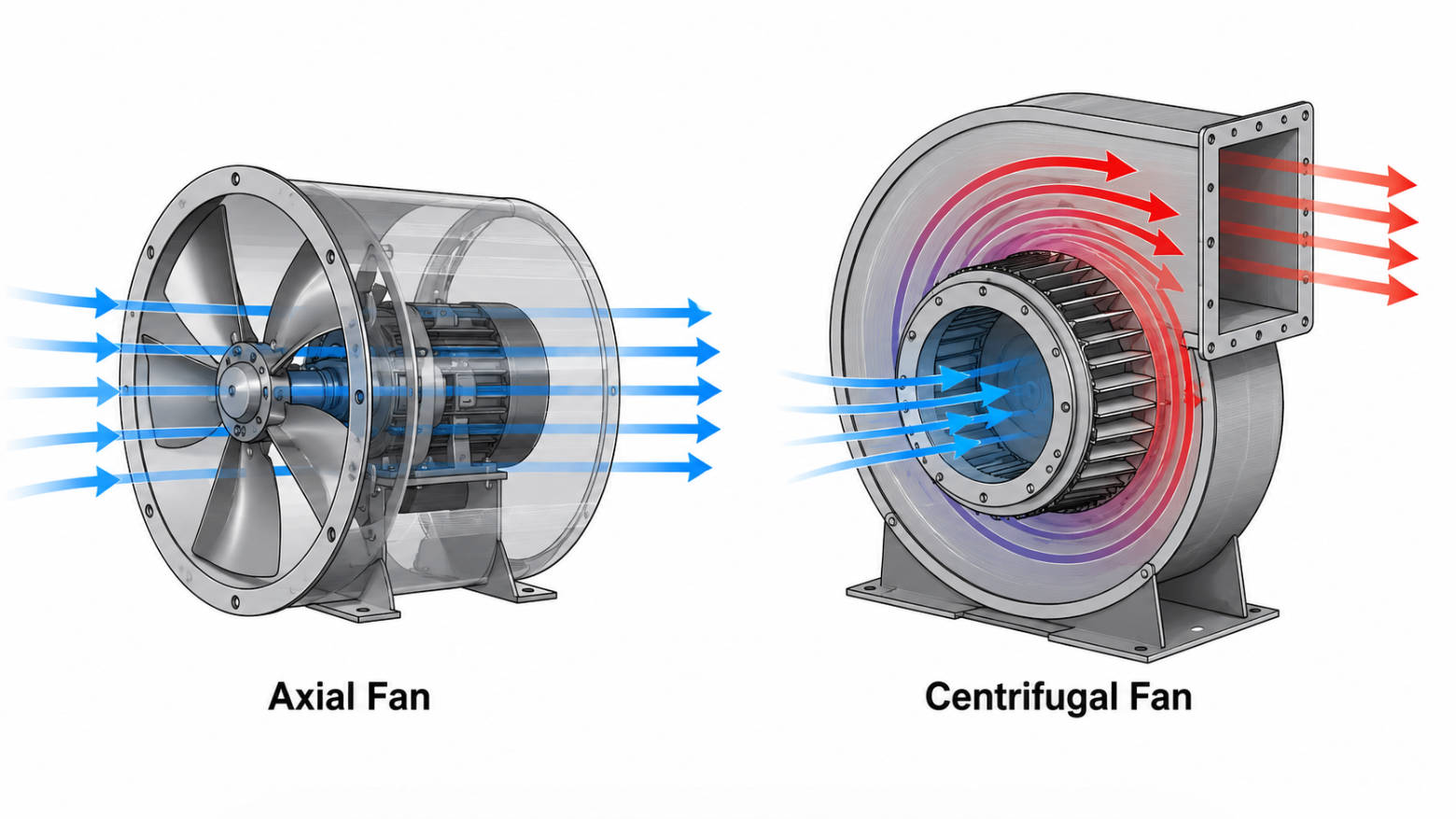
Axial fans move air parallel to the shaft and are the most common choice for general ventilation and open systems. [reddit]
Key characteristics:
- High airflow (high CFM) at relatively low static pressure. [reddit]
- Typically more compact and cost-effective for open airflow paths.
- Ideal for cabinet cooling, exhaust, and systems with minimal obstruction. [electronics-cooling]
Use axial fans when:
- Your enclosure has large, well-designed vents and short airflow paths.
- You need to move a large volume of air through open space.
- Noise and power must be kept low, and static pressure is modest. [reddit]
Centrifugal fans (radial fans or blowers) pull air in at the center and expel it perpendicularly, generating higher pressure. [reddit]
They are better suited when:
- Air must be pushed through ducts, filters, narrow channels, or heat sinks.
- The system has high impedance, such as dense component arrays or long air paths. [electronics-cooling]
- Noise at a given static pressure must be minimized by operating in a more efficient part of the curve. [reddit]
In practice, when we design cooling for high-density telecom boards or RF power amplifiers with tight mechanical constraints, we often move from a large axial fan to a blower fan positioned to drive air precisely through the critical hot zones. [reddit]
Many underperforming designs come from misreading or ignoring fan curves. [sunon]
A fan PQ curve shows the relationship between airflow (Q) and static pressure (P) across the operating range. [sunon]
Important points:
- At zero static pressure, the fan delivers its maximum airflow (open-air CFM).
- At maximum static pressure, the airflow drops to zero (dead head). [sunon]
- Your real operating point is somewhere in between, determined by the system's impedance curve. [reddit]
To select the correct fan:
- Estimate or measure the pressure drop across your system (filters, vents, ducts, boards). [sunon]
- Plot or approximate the system impedance curve and find its intersection with the fan PQ curve.
- Ensure this intersection meets your minimum airflow requirement with margin for dust, aging, and manufacturing variation. [reddit]
As a practical rule of thumb, we prefer to operate toward the higher-flow, lower-pressure side of the curve, where the fan is more efficient and quieter. [electronics-cooling]
Cooling fans are often the loudest moving part in a system. To optimize acoustic performance: [forum.digikey]
- Select larger, slower fans instead of small fans at very high RPM when space allows.
- Use PWM speed control on DC fans to reduce RPM during low thermal load periods.
- Avoid sudden obstructions directly in front of or behind the fan, which can create turbulence and tonal noise. [electronics-cooling]
In telecom and networking projects, introducing a simple two-stage temperature control (low-speed and high-speed modes) drastically improves perceived noise without compromising safety margins. [forum.digikey]
Continuous 24/7 operation amplifies even small efficiency differences. BLDC DC fans generally offer: [sunon]
- Higher efficiency at partial load.
- Longer bearing life when operated below maximum rated speed.
- Reduced overall system power consumption.
AC fans, on the other hand, can be very robust but often run at fixed speed and constant power, making them better suited where energy cost is less critical than simplicity. [coolingfanmanufacturers]
In communication equipment, base stations, and RF systems, EMI is a real design constraint.
- DC fans with optimized BLDC drivers and EMI suppression typically produce lower electromagnetic interference, which is safer for RF front ends and sensitive receivers.
- AC fans may require additional filtering or shielding in particularly sensitive designs. [forum.digikey]
Even the best fan will underperform in a poorly designed enclosure. [electronics-cooling]
- Size inlet and outlet vents at least as large as the venturi opening of the fan. [electronics-cooling]
- Avoid sharp 90° turns immediately before or after the fan.
- Keep cable bundles and components away from immediate fan intake and exhaust zones.
- For dust-prone environments, use filters with large surface area to reduce pressure drop and extend maintenance intervals. [electronics-cooling]
- Consider pressurizing the cabinet (blowing in rather than exhausting out) when dust ingress is a major concern. [electronics-cooling]
Strategic placement also matters: locate components with highest heat dissipation near exits and those with tight temperature margins close to cooler inlet air. [electronics-cooling]
A modern cooling design is incomplete without monitoring and control. [forum.digikey]
- Use fans with tachometer outputs (FG signal) to monitor speed and detect failures.
- Implement thermal sensing near critical components, not just at a single point.
- Utilize closed-loop control on DC fans (PWM or voltage) to balance noise, lifespan, and thermal margin.
- Define a regular maintenance schedule for cleaning filters and fan blades, especially in dusty or outdoor deployments. [forum.digikey]
For large deployments in telecom or industrial environments, proactively replacing fans at a defined lifetime threshold is often cheaper than managing emergency downtime.
In real-world telecom and networking projects—such as base stations, switches, or private network systems—choosing between DC and AC fans is often driven by power architecture, uptime requirements, and serviceability. [blog.csdn]
Key patterns from the field:
- Network and telecom cabinets with 48 V DC power systems almost always favor DC fans for direct connection and precise speed control. [blog.csdn]
- When cabinet space is tight and heat density is high, DC axial or blower fans offer better airflow per unit volume and can be tuned dynamically as traffic load changes. [blog.csdn]
- Older or infrastructure-adjacent systems with existing 220 V AC rails continue to rely on AC fans, especially in large, floor-standing cabinets where simplicity and robustness are prioritized over fine-grained control. [blog.csdn]
If your design is at the architecture stage, standardizing on DC fans with intelligent control often yields a better long-term balance of efficiency, noise, and remote diagnosability.
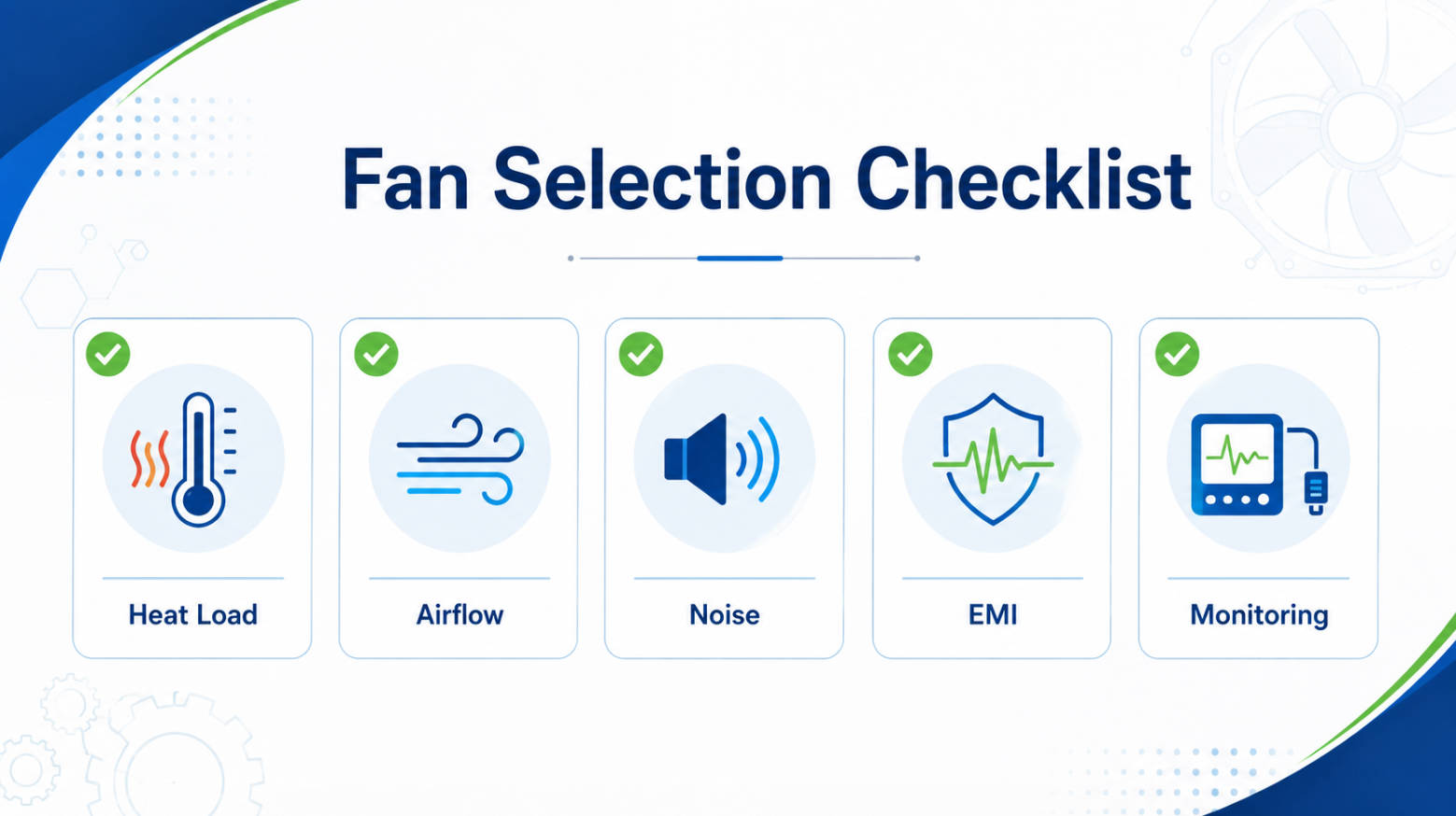
Based on day‑to‑day work with OEM customers, this is the 10-step checklist we encourage teams to follow before freezing the fan design: [forum.digikey]
1. Quantify total heat dissipation (W) at worst-case conditions.
2. Define maximum acceptable internal temperature rise above ambient.
3. Calculate required minimum airflow (CFM or m³/h).
4. Map airflow path and identify major restrictions (filters, grills, ducts).
5. Decide DC vs AC based on system power, control needs, and EMI.
6. Choose axial vs centrifugal according to required static pressure.
7. Select tentative fan models and analyze their PQ curves against estimated system impedance.
8. Evaluate noise, efficiency, and lifetime at the actual operating point, not only at maximum specs.
9. Verify mechanical integration: cutout, mounting, airflow direction, safety and IP requirements.
10. Plan monitoring, control, and maintenance: tach signal, alarms, filter cleaning intervals, spare policy.
Using this checklist early in the design cycle consistently reduces redesigns and late-stage thermal surprises in customer projects. [forum.digikey]
If you are designing a new product or troubleshooting an overheating system, do not rely on generic catalogue selection alone. Partnering with an experienced thermal solutions manufacturer that combines DC and AC fan expertise, independent brands, and leading global agencies can dramatically reduce your development risk.
Share your system specifications, mechanical drawings, and thermal targets, and request an engineering review. A structured co‑design process can help you validate airflow, select the optimal fan technology, and build a long-term sourcing strategy around reliable, supportable products.
Start from your power architecture and control requirements. If your system has a DC bus (12 V, 24 V, or 48 V) and you care about noise, efficiency, and variable speed, a DC fan is usually the better choice. If you need a simple, mains-powered solution in a large industrial enclosure and control is not critical, an AC fan is often sufficient. [forum.digikey]
The most common mistake is choosing a fan purely by size and maximum airflow rating without considering the system's static pressure. When the real operating point lies at higher pressure, actual airflow can be far lower than expected, leading to overheating even with a "high CFM" fan. [sunon]
You can often reduce noise by using a larger fan at lower RPM, optimizing airflow paths, and applying PWM control to slow the fan when full cooling is not needed. Also, avoid restrictive grills, abrupt flow changes, and poorly placed obstructions around the fan inlet and outlet. [forum.digikey]
Service intervals depend on environment and load, but dusty or outdoor applications require regular filter cleaning and periodic visual inspection. For 24/7 telecom or industrial systems, many operators adopt a proactive replacement schedule based on expected fan lifetime rather than waiting for failures. [forum.digikey]
This usually indicates a mismatch between airflow path and heat sources, or insufficient static pressure to drive air through constricted areas. Reviewing the mechanical layout, ensuring directed airflow over hot spots, and switching to a higher-pressure fan (or blower) often resolves the issue. [reddit]
1. Orion Fans, "How to Select the Right Fan for Your Application." [Link] [reddit]
2. Sunon, "How to Select the Right Fan or Blower" (technical guide). [Link] [sunon]
3. Electronics Cooling Magazine, "All You Need to Know About Fans." [Link] [electronics-cooling]
4. Cooling Fan Manufacturers, "DC vs. AC Axial Fans | Key Differences Explained." [Link]
5. Digi-Key Forum, "What to Look for When Choosing a Cooling Fan." [Link] [forum.digikey]
6. Cooltron / Digi-Key, "Not Sure Which Fan to Choose? Here's a Quick Guide from Cooltron." [Link] [forum.digikey]
7. CSDN, "网络机柜散热风扇选择直流还是交流风扇." [Link] [blog.csdn]
8. Primacy, "Query Fan-Out SEO: How AI Chooses Sources and What You Should Do." [Link] [primacy]


